
Key takeaways
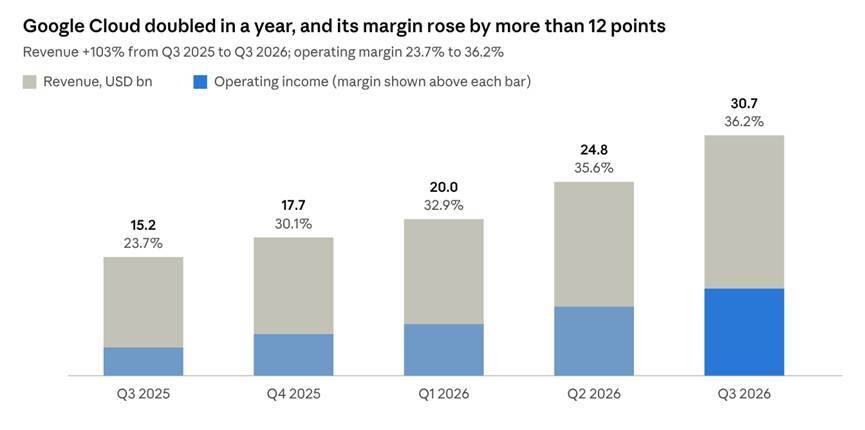
• Google Cloud doubled to USD 30.7bn at a 36.2% operating margin, with a USD 561bn backlog. TPU systems now count more than 100 significant external customers, including Anthropic, Apple and Meta.
• Free cash flow fell to minus USD 9.1bn, about minus USD 3.9bn excluding an EU fine, as capex reached 40% of revenue. Alphabet has bought back no shares in 2026.
• The full stack is Alphabet's strongest response to the AI threat on Search, and hard to copy. But it is a far less profitable business than Search: similar operating margins on paper, much more capital for every dollar of profit.
Four layers, one owner
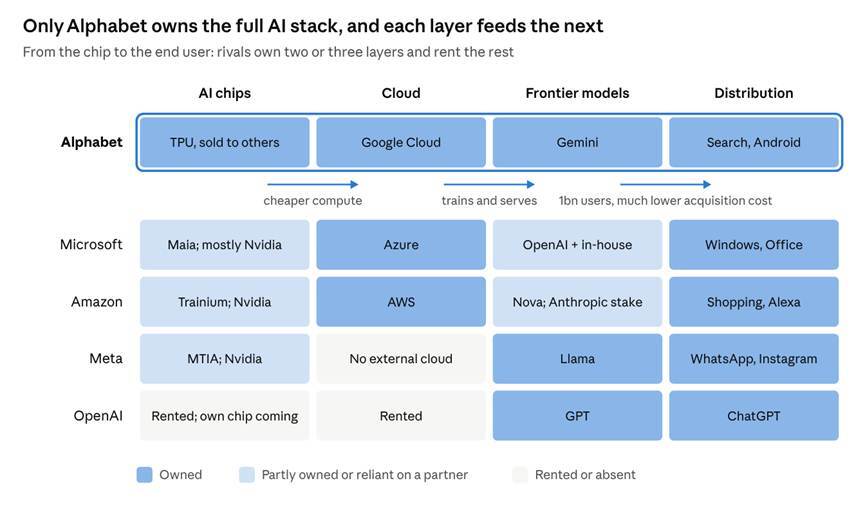
A full-stack strategy means owning every layer needed to deliver AI, from the chip to the end user, rather than renting some of them. There are four: chips, cloud, models and distribution. Most of Alphabet's rivals own two or three and rent the rest. Alphabet owns all four.
Source: Syz assessment based on company disclosures, October 2026
The value lies in how each layer feeds the next. TPUs give Google Cloud cheaper compute, since Google pays no margin to an outside chip supplier. Google Cloud trains and serves Gemini in data centres Alphabet owns, so it keeps the margin OpenAI pays to its compute providers. Gemini then reaches users through Search, Android and Chrome, which gave the Gemini app one billion users at a much lower acquisition cost than its rivals. Usage at that scale gives the TPU the volumes that lower its cost, and Google Cloud resells to outside clients the chips and models Alphabet first built for itself.
This is why the full stack is Alphabet's answer to the threat on Search. Alphabet earns from AI directly, through Search and Gemini, and indirectly when a rival pays it for compute. Several TPU clients compete with Google in models or cloud. Sundar Pichai, Alphabet's CEO, treats the TPU as a platform, like Android or Chrome, open to all. Even when a user picks another assistant, part of the AI spending can still end up at Alphabet.
What is a TPU, and how does it compare?
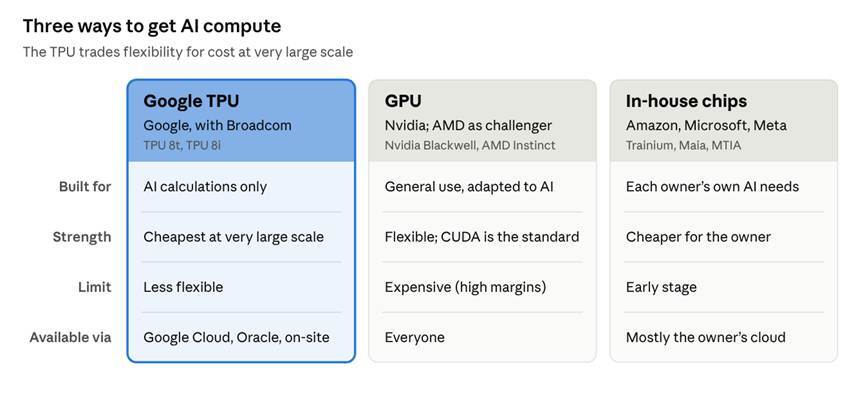
A TPU (tensor processing unit) is a chip Google designs only for the maths behind AI models, mostly large matrix multiplications. An Nvidia GPU started life as a graphics processor and is a far more general tool. The TPU gives up that flexibility in exchange for lower cost and energy use per calculation, once thousands of chips work together on the same model.
Syz assessment based on company disclosures. Performance claims are company-reported.
Google began designing the TPU around 2013 for its own needs and opened it to Google Cloud clients in 2018. For years, it was a cost line that helped Search, YouTube and later Gemini run more cheaply.
That changed over 2025 and 2026. Google now sells complete TPU systems, installs them outside its own data centres and counts rival AI labs among its clients. The TPU now appears in three places in the accounts: in Cloud revenue, where system sales were a "meaningful contributor" in Q3; in the USD 561bn backlog; and in inventory. An internal tool is turning into a product that investors can value on its own.
The TPU, an essential building block
The TPU is not the advantage on its own, but it is the layer rivals find hardest to replicate, for two reasons.
Cost comes first. Google pays no margin to an outside chip supplier, and the 8th generation launched this year offers up to 2.7x better training performance and 80% better inference price-performance than the last. That matters most for Search. If an AI answer earns less than a page of links, the cheapest server wins as usage shifts. Alphabet CEO Sundar Pichai added that selling TPUs outside Google raises volumes, and that in semiconductors scale "directly translates into better economics".
The second is a new source of revenue. Alphabet no longer rents only cloud access. It now sells complete TPU systems, with networking, storage and software included. Thomas Kurian, CEO of Google Cloud, counts more than 100 significant TPU customers, served in Google Cloud, in their own data centres, at Oracle and through Crux AI, a joint venture with Blackstone. Clients include Anthropic, Apple, Meta, Citadel Securities and Jump Trading.
What it brings to Google Cloud
Google Cloud is now a business of more than USD 120bn of annualised revenue, with USD 11.1bn of operating profit in Q3 2026 alone.
Alphabet earnings releases, Q3 2025 to Q3 2026; Q4 2025 and Q1 2026 Cloud figures via Nasdaq/Zacks and Eastern Progress reports, rounded
The Cloud backlog reached USD 561bn, of which just over 55% should turn into revenue within 24 months. TPU system sales contributed to growth, but Google Cloud Platform services made up the vast majority of Q3 revenue. The margin has two limits. It will face headwinds in Q4 as rented capacity ramps up, and it excludes the USD 7.7bn of shared AI costs booked at Alphabet level.
The cost in cash
Alphabet pays for its full stack before it earns from it. In Q3 2026, Alphabet generated USD 42.3bn of operating cash flow but spent USD 51.4bn on capex, leaving free cash flow of minus USD 9.1bn. Excluding the USD 5.2bn EU fine, it was still about minus USD 3.9bn. Trailing twelve-month free cash flow fell to USD 19.7bn.
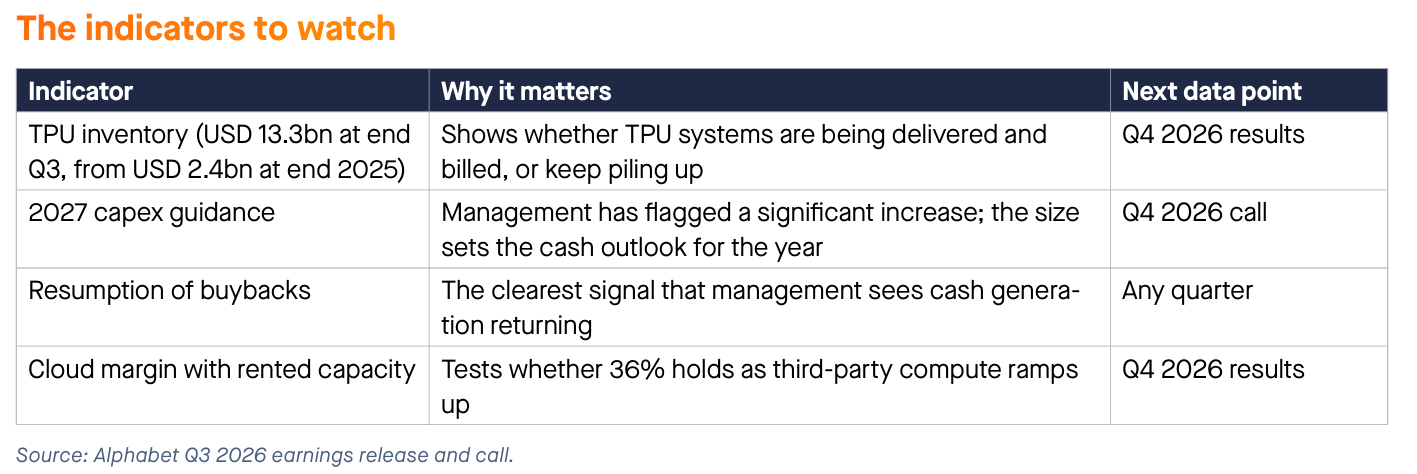
The largest item is capex. Guidance for 2026 is USD 195–205bn, and management already expects a significant increase in 2027. About 65% goes to servers and networking that wear out in six years, so depreciation, up 49% in Q3, will keep rising for years. Behind capex sit USD 924bn of future purchase commitments and USD 152bn of leases not yet started, although some contracts allow lower volumes.
The TPU business adds a cash cycle of its own. A signed contract enters the backlog; Google then buys components, builds the systems and holds them in inventory, which jumped from USD 2.4bn at the end of 2025 to USD 13.3bn. Cash comes back only on delivery and billing, mostly in 2027.
Management calls this a different cash cycle rather than traditional capex, and components are bought only once a contract is signed. In a ramp-up, however, every new contract consumes cash before it returns any.
Hard to copy, but less profitable than Search
This is the heart of the matter. Search is a near-monopoly that sets its prices through an auction and runs on infrastructure built long ago. Cloud and TPUs are a different kind of business. The margins look close on paper, with 36.2% for Cloud against 40.7% for Google Services in Q3. But Cloud competes with AWS and Azure, sells to a few large AI clients that can negotiate or build their own chips, and needs heavy new capital for every dollar of profit. Its margin also excludes USD 7.7bn of shared AI costs. The same dollar of profit is worth less when it comes from Cloud than from Search, and the market will not pay the same multiple for it.
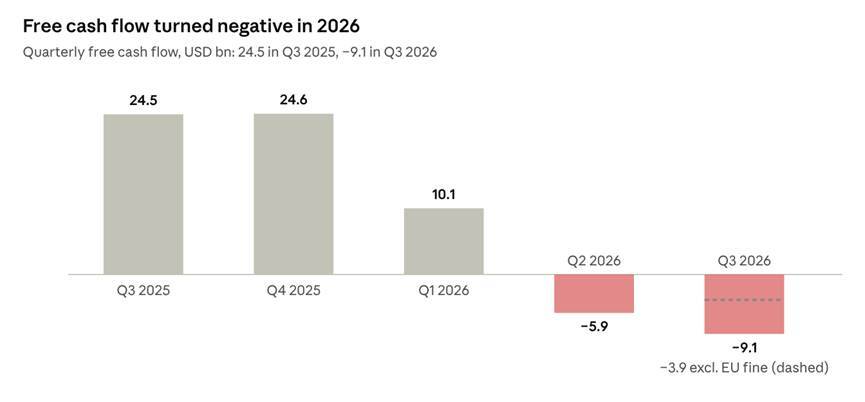
Source: Alphabet earnings releases, Syz Research
Capital intensity has nearly doubled. Capex rose to 40% of revenue in Q3 2026, up from 23% a year earlier. Revenue grew by 25%, while capex increased by 114%. An increasing share of growth is now driven by Cloud and TPUs, which require far more capital than Search ever did.
Buybacks have stopped. Alphabet repurchased no shares in the first nine months of 2026, compared with USD 39.8bn in the same period a year earlier. Dividends are now the only remaining form of direct shareholder returns. For many investors, buybacks formed a significant part of the investment case for owning the stock.
Search still funds most of the build-out, but its growth has slowed while capex keeps accelerating.
Management promises returns on invested capital well above its cost of capital, and much of the TPU inventory should turn into revenue in 2027. Neither shows up yet in the cash flow statement. Until it does, the full stack protects Alphabet's strategic position more than it answers the market's demand for cash. Management is walking a tightrope.
For two decades, Search paid for everything Alphabet wanted to build. With Search now under pressure, the full stack is Alphabet's answer, and the TPU is what makes it hard to copy. The backlog suggests customers are buying in. But the full stack replaces a capital-light near-monopoly with a capital-heavy business in a competitive market. It can protect Alphabet's growth. Whether it can also deliver returns comparable to those Search has delivered is still to be proven.
Disclaimer
This marketing document has been issued by Bank Syz Ltd. It is not intended for distribution to, publication, provision or use by individuals or legal entities that are citizens of or reside in a state, country or jurisdiction in which applicable laws and regulations prohibit its distribution, publication, provision or use. It is not directed to any person or entity to whom it would be illegal to send such marketing material. This document is intended for informational purposes only and should not be construed as an offer, solicitation or recommendation for the subscription, purchase, sale or safekeeping of any security or financial instrument or for the engagement in any other transaction, as the provision of any investment advice or service, or as a contractual document. Nothing in this document constitutes an investment, legal, tax or accounting advice or a representation that any investment or strategy is suitable or appropriate for an investor's particular and individual circumstances, nor does it constitute a personalized investment advice for any investor. This document reflects the information, opinions and comments of Bank Syz Ltd. as of the date of its publication, which are subject to change without notice. The opinions and comments of the authors in this document reflect their current views and may not coincide with those of other Syz Group entities or third parties, which may have reached different conclusions. The market valuations, terms and calculations contained herein are estimates only. The information provided comes from sources deemed reliable, but Bank Syz Ltd. does not guarantee its completeness, accuracy, reliability and actuality. Past performance gives no indication of nor guarantees current or future results. Bank Syz Ltd. accepts no liability for any loss arising from the use of this document.
Related Articles
The privacy coin sector is the only part of the crypto market trading above last year’s peak, and the US market’s main settlement house has just launched a tokenisation service on a confidential blockchain. Hiding transactions, long seen as a red flag, is starting to look like a condition for institutional adoption.
Alphabet, OpenAI and the battle for the world’s most valuable ad auction
US tech giants are investing hundreds of billions of dollars to develop the most advanced AI models. Meanwhile, Chinese companies are developing models with similar capabilities at a fraction of the cost, often making them freely available to download. Some analysts see this as a form of subsidy, but the economics behind it are more complex.


