

In August 2026, Coinbase began offering tokenised versions of Apple, Nvidia, Meta and Alphabet shares on Base, its own blockchain network. Each token is backed one-to-one by a real share held in custody, and it can be bought or sold at any hour of any day. Coinbase is far from alone. Ondo, Backed Finance, Binance and Robinhood are all competing for the same investors. Their rivalry reflects how quickly the market is growing, as tokenised stocks reached about $2.3bn in August 2026, up from roughly $1bn in March, according to Crypto Briefing citing CryptoRank data. The movement is also spreading beyond listed companies. In September, ARK Invest moved its ARK Venture Fund onto Ethereum, opening a new door to private technology firms. Lower entry costs and round-the-clock trading make the proposition attractive. But investors should pay just as much attention to how each token is structured as to the company it represents.
What is a tokenised stock?
The idea of representing traditional assets on a blockchain is older than it seems. In March 2012, Yoni Assia, then CEO of eToro, proposed "coloured coins", a method of marking small amounts of bitcoin so that they could stand for other assets such as shares or property. Meni Rosenfeld formalised the idea in a white paper in December of the same year. However, the technology was too limited at the time for real adoption. It took smart contract platforms such as Ethereum, followed by a decade of growth in crypto infrastructure, for the concept to become a working product.
A tokenised stock is a digital representation of a share, recorded on a blockchain. In the most common model, a regulated custodian buys and holds the real share, and an issuer creates one token for each share held. Coinbase's tokens, for example, are backed by shares kept in regulated custody with Alpaca under the Abu Dhabi Global Market framework. Because the custodian is the legal owner of the share, it collects the dividends and passes them on to token holders, usually by crediting additional tokens or a cash equivalent.
The blockchain then acts as the register of ownership. Transfers between users settle directly on the network, and smart contracts can apply rules automatically, for instance by limiting trading to verified users in eligible countries.
Not every product called a "stock token" works the same way. Some give the holder a claim on a share held in trust, as in the Coinbase model. Others, such as Robinhood's European tokens, are structured as derivatives that track the share price without a direct claim on the underlying share. Reading the legal documentation is therefore essential .
Who offers tokenised stocks today?
The market is still small compared with traditional equities, but it is already competitive. Ondo Global Markets is the leader, with about 30% of the market, or roughly $924mn in tokenised equities, according to Crypto Briefing citing RWA.xyz data from August 2026. Backed Finance, whose xStocks are distributed through Kraken, follows with about $895mn, while Binance's bStocks represent around $591mn.
Binance's presence is notable because the exchange already tried this once. It launched stock tokens in April 2021 and stopped selling them three months later, after warnings from regulators in Hong Kong and Germany. Robinhood entered the market in June 2025 with around 200 tokenised US stocks and ETFs for European customers, according to CoinDesk. Coinbase arrived later, but with the advantage of its own blockchain and a large existing user base. Its tokens are available only to eligible users outside the United States, and price data is supplied by Chainlink.
Traditional market infrastructure is also moving. The SEC approved a Nasdaq rule change on 18 March 2026 that allows tokenised securities to trade, and the DTCC completed live transactions with tokenised securities in July with around 40 financial firms, according to Payment Expert. These steps suggest that tokenisation is no longer limited to crypto-native platforms.
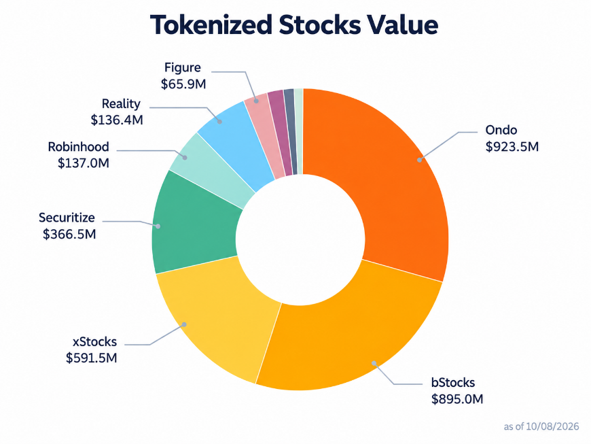
Source: RWA.xyz
Tokenisation reaches private markets
The most interesting development may be happening outside the stock exchange. Late September, ARK Invest announced that it had tokenised its ARK Venture Fund (ARKVX) on Ethereum through Securitize, a firm specialised in issuing digital securities. The fund manages about $1.3bn in net assets and holds stakes in private companies such as OpenAI, Anthropic, Stripe and Databricks.
The portfolio stays the same. Only the infrastructure changes. Investors who buy the token gain exposure to the same strategy as those who hold the traditional fund, but they can do so through a digital wallet. Cathie Wood, founder and CEO of ARK Invest, described the move as putting "our conviction in the evolution, if not revolution, of capital markets into practice", as reported by The Block.
The potential here is significant. Companies now stay private for much longer than they used to, which means that a large part of their value creation happens before they ever list on an exchange. Access to this growth has traditionally been reserved for institutions and wealthy investors, through funds with high minimum investments and long lock-up periods. By lowering ticket sizes and reducing administrative costs, tokenisation could open part of this market to investors with smaller portfolios. Eligibility rules still apply, however, and tokenisation does not remove the regulatory requirements that protect retail investors.
The advantages for investors
The first advantage of tokenised asset is access to fractions of shares. A single Nvidia or Alphabet share can represent a significant amount for a young investor, and tokens make it easy to buy a small part of one. This makes diversification possible even with a modest budget.
The second advantage is speed of settlement. A transfer on a blockchain is final within seconds or minutes, while a traditional share trade in the United States settles one business day after the transaction (T+1). Faster settlement reduces the period during which a trade can fail and frees up capital sooner.
The third advantage is continuous trading. Traditional exchanges close in the evening, at weekends and on public holidays, while token markets run around the clock. The demand is real. Over one weekend in September 2026, the 42 largest tokenised equities traded about $1.01bn, roughly the same as the previous Friday's session, according to The Defiant. For investors in Asia or Europe, this also removes the constraint of following New York opening hours.
Finally, tokens are easy to transfer. This is a real difference from the fractional shares that many investment apps already offer. On a traditional platform, a fraction of a share exists only as an entry in the broker's internal books, and it cannot be moved to another broker or used elsewhere. A token, in contrast, can be sent to another wallet or to any platform that supports that specific token, although some issuers limit transfers to verified users. According to Payment Expert, Coinbase's tokens may even be usable as collateral on decentralised finance applications in the future, allowing holders to borrow money against their shares.
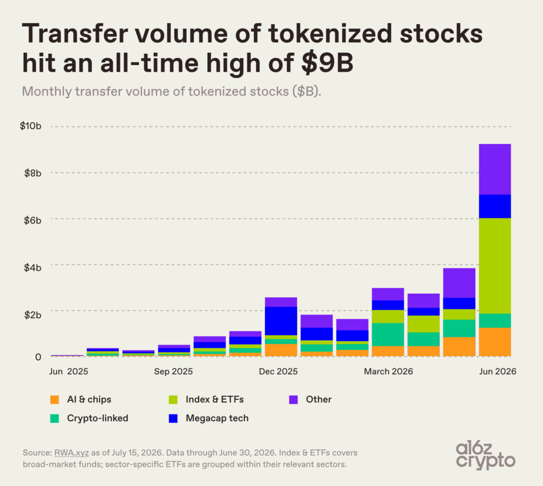
Source: a16zcrypto
The risks to keep in mind
Despite these advantages, tokenizsd stocks remain a young market, and they come with risks that traditional shares do not carry. First, a token carrying a company's name is not necessarily a share in that company. In June 2025, Robinhood distributed tokens linked to OpenAI and SpaceX to European customers. OpenAI quickly responded that "these 'OpenAI tokens' are not OpenAI equity" and that it had not approved any transfer of its shares. Robinhood explained that the tokens gave indirect exposure through a special purpose vehicle. Before buying, investors should therefore check whether the token is backed by real shares or simply tracks their price.
The second risk is a double exposure. A token holder carries the risk of the company itself, but also the risk of the issuer and the custodian. If the custodian fails, is badly managed or does not actually hold the shares, the token can lose its value even if the underlying company performs well.
Third, the price of a token can differ from the price of the share. When the traditional market is closed, there is no official reference price, and tokens can trade at a premium or a discount. Tokenised stocks on xStocks traded at a noticeable premium to their Nasdaq counterparts after their launch, before the gap narrowed.
Liquidity is the fourth risk. Weekend trading volumes on tokenised stocks often fall to 30% or less of weekday levels, and the five most traded tokens account for 91% of total volume, according to Four Pillars. Outside the most popular names, an investor may struggle to sell quickly at a fair price.
Fifth, the legal framework varies widely from one country to another. Coinbase's product excludes US residents, and Binance's 2021 experience shows that regulators can force a platform to close its offering, leaving investors to sell under time pressure.
Technical risks must also be considered. Smart contracts can contain bugs, platforms can be hacked, and prices often depend on external data providers, known as oracles, which can fail or be manipulated.
Finally, transparency on the backing is not always sufficient. Investors depend on the issuer's statements and audits to confirm that every token is truly backed by a share. This issue is even more important in private markets, where assets are valued less frequently, often quarterly, and with more subjective methods than listed shares.
Conclusion
Tokenised stocks are moving from experiment to mainstream product. With Coinbase, Robinhood and Ondo competing for investors, and ARK opening its venture fund to blockchain investors, the infrastructure of financial markets is clearly starting to change. The benefits are concrete for investors who want small positions and access at any time. The risks are just as real, from custodian failure to legal uncertainty. Before buying, investors should check what the token legally represents, who holds the underlying asset and in which jurisdiction. Tokenisation changes the wrapper of an investment, but the need for careful due diligence remains exactly the same.
Disclaimer
This marketing document has been issued by Bank Syz Ltd. It is not intended for distribution to, publication, provision or use by individuals or legal entities that are citizens of or reside in a state, country or jurisdiction in which applicable laws and regulations prohibit its distribution, publication, provision or use. It is not directed to any person or entity to whom it would be illegal to send such marketing material. This document is intended for informational purposes only and should not be construed as an offer, solicitation or recommendation for the subscription, purchase, sale or safekeeping of any security or financial instrument or for the engagement in any other transaction, as the provision of any investment advice or service, or as a contractual document. Nothing in this document constitutes an investment, legal, tax or accounting advice or a representation that any investment or strategy is suitable or appropriate for an investor's particular and individual circumstances, nor does it constitute a personalized investment advice for any investor. This document reflects the information, opinions and comments of Bank Syz Ltd. as of the date of its publication, which are subject to change without notice. The opinions and comments of the authors in this document reflect their current views and may not coincide with those of other Syz Group entities or third parties, which may have reached different conclusions. The market valuations, terms and calculations contained herein are estimates only. The information provided comes from sources deemed reliable, but Bank Syz Ltd. does not guarantee its completeness, accuracy, reliability and actuality. Past performance gives no indication of nor guarantees current or future results. Bank Syz Ltd. accepts no liability for any loss arising from the use of this document.
Related Articles
One of John Ternus’s first major launches as Apple CEO takes the company into a market already served by Amazon and Google. With HomeView, Apple is betting that a smarter Siri and its tightly integrated ecosystem can persuade consumers to pay a premium for a place in their homes.
Why the hyperscalers’ spending spree and circular AI financing deserve scrutiny, why the AI boom may still have years to run, and where the best investment opportunities may lie.
Anthropic told investors at its third-quarter results briefing that revenue reached $16.8bn, up 46% from $11.5bn in the second quarter, and that it was profitable on an adjusted basis and cash-flow positive for the second quarter running.


