


.png)
Introduction
Inflation measurement sits at the centre of modern macroeconomics. Interest rates, asset prices, fiscal planning, and central-bank credibility ultimately depend on the trajectory of price pressures. Yet the primary reference point for that assessment is a monthly government release, particularly the Consumer Price Index (CPI), designed for a far less dynamic economic environment.
A growing body of market participants are now complementing that traditional benchmark with real-time data. Among the available alternatives, Truflation has become the most widely referenced real-time inflation index. Drawing on millions of observed prices across the economy and updating continuously, it provides a live read on inflation dynamics. In early 2026, it is sending a materially different signal from official CPI.
Methodology and structural differences
Truflation was launched in December 2021 in response to widespread frustration over the delay of traditional inflation reporting. Official CPI is published monthly and relies heavily on survey inputs and statistical smoothing, while Truflation takes a bottom-up digital approach.
The index aggregates pricing information from more than 30 million items across over 30 licensed data providers, including online retailers, housing platforms, and consumer data firms. These prices are updated daily and secured using decentralised oracle infrastructure through the Chainlink blockchain, making the methodology transparent and resistant to retrospective manipulation.
The index follows the same twelve broad consumption categories as CPI, but category weights are updated annually based on using observed spending patterns rather than static survey assumptions. This produces a dataset that responds immediately to shifts in pricing dynamics across goods and services.
Historically, this responsiveness has proven meaningful. Empirical comparisons indicate that Truflation has tended to lead official CPI turning points by approximately 40 to 75 days, often signalling changes in inflation momentum well before they appear in government releases.
Institutional validation
Scepticism toward alternative inflation measures is understandable. However, Truflation has met several of the credibility standards typically required for broader acceptance.
Its short-term forecasting performance has been consistent. Throughout 2024 and 2025, Truflation’s readings frequently anticipated official CPI releases within approximately ±0.1 percentage points. This level of precision contributed to growing adoption among macro traders and systematic funds.
Institutional validation has also progressed. In early 2026, Truflation was integrated into the Bloomberg terminal ecosystem, a quiet but important validation that moved it from “crypto-native experiment” into the mainstream macro toolkit.
Additionally, transparency further supports its relevance. Data updates occur daily and the methodology is visible and independently audited. In an environment where markets reprice continuously, access to high-frequency, auditable inflation data represents a tangible structural advantage over traditional monthly releases.
The Truflation-CPI divergence in 2026
As of mid-February 2026, the gap between Truflation and official CPI has widened to one of the largest divergences since Truflation’s inception.
- Official CPI (January 2026): 2.4% year-over-year
- Truflation (1-18 Feb 2026): approximately 0.7%
- Core CPI: approximately 2.5%
- Truflation core proxy: approximately 1.3%
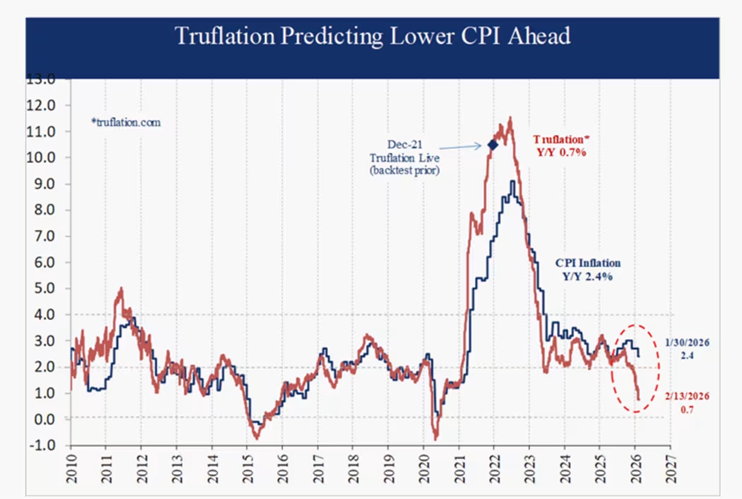 Source: Zweig-DiMenna
This difference suggests two distinct views of current inflation momentum. The primary driver of this divergence is housing. Truflation tracks real-time asking rents using market platforms, capturing the recent cooling in rental prices. Official CPI, by contrast, relies heavily on “Owner’s Equivalent Rent,” a survey-based measure that can lag actual market conditions by six to twelve months.
As a result, the two indices are effectively referencing different points in time. Truflation reflects current housing conditions, CPI continues to incorporate earlier rental dynamics.
The macro implications are meaningful. If the real-time measure is closer to reality, the US economy may be approaching deflationary territory, an environment historically associated with recession risk. Meanwhile, government data continues to suggest a controlled soft landing with inflation comfortably near target.
Explaining the reluctance
Despite a solid track record, many economists remain cautious about integrating Truflation into formal analysis. The resistance rests on three arguments:
The first is institutional inertia. CPI has decades of history behind it, with forecasting models, policy rules and research processes deeply anchored to its monthly release cycle. Introducing a daily inflation measure would require adjustments not only to projections, but to established workflows.
The second relates to volatility bias. Truflation adjusts rapidly and can exhibit sharp short-term moves. A pronounced daily decline may be dismissed as volatility, even when it reflects a genuine shift in pricing dynamics. The smoother profile of official data often feels “safer”, even if that stability comes at the cost of timeliness.
The third concerns composition. Truflation assigns slightly less weight to housing than CPI. Critics argue that this may understate inflation during periods of accelerating rents. However, the same logic applies in reverse. When rental markets cool quickly, CPI can overstate underlying inflation, as appears to be happening now.
Ultimately, the hesitation does not stem from a lack of information. It reflects discomfort with a measure that delivers signals earlier and with less statistical smoothing.
Conclusion: why the current signal is relevant
If Truflation’s signal proves correct, monetary policy expectations may be misaligned with underlying inflation trends. The Federal Reserve could have more leeway to ease than current consensus implies, despite surface-level indicators pointing to economic resilience.
This does not imply that Truflation should displace CPI as the official benchmark. However, dismissing a persistent divergence becomes increasingly difficult.
The broader conclusion extends beyond a comparison of indices. Inflation cannot be treated purely as a monthly datapoint in an economy where prices adjust continuously. Measurement tools must evolve accordingly.
Truflation’s relevance does not depend on perfection. Its value lies in speed, transparency and the growing difficulty of overlooking its signal.
Disclaimer
This marketing document has been issued by Bank Syz Ltd. It is not intended for distribution to, publication, provision or use by individuals or legal entities that are citizens of or reside in a state, country or jurisdiction in which applicable laws and regulations prohibit its distribution, publication, provision or use. It is not directed to any person or entity to whom it would be illegal to send such marketing material. This document is intended for informational purposes only and should not be construed as an offer, solicitation or recommendation for the subscription, purchase, sale or safekeeping of any security or financial instrument or for the engagement in any other transaction, as the provision of any investment advice or service, or as a contractual document. Nothing in this document constitutes an investment, legal, tax or accounting advice or a representation that any investment or strategy is suitable or appropriate for an investor's particular and individual circumstances, nor does it constitute a personalized investment advice for any investor. This document reflects the information, opinions and comments of Bank Syz Ltd. as of the date of its publication, which are subject to change without notice. The opinions and comments of the authors in this document reflect their current views and may not coincide with those of other Syz Group entities or third parties, which may have reached different conclusions. The market valuations, terms and calculations contained herein are estimates only. The information provided comes from sources deemed reliable, but Bank Syz Ltd. does not guarantee its completeness, accuracy, reliability and actuality. Past performance gives no indication of nor guarantees current or future results. Bank Syz Ltd. accepts no liability for any loss arising from the use of this document.
Related Articles
The iShares Expanded Tech-Software ETF (IGV), treated as the benchmark for the sector, has slid almost 30% from its September peak, a sharp reversal for what was considered one of the market’s safest growth franchises. Every technological cycle produces its moment of doubt. For software, that moment may be now.
Nuclear power is getting a second life, but not in the form most people imagine. Instead of massive concrete giants, the future may come from compact reactors built in factories and shipped like industrial equipment. As global energy demand surges and grids strain under new pressures, small modular reactors are suddenly at the centre of the conversation.
Cosmo Pharmaceuticals’ successful Phase III trials in male hair loss has drawn attention to a market long seen as cosmetic. Growing demand for effective treatments has accelerated research and encouraged the rise of biotechnology companies exploring new approaches.