


.png)
The Federal Reserve’s FOMC committee decided to cut its key rate by 0.25 percentage points to a target range of 3.75% to 4.0%, and to fade its quantitative tightening—otherwise known as the reduction of its balance sheet—in November, and stopping the reductions on 1 December.
By delivering these two measures, the FOMC committee met all market expectations. However, during the press conference, Fed Chair Jerome Powell made statements that another rate cut in December is not a done deal. He stated, “in the committee’s discussion at this meeting, there were strongly differing views about how to proceed in December” and added “a further reduction in the policy rate at the December meeting is not a foregone conclusion – far from it.”
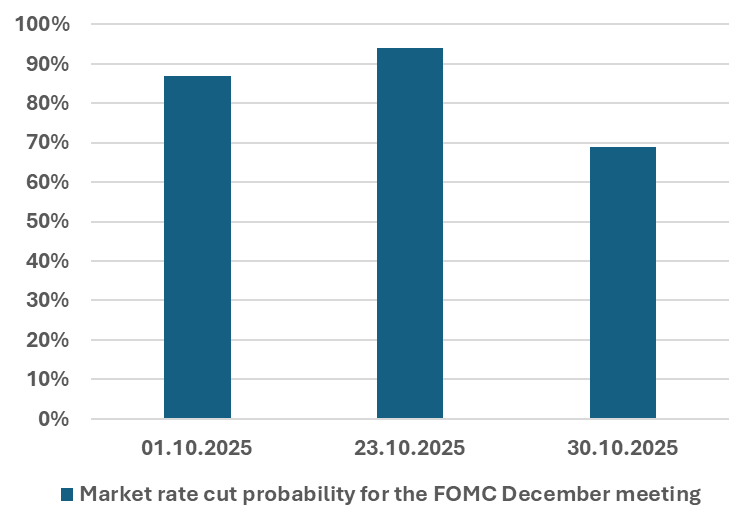
The hawkish shift in tone let the markets reprice sharply the probability of a December rate cut
This led the stock market to weaken, US treasury yields to surge, and the US dollar to appreciate, as the market sharply revised down the probability of another interest rate cut—from about 90% before the Fed’s decision to below 70% after Powell’s comments.
The reaction was supported by Powell's opening remarks at the press conference, showing a change in noting that “growth in economic activity may be on a somewhat firmer trajectory than expected”.
Interestingly, there were two dissenting votes on this decision, but otherwise all members were in agreement. Powell managed to secure a virtually unanimous decision among his colleagues. And while FOMC newcomer Stephen Miran once again voted for a larger rate cut of 0.5 percentage points, he was offset by regional Fed President Jeffrey Schmid, who voted to keep rates stable at 4% to 4.25%.
It also appeared that the combination of lingering worries of more “cockroaches” in the US banking system and more economic activity potentially adding to the already existing price pressures caused markets to forget the positive effects of an earlier stop of QT.
What will we monitor now?
We will closely monitor how the Fed's decision, Powell's statements, and upcoming economic and liquidity data shape market inflation expectations. Our attention will also turn to whether the announced end of quantitative tightening and a possible rebound of organic balance sheet growth help ease money market strains and reduce signs of liquidity stress, such as banks’ use of the Fed’s repo facility. With markets sharply repricing the odds of a December rate cut, the ongoing government shutdown leaves investors and policymakers “dancing in the dark,” as much of the usual economic data is unavailable. As Powell put it, “What do you do if you are driving in the fog? You slow down”. For now, both the Fed and markets will need more data to judge the economy’s direction — and another rate cut in December, in Powell’s words, is “not a foregone conclusion – far from it.”
Chart 1: The Federal Reserve cuts again its key interest rate
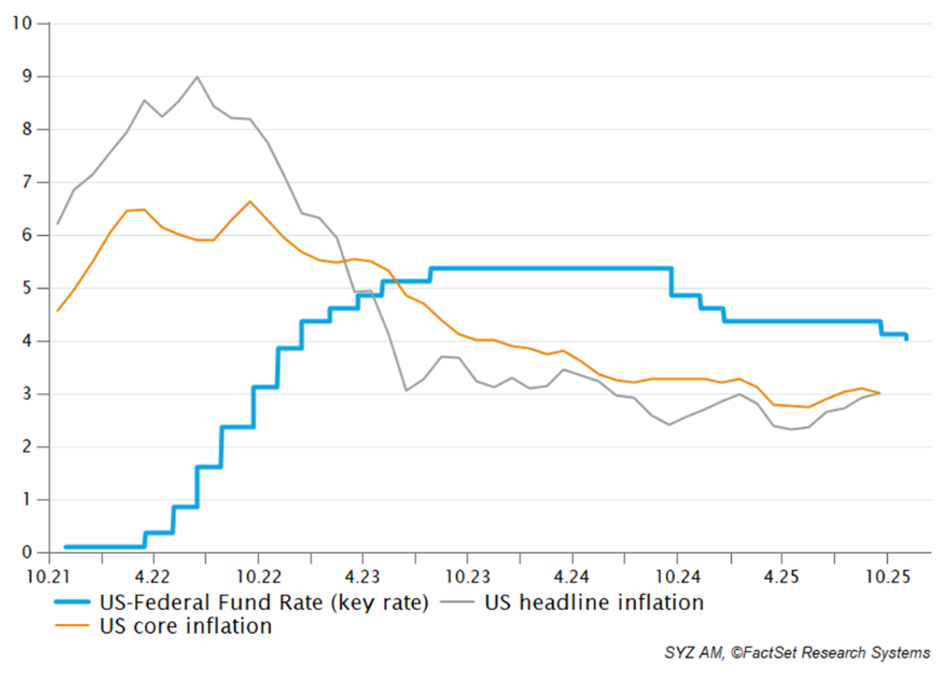
Chart 2: Substantial repricing of the probability for another Fed key rate cut in December – from sure, to not so sure
Disclaimer
This marketing document has been issued by Bank Syz Ltd. It is not intended for distribution to, publication, provision or use by individuals or legal entities that are citizens of or reside in a state, country or jurisdiction in which applicable laws and regulations prohibit its distribution, publication, provision or use. It is not directed to any person or entity to whom it would be illegal to send such marketing material. This document is intended for informational purposes only and should not be construed as an offer, solicitation or recommendation for the subscription, purchase, sale or safekeeping of any security or financial instrument or for the engagement in any other transaction, as the provision of any investment advice or service, or as a contractual document. Nothing in this document constitutes an investment, legal, tax or accounting advice or a representation that any investment or strategy is suitable or appropriate for an investor's particular and individual circumstances, nor does it constitute a personalized investment advice for any investor. This document reflects the information, opinions and comments of Bank Syz Ltd. as of the date of its publication, which are subject to change without notice. The opinions and comments of the authors in this document reflect their current views and may not coincide with those of other Syz Group entities or third parties, which may have reached different conclusions. The market valuations, terms and calculations contained herein are estimates only. The information provided comes from sources deemed reliable, but Bank Syz Ltd. does not guarantee its completeness, accuracy, reliability and actuality. Past performance gives no indication of nor guarantees current or future results. Bank Syz Ltd. accepts no liability for any loss arising from the use of this document.
Related Articles
Meanwhile, earnings growth, not valuation expansion, is doing the heavy lifting behind the S&P 500’s rally. Each week, the Syz investment team takes you through the last seven days in seven charts.
Meanwhile, what does Anthropic’s $2tn valuation assume about future growth? Each week, the Syz investment team takes you through the last seven days in seven charts.
Meanwhile, US earnings growth leaves the rest of the world behind. Each week, the Syz investment team takes you through the last seven days in seven charts.