


.png)
As if he had known that there might be news which would rattle the US banking system this week, Jerome Powell, Chair of the US central bank, reassured markets in a speech earlier this week, that the committee is acting in a “deliberately cautious approach” when it comes to the liquidity of the US banking system and the Fed’s balance sheet. He explicitly mentioned that “the Committee's plans lay out a deliberately cautious approach to avoid the kind of money market strains experienced in September 2019.”
It was a timely speech because later this week, two regional banks disclosed that they are dealing with bad loans tied to alleged fraud. This followed the bankruptcies of auto parts supplier First Brands and subprime auto lender Tricolor in September. There are now fears that other financial institutions that dealt with the lenders could also be affected. Towards the end of his speech, Powell reiterated the statement seen by markets as dovish: “Rising downside risks to employment have shifted our assessment of the balance of risks.” Later, Powell also stressed the usual reminder that “we will set policy based on the evolution of the economic outlook and the balance of risks, rather than following a predetermined path.” Interestingly, the usually “dovish” Fed Governor Christopher Waller conveyed two days later a similar message that seems to indicate that the December rate cut is not a done deal, as currently priced in by financial markets: “I believe that the FOMC should reduce the policy rate another 25 basis points at our meeting that concludes October 29. But beyond that point, I will be looking for how the solid GDP data reconcile with the softening labour market.”
Dancing in the Dark
At this point, we need to bear in mind that we are currently all “dancing in the dark” as long as the US government shutdown is leading to many important economic data not being published. So, we and the Fed will focus on October 24, when the Bureau of Labour Statistics (BLS) will publish the CPI for September. We will then review our Fed outlook that currently expects fewer rate cuts than the markets. The BLS will publish the CPI data despite the shutdown because the data is needed to produce the 2026 Social Security Cost-of-Living Adjustment (COLA).
All this comes at a time when around 40% of the federal civilian employees, around 850,000 people, are furloughed because the US federal government shutdown is still in place. The shutdown only affects about 25% of federal outlays, as most government spending is mandatory. However, the hundreds of thousands furloughed federal employees will trigger a drop in compensation resulting in a drag of 0.15 to 0.2 percentage points on the quarterly GDP growth – per week. As the shutdown currently runs since the 1st of October, we are now approaching the third week of partial federal administration standstill. A reduction of around 0.3 percentage points in the quarterly growth figures are already in the cards. There are important key dates, usually around mid-month and end of month, where a large share of federal employees and military personnel usually get their pay checks. One of these deadlines has now been missed and the US bipartisan policy centre estimates around 1.7 million civilian employees have now missed a pay check. However, if also military personnel is not paid, this number would increase to more than 5 million people. So far, the White House is said to have found some new sources to pay at least the active military staff. At some point, however, the missing pay checks can be expected to tangibly weigh on consumption and overall domestic demand in the US. This can still be seen as a temporary drop and we will likely see some catch up effects after a potential end of the shut down. We need to bear this in mind when we will look at fluctuations in consumption and other economic activity indicators.
As the shutdown continues, more and more economic data are missing as the federal agencies producing them are heavily affected by the standstill. Data from the Bureau of Labour Statistics or from the Bureau of Economic Analysis do not produce their data among other government bodies. This means key data on labour statistics, economic activity and price changes are not produced and released. When looking at this week’s data, the consumer price index, a key ingredient for financial markets and the US central bank, was missing. Thanks to the independent funding of the Federal reserve, regional indicators like the Empire manufacturing survey by the NY Fed or the Philadelphia Manufacturing survey were produced this week. The two indicators showed a contradicting picture with the “Empire” showing a strong increase in manufacturing sentiment and orders while the “Philly Fed” showed a disappointing drop. However, both indicators pointed to an ongoing upward pressure in prices.
When the usual data are missing, look at alternative and old fashioned data: the “Beige Book”
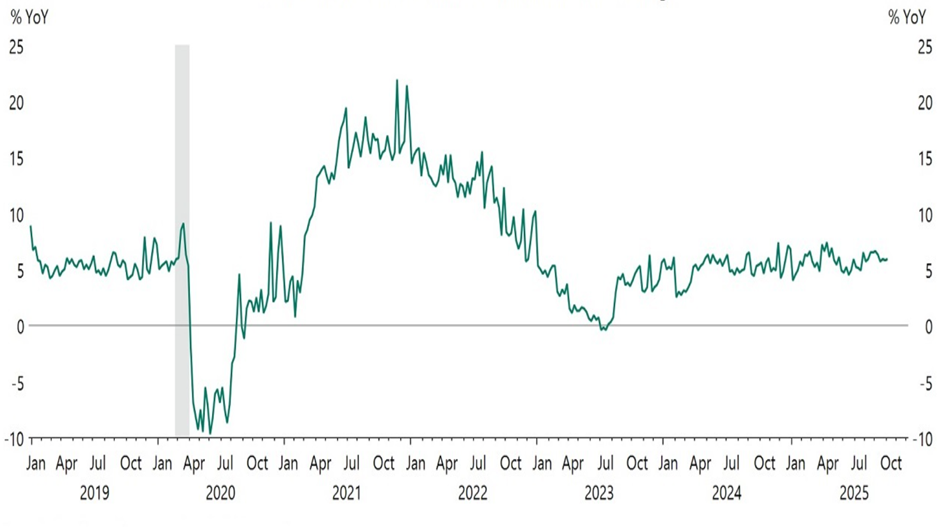
In such a situation, the Fed also feels like it’s dancing in the dark and has to look at alternative data. Just like we do, they might look into alternative consumer data from in store sales. Here we see, for now, a still solid picture of US consumer growth (see chart below).
However, in such a time when the usual data are missing, it can help to resort to the more old-fashioned, traditional information sources such as the “Beige Book”. The “BB” is produced monthly and aggregates interviews of hundreds of business contacts in each of the Federal Reserve regional districts – and provides an interesting view “from the street” of the US economy, somewhat geared toward the small and mid sized businesses of the country. Interestingly, the Beige Book’s take on US economic activity shows a resilient picture “Economic activity changed little on balance since the previous report, with three Districts reporting slight to modest growth in activity, five reporting no change, and four noting a slight softening.”. And it is quite outspoken in terms of current price pressures: “Prices rose further during the reporting period. Several District reports indicated that input costs increased at a faster pace due to higher import costs and the higher cost of services such as insurance, health care, and technology solutions.” On the other hand, the BB’s statement about the US labour market is clearly painting a “cooling” picture but is surprisingly well balanced between positive and negative factors, as you can see in the summary here:
“Employment levels were largely stable in recent weeks, and demand for labour was generally muted across Districts and sectors. In most Districts, more employers reported lowering head counts through layoffs and attrition, with contacts citing weaker demand, elevated economic uncertainty, and, in some cases, increased investment in artificial intelligence technologies. Employers that reported hiring generally noted improved labour availability, and some favored hiring temporary and part-time workers over offering full-time employment opportunities. Nevertheless, labour supply in the hospitality, agriculture, construction, and manufacturing sectors was reportedly strained in several Districts due to recent changes to immigration policies. Wages grew across all reporting Districts, generally at a modest to moderate pace, and labor cost pressures intensified in recent weeks due to outsized increases in employer-sponsored health insurance expenses.”
Overall, the US economy remains on solid footing. Consumption is still robust, as also indicated by persistent price pressures, despite signs of cooling in the labour market, which now appears more balanced than earlier anticipated after several releases of weak payroll data.
Chart 1: Two opposing signals for manufacturing activity in the US but one voice about ongoing price pressures
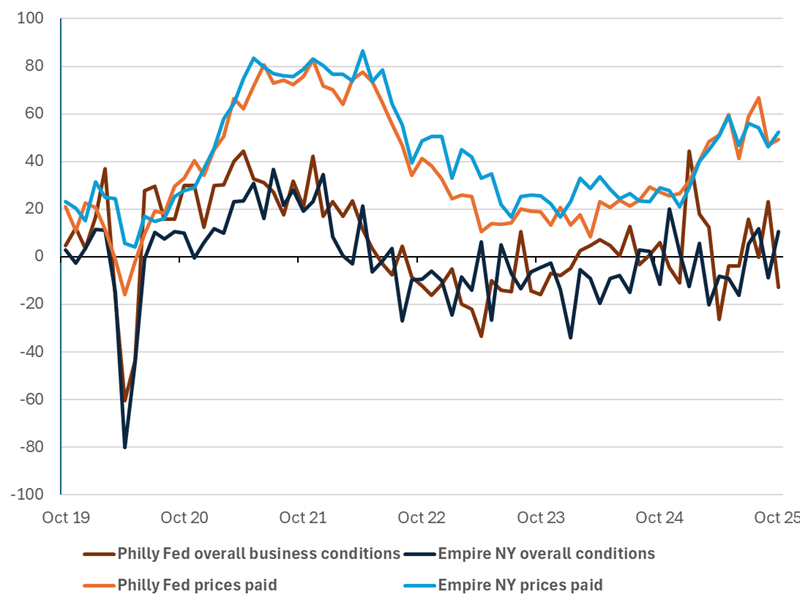
Chart 2: Redbook weekly same-store retail sales point to ongoing robust US consumption despite Shutdown
Disclaimer
This marketing document has been issued by Bank Syz Ltd. It is not intended for distribution to, publication, provision or use by individuals or legal entities that are citizens of or reside in a state, country or jurisdiction in which applicable laws and regulations prohibit its distribution, publication, provision or use. It is not directed to any person or entity to whom it would be illegal to send such marketing material. This document is intended for informational purposes only and should not be construed as an offer, solicitation or recommendation for the subscription, purchase, sale or safekeeping of any security or financial instrument or for the engagement in any other transaction, as the provision of any investment advice or service, or as a contractual document. Nothing in this document constitutes an investment, legal, tax or accounting advice or a representation that any investment or strategy is suitable or appropriate for an investor's particular and individual circumstances, nor does it constitute a personalized investment advice for any investor. This document reflects the information, opinions and comments of Bank Syz Ltd. as of the date of its publication, which are subject to change without notice. The opinions and comments of the authors in this document reflect their current views and may not coincide with those of other Syz Group entities or third parties, which may have reached different conclusions. The market valuations, terms and calculations contained herein are estimates only. The information provided comes from sources deemed reliable, but Bank Syz Ltd. does not guarantee its completeness, accuracy, reliability and actuality. Past performance gives no indication of nor guarantees current or future results. Bank Syz Ltd. accepts no liability for any loss arising from the use of this document.
Related Articles
Nothing seems to curb the 10-year Treasury yield’s rise. Meanwhile, Japan’s currency defense is drying up it’s FX reserves and the S&P 500 is hiding something important. Each week, the Syz investment team takes you through the last seven days in seven charts.
Meanwhile, European countries are having their own bond crisis. Each week, the Syz investment team takes you through the last seven days in seven charts.
Victoria’s Secret is back: a $100,000 investment has quadrupled since the Fashion Show’s return was announced. Each week, the Syz investment team takes you through the last seven days in seven charts.