.png)
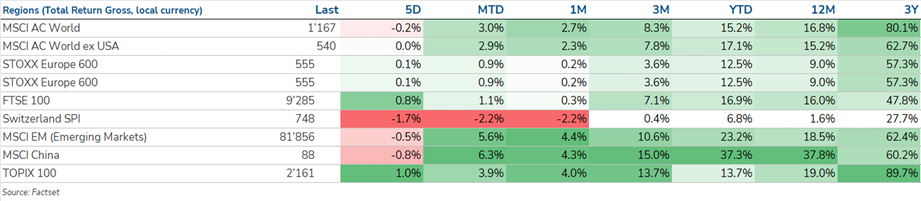
Last week was soft for equity markets, with the MSCI World Index down 0.4% as the U.S. 10-year yield rose to 4.17%. Rates remained an overhang on sentiment as markets dialed back some near-term easing expectations. Thursday’s macro data was the latest driver, particularly another notable decline in initial jobless claims. In addition, outside of Miran, Fed commentary again highlighted a preference for a more cautious approach to easing.
The S&P 500 finished the week down 0.3%, with the Mag7 providing no support as the group declined 1%. Within technology, semiconductors outperformed (+1.1%) while software stocks lagged (-1.9%). Small caps underperformed, with the Russell 2000 down 0.6%. In Europe, the STOXX 600 gained marginally (+0.1%), supported by the Energy sector. In both the U.S. and Europe, value stocks outperformed last week. Emerging markets fell 1.1%, dragged lower by technology (KWEB -1.8%). At a country level, China proved relatively resilient (-0.9%) while India was the weakest performer (-3.9%).
Trade Policy Update
Donald Trump announced 100% tariffs on medicines and pharmaceutical goods imported into the U.S., marking a sudden escalation in his global trade war. The levies, effective October 1, will apply to all branded or patented pharmaceutical goods. Exemptions will be granted to companies actively building new manufacturing capacity in the U.S. Importantly, generic (off-brand) drugs are excluded. The administration has indicated it will respect the existing 15% tariff cap on pharmaceutical imports from the EU and Japan. Whether APIs (Active Pharmaceutical Ingredients — the raw components used to make finished drug products) will be covered depends on how “pharmaceuticals” and “drugs” are defined in the tariff’s legal text and implementing regulations. Today, less than 15% of total API volume for U.S. prescription drugs is produced domestically. While negative, the sector rebounded on the news as stocks are already pricing in some tariffs increase and several of the large pharma companies have expansion plan in the US and could avoid these tariffs.
On the corporate front, First Brands, an Ohio-based auto parts company, filed for bankruptcy protection, disclosing more than $10 billion in total liabilities, marking one of the most significant collapses in the private debt markets in recent years. On the earnings front, Cintas saw its share price rise 2% last week after reporting strong results, with top-line growth of 7.8% in constant currency. Costco, meanwhile, declined 3.7% despite delivering continued revenue growth of 6.4%, though its worldwide membership renewal rate slipped 40 basis points to 89.8%. In Europe, H&M surprised the market with a notable rebound in profitability, posting a 14% increase.