
.png)
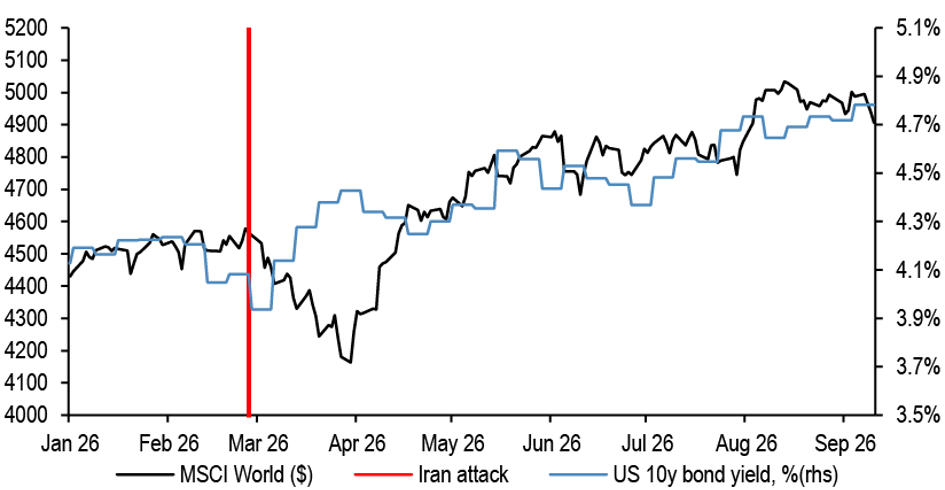
MSCI World and the US 10-year bond yield both continue to trend higher
Source: Bloomberg, JP Morgan

We are sorry that for legal reasons we are not able to help US citizens or Canadian residents other than in Ontario, Quebec, or Alberta. Best wishes for the future…
We are sorry that for legal reasons we are not able to help US citizens or Canadian residents other than in Ontario, Quebec, or Alberta. Best wishes for the future…
You chose the following profile. If you made a mistake, please change here USA
This marketing document has been issued by Bank Syz Ltd. It is not intended for distribution to, publication, provision or use by individuals or legal entities that are citizens of or reside in a state, country or jurisdiction in which applicable laws and regulations prohibit its distribution, publication, provision or use. It is not directed to any person or entity to whom it would be illegal to send such marketing material.
This document is intended for informational purposes only and should not be construed as an offer, solicitation or recommendation for the subscription, purchase, sale or safekeeping of any security or financial instrument or for the engagement in any other transaction, as the provision of any investment advice or service, or as a contractual document. Nothing in this document constitutes an investment, legal, tax or accounting advice or a representation that any investment or strategy is suitable or appropriate for an investor's particular and individual circumstances, nor does it constitute a personalized investment advice for any investor.
This document reflects the information, opinions and comments of Bank Syz Ltd. as of the date of its publication, which are subject to change without notice. The opinions and comments of the authors in this document reflect their current views and may not coincide with those of other
Syz Group entities or third parties, which may have reached different conclusions. The market valuations, terms and calculations contained herein are estimates only. The information provided comes from sources deemed reliable, but Bank Syz Ltd. does not guarantee its completeness, accuracy, reliability and actuality. Past performance gives no indication of nor guarantees current or future results. Bank Syz Ltd. accepts no liability for any loss arising from the use of this document.
MSCI World and the US 10-year bond yield both continue to trend higher
Source: Bloomberg, JP Morgan
Global markets
Global equities retreated during the week ending on 11 September 2026, with the MSCI ACWI down 1.0% as a cluster of inflation and geopolitical shocks outweighed a still-resilient AI capex narrative. The week opened against a backdrop of a stronger-than-expected August US payrolls report released on the prior Friday close that anchors this period, which had already begun to temper hopes for near-term Federal Reserve easing. From there, sentiment deteriorated further as Brent crude pushed toward $100 a barrel on renewed Middle East hostilities, including reported strikes on Saudi energy infrastructure, at the same time as a US-Canada trade dispute escalated into retaliatory tariffs on both sides of the border. The combination revived the inflation scare that has periodically unsettled markets this year, and it showed up directly in the data: a hotter-than-expected August producer price report on Thursday and an August CPI print on Friday that came in mostly in line at the headline level but hotter on core, alongside a soft reading on consumer sentiment and rising inflation expectations.
Both value and growth indices fell in tandem (MSCI ACWI Value and Growth both down roughly 1%), underlining that this was a broad risk-off move rather than a rotation between styles. But emerging markets performed notably better. Nearly every major developed market fell, while MSCI EM rose 1.1%, helped by a powerful rally in Korean equities tied to memory-chip demand. Within Europe specifically, the STOXX Europe 600 pulled back -1.6%, as European equities absorbed both the oil shock and a hold from the ECB.
Sector performance reflected this cross-current: energy was one of the few pockets of strength globally as oil rallied, while sectors sensitive to real rates and growth expectations - healthcare, materials, consumer discretionary and construction - underperformed. Within technology, the picture was split: semiconductor names broadly rallied on continued AI infrastructure demand and a rotation toward memory suppliers, even as some of the largest AI beneficiaries of the past two years lagged.
US
The S&P 500 fell 1.1% and the Nasdaq 100 fell 0.4% during the week. The more domestically oriented Russell 2000 index fell 2.1%, underperforming alongside the Dow (-2.1%). Breadth was notably weak - the equal-weighted S&P 500 fell 2.4%, nearly double the headline index's decline, pointing to concentration in the handful of names still holding the market up. Healthcare was the worst-performing sector by a wide margin, down 4.5%. The trigger was Novartis' two consecutive drug trial failures, which drove heavy selling in US-listed peers with competing or adjacent pipelines, including Amgen, Sarepta and Dyne Therapeutics, compounded by company-specific setbacks at Stryker and Boston Scientific. Financials, materials and consumer discretionary also lagged, while technology and energy were the only sectors to post gains.
Within technology, the divergence was stark. Semiconductors rallied hard (+5.0%), led by AMD and Intel, as investors rotated toward chipmakers seen as direct beneficiaries of the memory supercycle rather than pure GPU exposure; Dell also surged to a record high on a bullish broker initiation. Nvidia bucked the group, falling 4.3% amid a shift in investor attention toward memory suppliers. Oracle reported strong quarterly results but sold off regardless, as investors focused on the rising capital intensity of its cloud build-out rather than the beat itself. Meta was the standout Magnificent Seven performer, up 6.1% helped by the successful launch of Muse - a standalone personal AI agent. Markets ended the period on a firmer note Friday, snapping a multi-day losing streak, but remained cautious heading into next week's FOMC meeting.
Europe
European equities declined, with the STOXX Europe 600 down 1.6% in local-currency terms. The DAX (-1.8%) and CAC 40 (-1.2%) both fell, while the FTSE MIB was a rare bright spot, up 0.7%. The most significant single-name driver of the week was Novartis' two consecutive trial failures, which resulted in sharp share-price weakness through the first half of the week; given the stock's weight in Swiss benchmarks, this drove an outsized decline in the Swiss market that stood out even against a weak regional backdrop.
At the sector level, energy was the clear outperformer (+2.6%) as oil prices climbed on Middle East supply concerns, while construction and materials, and consumer discretionary, were the weakest performers, reflecting both the drag from higher input costs and broader growth concerns.
The ECB's decision to hold rates steady at its Thursday meeting - despite headline inflation running comfortably above target - added a layer of policy uncertainty, with banks ending the period roughly flat as investors weighed the implications for net interest margins against a less hawkish near-term path than some had priced in.
Rest of the world
Emerging markets were the standout region, with MSCI EM up 1.1% even as developed markets broadly declined. This divergence was driven overwhelmingly by Korea. MSCI Korea surged 6.8% as memory-chip exporters extended their 2026 rally, with South Korean semiconductor shipment data showing another sharp year-on-year increase and reinforcing the narrative of a structural memory supercycle tied to AI infrastructure demand; this also fed the broader rotation within global tech away from GPU-centric names and toward memory suppliers. Taiwan's TAIEX held up relatively well (-0.9%) given its own semiconductor exposure, while China equities slipped modestly (MSCI China -1.6%) amid a comparatively quiet newsflow week for the mainland. India underperformed (-2.8%), while Brazil posted a small gain (+0.4%) and Japan was roughly flat (-0.2%), leaving the region's performance almost entirely a function of the Korean chip story rather than a broad-based emerging-market rally.
Equity asset class
We maintain a neutral equity exposure, balancing a constructive earnings outlook against the headwind from higher real rates.
Earnings
The outlook remains constructive, supported by AI-related investment, broadening earnings participation across sectors and regions, near-record margins and resilient management confidence.
Valuation
Valuations remain supported by earnings growth, with forward estimates rising faster than share prices. The S&P 500 trades close to 20x forward earnings, while Europe, Japan and Asia remain closer to historical averages.
Risks
The main risk remains a further rise in real yields, increasing discount-rate pressure, although the Treasury’s expanded long-dated buybacks provide some support at the long end.
This marketing document has been issued by Bank Syz Ltd. It is not intended for distribution to, publication, provision or use by individuals or legal entities that are citizens of or reside in a state, country or jurisdiction in which applicable laws and regulations prohibit its distribution, publication, provision or use. It is not directed to any person or entity to whom it would be illegal to send such marketing material. This document is intended for informational purposes only and should not be construed as an offer, solicitation or recommendation for the subscription, purchase, sale or safekeeping of any security or financial instrument or for the engagement in any other transaction, as the provision of any investment advice or service, or as a contractual document. Nothing in this document constitutes an investment, legal, tax or accounting advice or a representation that any investment or strategy is suitable or appropriate for an investor's particular and individual circumstances, nor does it constitute a personalized investment advice for any investor. This document reflects the information, opinions and comments of Bank Syz Ltd. as of the date of its publication, which are subject to change without notice. The opinions and comments of the authors in this document reflect their current views and may not coincide with those of other Syz Group entities or third parties, which may have reached different conclusions. The market valuations, terms and calculations contained herein are estimates only. The information provided comes from sources deemed reliable, but Bank Syz Ltd. does not guarantee its completeness, accuracy, reliability and actuality. Past performance gives no indication of nor guarantees current or future results. Bank Syz Ltd. accepts no liability for any loss arising from the use of this document.
Global equities were roughly flat over the week to 4 September 2026, as a much stronger than expected US August jobs report and renewed US-Iran tensions pushed oil prices and bond yields higher, reviving the case for a September Fed rate hike. The repricing hit European equities harder than the US, with German and French markets underperforming on rate- and energy-sensitive exposure, while banks and energy stocks outperformed globally. Within US tech, a sharp divergence emerged inside the Magnificent Seven, driven by company-specific news at Meta and Nvidia rather than a shared theme. Brazil was the standout market of the week, rallying on rate-cut expectations and firmer oil prices.
Global equities edged modestly higher over the past week, as a blowout Nvidia earnings beat and a sharp pullback in oil prices lifted risk appetite, only for a hawkish Jackson Hole debut from Federal Reserve Chair Kevin Warsh to reverse much of the optimism by Friday. This report examines the drivers behind the week's gains and reversals across the US, Europe, and emerging markets, including the rotation out of health care and small caps, the AI-driven strength in software and cybersecurity, and the easing of the oil risk premium following new US sanctions on Iran.
Global equities advanced despite the week between 24-31 July despite some by sharp divergences. Big Tech earnings split investors between AI capex winners and losers, the Federal Reserve held rates amid its first multi-member dissent in decades, and oil extended its climb on escalating Middle East tensions. Korean and Taiwanese equities were rocked by extreme volatility as leveraged AI-related positioning unwound and then violently reversed, while resilient eurozone growth data and broad emerging-market strength helped underpin the wider advance. This report examines the key drivers behind the past week's market moves, with a focus on US mega-cap earnings dispersion, the Fed's policy signals, and the forces behind Asia's dramatic swings.
Live feeds, charts, breaking stories, all day long.
Our latest research, commentary and market outlooks