

Adrien Pichoud

Head of Fixed Income

What happened last week?

Central banks

The feud between President Trump and the Fed escalated further last week. Governor Lisa Cook was “dismissed” from her position on the Board of Governor by the President, via letter posted on the TruthSocial network citing allegations that she committed mortgage fraud. However, she refused to quit her position, filed a lawsuit challenging her firing and even sued Trump over his move to oust her from the Fed’s board. Trump’s push to remove Fed Governor Lisa Cook, could flip the balance of power inside the Fed. If Cook eventually leaves the Fed’s board and is rapidly replaced, Trump-appointed Governors would hold 4 of 7 seats (excluding Powell). That would give Trump’s nominees’ a majority on the board for the first time in history. This shift could open the door to aggressive easing in 2026.

And in 2026 an important deadline looms: the appointment of 12 Regional Fed President at the end of February 2026. Crucially, they are subject to final approval by the rapidly transforming Board of Governors in Washington. This will provide President Trump with another opportunity to cement his influence the Fed’s monetary policy for the years ahead. All these potential shifts could open the door to a much more expansionary monetary policy in 2026.

In parallel, Governor Waller made again the case for a 25bps cut in September. The odds of a September Fed rate cut stay steady around 90%.

The release of the minutes of the ECB’s July meeting revealed that ECB members saw inflation risks as broadly balanced and didn’t want to send hints on potential next moves. Future markets price only a small chance of another ECB rate cut by the end of the year (30%).

In Asia, the Bank of Korea kept its Base Rate unchanged at 2.50%.

Credit

Credit markets continued to see a strong inflow, and stronger than in the previous decade in EUR credits. Investors favored EUR investment-grade funds over government bond funds, with short-term EUR investment grade funds posting their 27th consecutive week of inflows and capturing the lion’s share—despite French political risks.

EUR high-yield funds also recorded their 18th consecutive week of inflows, as investors continue to reach for yield.

In the U.S., foreign participation in credit markets was notably strong, marking the largest net foreign purchases in the first half since 2015. Attractive all-in yields in corporate bonds drew demand, and concerns over investors’ underweighting USD credit did not materialize.

Spreads widened across most segments, with the exception of U.S. high yield. U.S. investment-grade total returns slipped slightly, while U.S. high-yield ETFs gained (Vanguard USD Corporate Bond ETF -0.2%; iShares Broad USD High Yield ETF +0.1%). In Europe, EUR investment-grade ETFs posted a modest loss (-0.1%) and EUR high-yield declined (-0.4%), with EUR HY spreads now trading slightly wider than U.S. high yield.

Arguably, September’s heavy issuance calendar may weigh on spreads, though historically the impact has been more pronounced in Europe than in the U.S. The heavy issuance in May-June this year may reduce the supply risks.

Rates

Treasury yields twisted steeper last week as rate cut expectations continued to pull front-end yields lower. Persistent concerns regarding Fed independence, with the dismissal of Fed Governor Cook, maintained upward pressure on longer-term bond yields in the US.

USD rates declined on maturities up to 10 years but edged higher on longer-maturities last week. The US Treasury 2y yield was down -8bp to 3.62%, the 5y fell by -6bp to 3.70% while the 10y was down -3bp to 4.23%. Meanwhile, the 30y rose +5bp to 4.93%. The US 10-year inflation breakeven rate didn’t moved much (-1bp to 2.41%).

The iShares USD TIPS ETF was down -0.2% last week, a similar decline than for the broad USD Treasuries ETF (-0.2%). US Treasury ETF’s performances were positive in absolute terms across maturities up to 10 years (+0.2% for the 1-3y, +0.4% for the 3-7y, +0.4% for the 7-10y) while they were slightly negative for longer-term bonds (iShares 20y+ -0.5%).

EUR long term rates were up last week, led by a resurgence of French sovereign risk after the call by Prime Minister Bayrou for a confidence vote in Parliament on September 8th. The OAT-Bund spread climbed back to 80bp, a level last seen in December 2024 when former PM Barnier was himself ousted. The French 10-year yield rose +9bp to 3.51%, while the German 10-year was flat at 2.72%. Other European sovereign yields experienced milder increases than French OATs (Italy +6bp to 3.59%, Spain +3bp to 3.33%).

Emerging market

Sovereign USD bonds edged lower last week after several weeks of strong gains, while global EM debt funds recorded their 19th consecutive week of inflows. Argentina bonds came under pressure following a corruption scandal involving President Milei’s sister, Karina Milei, and the General Secretary of the Presidency, Diego Spagnuolo. While the case has dented public trust, it is unlikely to seriously threaten Milei’s leadership. Milei maintains a comfortable lead in the polls, implying that majority voters may have already made up their mind.

In Mexico, the government is weighing higher tariffs on Chinese imports to protect domestic factories and respond to longstanding demands from Donald Trump.

Market performance diverged across EM segments. EM USD sovereign bond fell -0.1%, giving back part of prior gains. The VanEck J.P. Morgan EM Local Currency Bond ETF lost -0.2%. EM USD corporate bonds held firm at +0.1%. The iShares USD Asia High Yield Bond ETF fell -0.3%.

Looking ahead, we stay vigilant on the political agenda with major elections in Argentina and Chile this year, followed by Colombia, Peru and Brazil next year.

Our view on fixed income 

Rates
NEUTRAL, don't go too long

 We still like short-to-medium term maturities in our sovereign fixed income allocation. However, we hold a Neutral and cautious view on long-term government bonds due to uncertainties surrounding the inflation outlook. The impact of supportive fiscal policy, fueled by surging public debt, and of political interferences in the Fed’s monetary policy are major factors of uncertainties for US Treasury yields. In Europe, new government spending, particularly in defense, is exerting upward pressure on long-term rates. 


Investment Grade
NEUTRAL, harvest the carry
We find Investment Grade corporate bonds attractive in the current environment, given their yield level and our constructive economic scenario. However, tight credit spreads have reduced the margin for safety in credit, that can be deemed as expensive from a valuation standpoint. As a result, we hold a Neutral stance on Investment Grade credit from an asset allocation perspective. The credit market's overall health is supported by robust demand and strategic maturity management. 
High Yield
NEUTRAL, go short-term

We like High Yield bonds with short maturity for their attractive combination of yield and low sensitivity to interest rate movements. HY spreads have tightened, signaling economic stability and contained default risk in the short run. However, those tight spreads are not attractive for medium-to-long term maturities as they do not compensate adequately for a potential deterioration in the economic environment. As such, we hold a Neutral view for High Yield in an allocation, with a clear preference for short-duration investments. We continue to find value in subordinated debt.

 
Emerging Markets
NEUTRAL, be selective
We plead for a careful selection of issuers to benefit from attractive absolute yields. Substantial inflows into EM debt this year have been fueled by a weak dollar along with EM corporates’ solid credit metrics and support the asset class. However, risks persist, with rich valuations and unpredictable Trump’s trade policies. Idiosyncratic risks also remain, notably in Brazil and India. Given this backdrop, we stay selective, favoring short-duration opportunities while remaining Neutral on the broad EM debt asset class. 

The Chart of the week

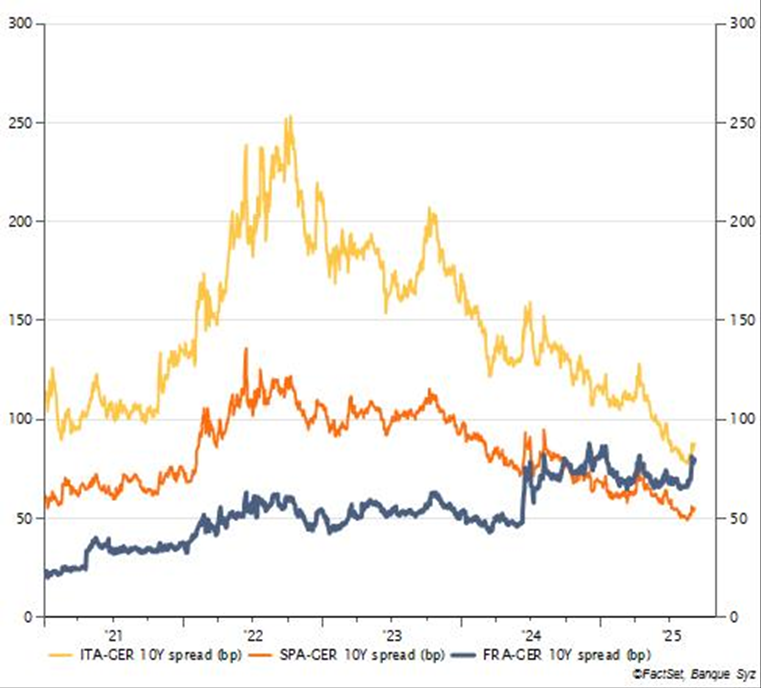
France sovereign spreads jump back toward 80bp 

For the third time in fourteen months, a political gamble is bringing France on the brink of complete gridlock, and financial markets are increasingly worried. French Prime Minister Bayrou has called for a confidence vote in Parliament on 8 September in a bid to clear the way for the adoption of a budget law aiming at EUR 44billion of public spending cuts next year—but the “coup” appears to be lost already.

For investors, this drama could be mere distractions if French public finances were not already on an alarming trajectory. Unfortunately, they are. Unlike other major European economies, France has been unable to normalise its public finances after the Covid pandemic shock. The public deficit has been exceeding 5% of GDP since 2023, when most other economies were bringing back their deficit toward the 3% limit or below. France’s public debt is the largest among European economies, nearing EUR 3’500bn and steadily heading toward 120% of GDP. France’s debt-to-GDP ratio stands much above its pre-pandemic level, and it has not declined since the end of the pandemic, unlike European peers.

While the absolute level of debt relative to the economy is at an elevated but still manageable level, the dynamic of public finances is clearly alarming. Should deficits remain at current levels and debt continue to grow at the current pace, Europe’s second largest economy will eventually reach a level where its debt sustainability is questioned.

The surprise announcement of the 8 September vote has suddenly raised back markets’ concerns around France’s public debt. Bayrou’s government likely fall suddenly revives fear of persisting elevated deficits, should there be no leadership nor majority for adopting the 2026 budget in the coming months.

As a result, the OAT-Bund 10y spread has just spiked back toward the peaks reached a year ago. It jumped from 70bp to 82bp, close to the peak of 88bp hit in December last year. In the meantime, the 10y spread between French OATs and Italian BTPs has narrowed to its tightest level in over two decades, 5bp.

Disclaimer

This marketing document has been issued by Bank Syz Ltd. It is not intended for distribution to, publication, provision or use by individuals or legal entities that are citizens of or reside in a state, country or jurisdiction in which applicable laws and regulations prohibit its distribution, publication, provision or use. It is not directed to any person or entity to whom it would be illegal to send such marketing material. This document is intended for informational purposes only and should not be construed as an offer, solicitation or recommendation for the subscription, purchase, sale or safekeeping of any security or financial instrument or for the engagement in any other transaction, as the provision of any investment advice or service, or as a contractual document. Nothing in this document constitutes an investment, legal, tax or accounting advice or a representation that any investment or strategy is suitable or appropriate for an investor's particular and individual circumstances, nor does it constitute a personalized investment advice for any investor. This document reflects the information, opinions and comments of Bank Syz Ltd. as of the date of its publication, which are subject to change without notice. The opinions and comments of the authors in this document reflect their current views and may not coincide with those of other Syz Group entities or third parties, which may have reached different conclusions. The market valuations, terms and calculations contained herein are estimates only. The information provided comes from sources deemed reliable, but Bank Syz Ltd. does not guarantee its completeness, accuracy, reliability and actuality. Past performance gives no indication of nor guarantees current or future results. Bank Syz Ltd. accepts no liability for any loss arising from the use of this document.

Read More

Straight from the Desk

Syz the moment

Live feeds, charts, breaking stories, all day long.

Thinking out loud

Sign up for our weekly email highlighting the most popular posts.

Follow us

Thinking out loud

Investing with intelligence

Our latest research, commentary and market outlooks