


.png)
Last week, the Financial Times highlighted comments from LVMH CEO Bernard Arnault warning that tensions in the Middle East could spiral into a “global catastrophe.” But are corporate executives broadly as negative as the headlines suggest?
To answer this question, we analysed S&P 500 earnings call transcripts sourced from the Bloomberg DS library using AI-driven contextual language models. Rather than relying on simple keyword counts, AI models process transcripts using contextual understanding — identifying synonyms, related language, and the broader meaning of discussions. This approach provides a more accurate picture of management concerns, strategic priorities, and evolving market narratives.
April’s snapshot covers more than 360 newly released transcripts from the Q1 2026 earnings season. Tracking how frequently key themes are discussed across management teams offers a valuable bottom-up indicator of corporate sentiment.
Macro concerns: limited evidence of stagflation fears in management commentary
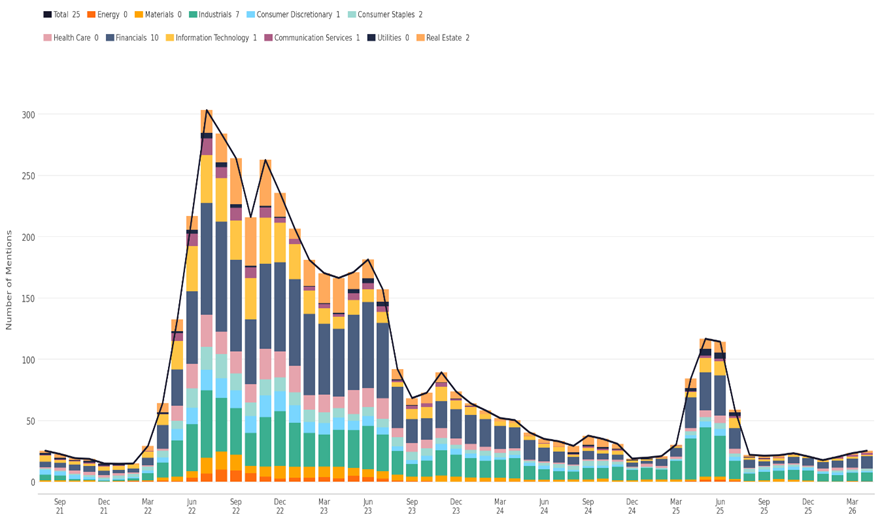
Despite elevated geopolitical tensions in the Middle East and growing concerns around weaker growth and renewed inflationary pressures, corporate commentary remains notably composed. Mentions related to “economic slowdown” have been trending lower since the sharp surge observed in 2022. Discussions temporarily increased again following President Trump’s Liberation Day tariff shock, but concerns have since faded back toward cyclical lows, with only 26 mentions recorded in April across S&P 500 earnings transcripts.
Broadening the analysis to the Russell 3000 — including large-, mid-, and small-cap companies — leads to a similar conclusion, with only 65 mentions recorded. Discussions related to economic slowdown have now fallen to levels comparable to “climate change” (28 mentions), a topic that is no longer a major focus during earnings calls.
References to “inflation” have increased modestly to around 300 mentions, broadly similar to levels observed during the Liberation Day tariff episode, but still far below the peaks reached in 2022, when mentions exceeded 1,000 occurrences. A similar pattern can be observed in “supply chain” discussions, although with lower intensity.
Mentions related to “job cuts” have also edged modestly higher from the lows seen in 2024–2025. However, levels remain well below previous peaks, suggesting targeted cost discipline rather than broad-based labour market deterioration.
Overall, management teams appear far more focused on operational execution, productivity, and AI-related opportunities than on recession or stagflation risks.
Chart 1: AI-identified mentions in S&P 500 transcripts: economic slowdown (26 mentions)
Management teams show limited concern about an economic slowdown. The same conclusion applies across the broader Russell 3000 universe, with only 65 mentions recorded.
 Source: Syz, Bloomberg data
AI mentions are exploding across transcripts — the revolution is now visible beyond technology
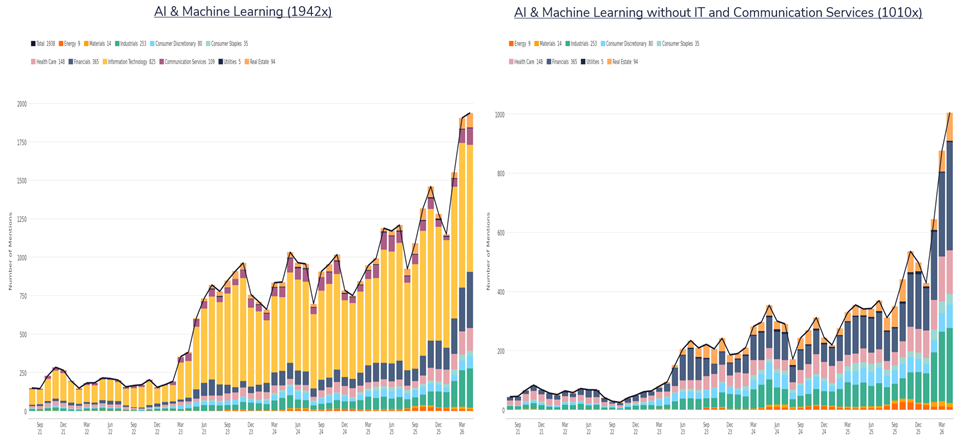
Among all themes tracked in earnings transcripts, “AI & Machine Learning” stands out as the clear outlier. AI-related mentions have risen sharply from approximately 750 in mid-2023 to nearly 2,000 in April 2026, more than doubling in less than three years.
Part of this trend reflects the heavy weight of the Information Technology and Communication Services sectors within the S&P 500. However, the signal remains exceptionally strong even when these sectors are excluded, confirming that the acceleration in AI discussions is not simply an index composition effect.
Outside of Technology, three sectors stand out disproportionately: Financials with 366 mentions, followed by Industrials (255 mentions) and Healthcare (149 mentions). This suggests that AI is increasingly becoming a strategic priority across a broad range of industries, particularly through productivity enhancement, automation, operational efficiency, and competitive positioning.
The key takeaway is that AI is transitioning from a pure technology story into a broad-based transformation of operating models across the global economy.
Chart 2: AI-identified mentions in S&P 500 transcripts: AI & machine learning (1,942 mentions)
AI-related discussions continue to accelerate sharply, even excluding the Information Technology and Communication Services sectors. The theme is increasingly prominent across Financials, Industrials, and Healthcare.
Source: Bloomberg
From signal to substance: what management teams are actually saying
The substance behind the signal matters as much as its frequency. Across Q1 2026 transcripts, management commentary has moved decisively from aspiration to execution. The four examples below — drawn from Financials, Healthcare, and Industrials — illustrate the operational specificity now embedded in AI discourse across sectors.
Jamie Dimon, Chairman & CEO, JPMorgan Chase | Q1 2026 Earnings Call, 14 April 2026
"We do a lot to reduce risk and fraud and scam by using AI. We do a lot better job on prospecting, we offer AI services to clients. So it will enhance a lot of things you can do directly and it will create more adjacencies in my opinion, if you can use it quickly and wisely."
Sandeep Dadlani, CEO, OptumInsight | UnitedHealth Q1 2026 Earnings Call, 17 April 2026
"We are spending about $1.5 billion in AI across UnitedHealth Group. We expect a return conservatively of 2 to 1 on these programs over the next few years, many of them paying back within the next 12 to 18 months."
Larry Culp, Chairman & CEO, GE Aerospace | Q1 2026 Earnings Call, 21 April 2026
"At our Lafayette, Indiana facility, we expanded the deployment of an AI-based material assistant to predict shop visit work scopes for LEAP engines nine months in advance."
These are not exploratory commitments — they are operational facts with measurable KPI linkages. The progression from Dimon's revenue adjacencies thesis to Dadlani's 12–18-month payback horizon, Culp's nine-month predictive window. Management teams are no longer narrating AI ambitions; they are being held to AI outcomes.
Conclusion: investment takeaways
The divergence between muted macro language and accelerating AI discourse indicates that management teams are prioritizing structural drivers over cyclical risks. This does not imply that macro risks have disappeared, but rather that they are not yet binding at the earnings level, consistent with the historical lag between macro shocks and EPS revisions.
Transcript analysis therefore points to a regime where macro concerns remain contained in the near term, while AI is emerging as the dominant, economy-wide earnings and productivity driver. The most actionable signal lies in the breadth of adoption across sectors.
The key risk to monitor is a reversal of this pattern: a renewed acceleration in “economic slowdown” or “inflation” mentions — particularly if accompanied by a plateau or deceleration in AI-related discourse — would signal that cyclical pressures are beginning to dominate and could mark an inflection point for earnings expectations and market leadership.