

Charles-Henry Monchau

Chief Investment Officer


H1 in review

As the first half of 2025 concludes, it's time to evaluate how cryptocurrency markets performed against our year-start predictions. While significant developments have shaped the landscape, notably Donald Trump's presidential return, overall market performance has fallen short of expectations.

At the start of the year, our outlook considered Bitcoin’s potential trajectory toward becoming a global strategic reserve asset. This vision began to materialise as the US established a national bitcoin reserve and several states followed suit. This move gave bitcoin renewed legitimacy as a geopolitical asset. Corporate and institutional adoption also accelerated. Over the semester, bitcoin reached an all-time high near $112,000, before settling at $108,500 by June 30, a 12% gain since January. In contrast, demand from ETF investors moderated, with inflows totalling $13.1 billion so far, below 2024's $35 billion total.

Ethereum, however, had a tough start, falling roughly 45% as it slid from near $4,000 in January to around $1,800 by spring. Despite the drag on price, institutional confidence grew: ETF flows surged, and by May, Ethereum began rebounding toward the $2,600 range. A key catalyst was the May Pectra upgrade, Ethereum’s most significant overhaul since the Merge upgrade. It introduced 11 enhancements such as account abstraction, higher staking caps, and efficiency improvements, strengthening scalability and usability.

Stablecoin adoption has exceeded expectations so far this year. Market capitalisation rose by $47.5 billion, extending the momentum from 2024 as over-the-counter transaction volumes grew from 46% to approximately 75% of total stablecoin activity in 2025. This surge was further validated in June, when Circle’s IPO became the most successful US public offering since 1980. Priced at $31 per share, Circle’s stock soared to $270 within days.

One of the most remarkable crypto stories of the semester was the TRUMP memecoin, which reached a $27 billion market cap within 48 hours of its launch and entered the top 20 global cryptos. Nevertheless, the token has lost 70% of its value, being particularly volatile. 
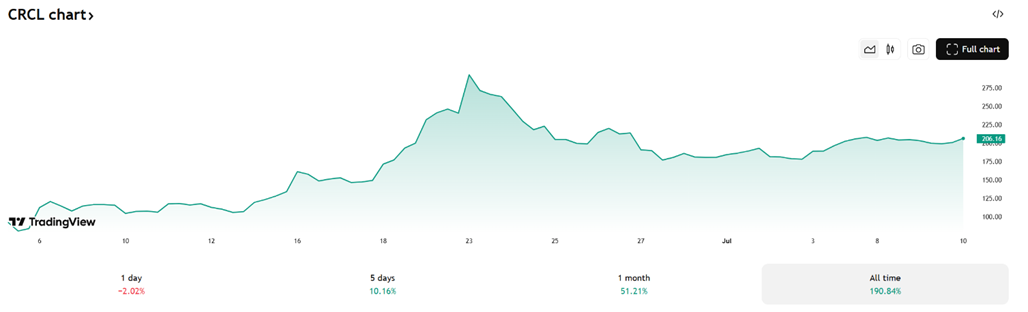
Source: TradingView 


Turning to the regulatory front, our analysis regarding the SEC’s ongoing lawsuit against Ripple (XRP) ultimately played out as described. After years of legal uncertainty, the case reached a definitive conclusion in mid-2025, with both parties dropping all remaining appeals.

 Our outlook also highlighted MicroStrategy’s prospects for joining the S&P 500. Since joining the Nasdaq-100, MicroStrategy has made steady progress toward meeting the S&P 500’s requirements. The adoption of new Financial Accounting Standards Board (FASB) rules mandating mark-to-market accounting for bitcoin, along with strong Q2 results fuelled by rising bitcoin prices, pushed its trailing 12-month Generally Accepted Accounting Principles (GAAP) net income above $11 billion, surpassing the index’s profitability threshold. Inclusion could come as early as September, depending on the S&P Index Committee’s upcoming review.


H2 predictions

1. Bitcoin will break a new ATH [probability high]

Many analysts see a consistent 4-year cycle around the Bitcoin halving, indicating a potentially bullish phase. The halving cuts mining rewards in half, slowing new bitcoin supply and increasing scarcity, which has historically boosted prices. Long-term indicators suggest the cycle top is not yet reached. According to Matthew Weller, key levels to watch are $118,000 (127.2% Fibonacci extension) and $131,000 (161.8% Fibonacci extension).

From a macroeconomic perspective, monetary policy remains supportive, though global easing may be nearing its peak. Central banks continue cutting rates but at a slower pace. Major banks like the ECB are expected to probably keep easing, just more gradually.

Meanwhile, fiat money growth is becoming more stimulative. “M2,” which measures total money supply including cash, checking, savings, and short-term deposits, is rising again. The graph below shows a strong correlation between M2 and bitcoin’s price with an 11-week lag. Global money supply growth fell to 1% early 2024 but rebounded above 8%. bitcoin’s role as “hard money” and a hedge against fiat inflation may support its price.

Large financial entities are buying bitcoin faster. According to Farside Investors, companies hold it as a treasury asset, and traditional investors are heavily investing in bitcoin ETFs, with total inflows nearing $50 billion. If this continues, bitcoin’s price dips may be smaller.
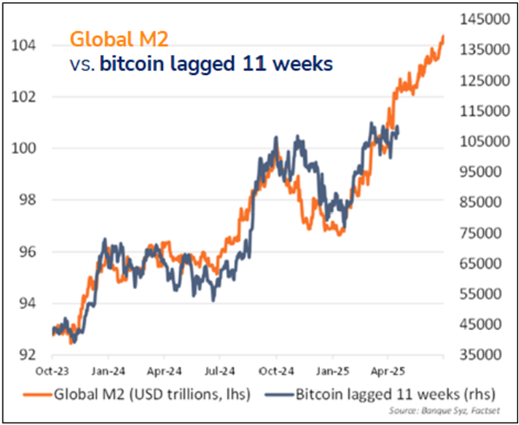
Source: Banque Syz, FactSet

2. Ethereum ETFs powering Ethereum price [probability high]

On June 30, Robinhood announced via X it is building “Robinhood Chain” on Arbitrum to “power the future of asset ownership.” Although no launch date was given, choosing Ethereum’s leading Layer-2 solution strengthens Ethereum’s role at the heart of tokenised finance. The Ethereum Foundation echoed this, stating: “Ethereum is for tokenised stocks.”

Building on this, Bitwise CIO Matt Hougan shares a bullish outlook: “Flows into Ethereum ETFs will accelerate significantly in H2. The mix of stablecoins and stocks on Ethereum is an easy narrative for traditional investors”. He highlighted $1.17 billion in Ethereum ETF inflows in June alone and suggested H2 2025 could bring even larger totals.

Analysts agree that the merging of stablecoins, tokenised equities, and staking on Ethereum offers a strong use case for institutional capital. With nearly 30% of ETH supply locked in staking and Layer-2 usage rising, Ethereum is increasingly seen as the base layer for real-world asset tokenisation. Traders are eyeing the $2,800 resistance level, which if surpassed, could boost bullish momentum into H2.
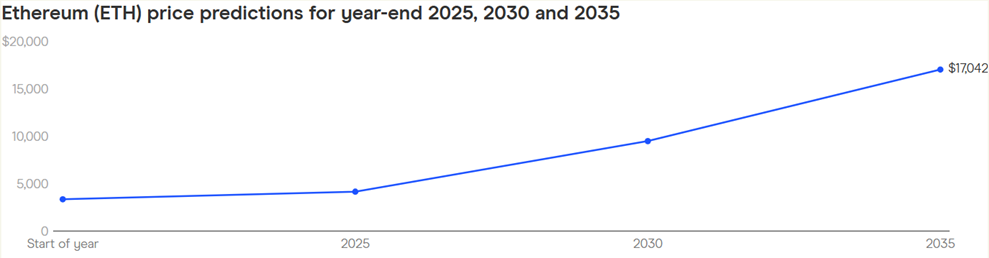
Source: Finder

3. Stablecoins about to upend the Visa & Mastercard duopoly [probability low]

The new GENIUS Act, passed by the US Senate in June and soon to be reviewed by Congress, represents the most ambitious federal effort to date to regulate stablecoins. It requires all stablecoins to be backed 1:1 by dollars and audited regularly. The legislation aims to bring legal clarity, financial stability, and consumer protection to an industry that has rapidly scaled without uniform oversight. Internationally, the bill asserts US leadership in setting global digital asset norms, especially as China is pushing for an international e-Yuan. It aligns with the European Union’s MiCA framework and requires foreign stablecoins seeking access to the US market to meet comparable standards.

Major retailers like Walmart, Amazon, Expedia, as well as some major airlines, are now exploring their own US dollar-backed stablecoins to reduce interchange fees and potentially bypass card networks. Even without full displacement, the threat of stablecoin alone could give merchants more leverage to negotiate lower fees with Visa and Mastercard. Visa and Mastercard are actively adapting. Visa has piloted settlements in stablecoins like USDC, and both firms are exploring blockchain solutions to modernise areas like cross-border payments.

But history shows that displacing Visa and Mastercard is no easy task. Past efforts by large technology firms and retailer consortia have failed to meaningfully erode their dominance. Global acceptance, extensive merchant relationships, and deeply integrated technology infrastructure provide a structural advantage that is difficult to replicate.  
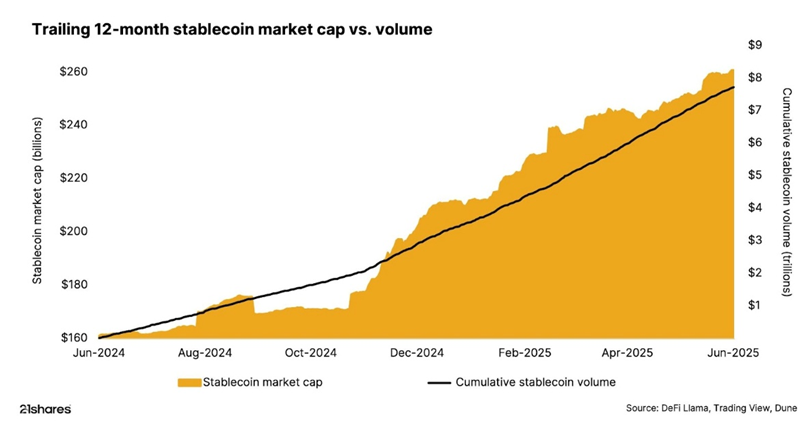
Source: 21shares
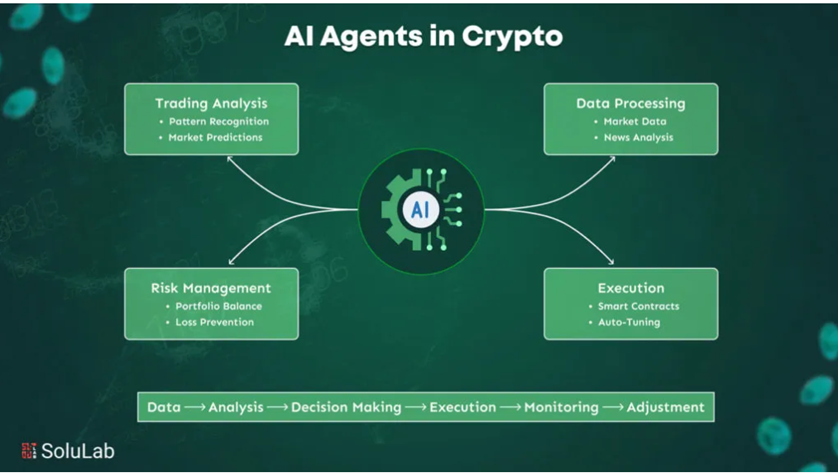
4. AI-powered DeFi 3.0 protocols will accelerate [probability medium]

Total Value Locked (TVL) in DeFi jumped to $112 billion in June 2025. Decentralised Exchanges (DEXs) such as Uniswap and PancakeSwap have seen record network activity. Now, artificial intelligence is driving the next phase of innovation in DeFi. Protocols like Fetch.ai (FET), SingularityNET (AGIX), and Bittensor (TAO) deploy smart agents that automate trading, manage risk, and optimise yield by leveraging real-time blockchain data. These protocols run on blockchain networks and use crypto tokens for incentives, governance, and access to services.

By introducing a new generation of features from self-learning trading bots to automated smart contract auditing and intelligent liquidity management, these AI protocols are making DeFi more efficient, accessible, and attractive to a broader range of crypto users, conceivably hinting at massive future potential for the niche AI-tokens.

Source: SoluLab


5. NFTs: Moving beyond hype toward market maturity [probability low] 

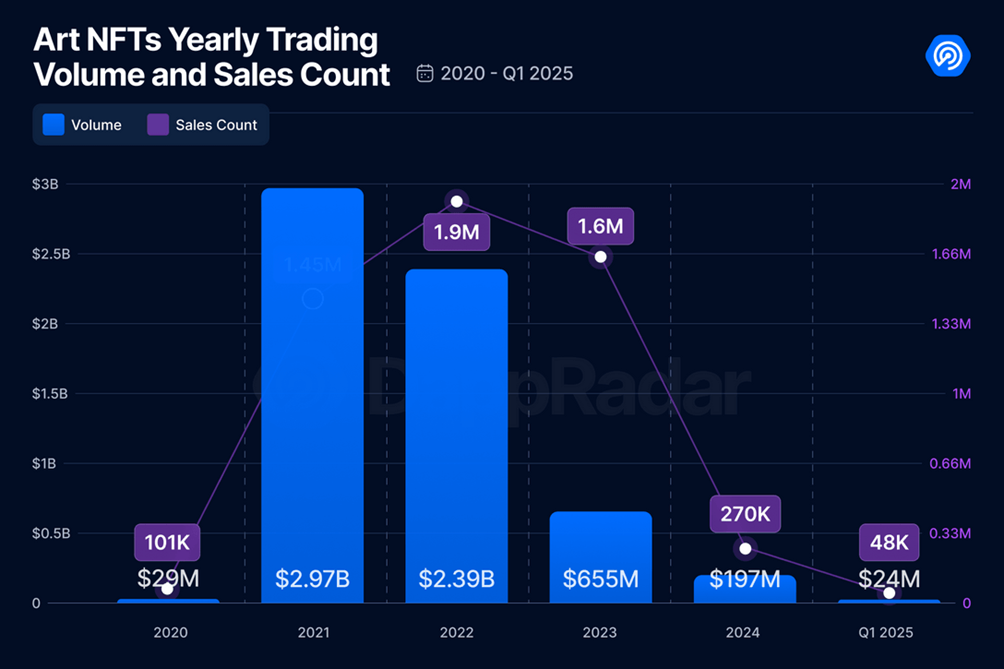
According to DappRadar, the Art NFT boom has sharply declined as active traders dropped from a peak of 529,101 in 2022 to only 19,575 in 2025. The top 20 Art NFT collections from 2021 saw volume and sales drop about 95%. Although Art NFTs once attracted mainstream attention and empowered artists financially, the sharp pullback shows the market is far from recovering. The decline reflects shifting sentiment and a move toward a more cautious, niche collector base in 2025.

On the other hand, Bitcoin NFTs, known as Ordinals, surged with average prices rising 896% from $63 in 2023 to $633 in early 2025. Since 2023, Ordinals have become strong competitors to Ethereum’s art NFTs. Their price growth reflects rising demand tied to Bitcoin’s digital gold status and blockchain prestige. While Bitcoin and Ethereum dominate the high-end market, Polygon remains a more accessible, eco-friendly choice for smaller community projects. Buyer-to-seller ratios might indicate a shift from frenzy to steady activity with a loyal collector base.

The Art NFT market is not dead but is maturing, shifting from hype to a focused, value-driven niche similar to traditional art.
 

Source: DappRadar


6. Wild Card: On-chain reputation and identity systems will see breakthrough adoption [probability low]

Worldcoin, the iris‑scanning identity project from Sam Altman’s Tools for Humanity, opened six US Orb‑scan centres in May 2025. The Orb, a spherical device, captures a user’s iris to generate an encrypted “IrisCode,” aiming to prove human identity online. It offers iris scans in exchange for a global “World ID” and free WLD tokens. World also announced plans to launch a Visa-backed debit card in the US later this year. The card is designed to act as a bridge between World’s crypto tokens and traditional fiat currencies, allowing users to spend their World tokens anywhere Visa is accepted.

Meanwhile, Polygon ID leverages zero‑knowledge proofs (ZKPs) to let users prove facts about themselves, such as age, creditworthiness, or on-chain reputation, without exposing sensitive underlying data. With this approach, encrypted claims are stored off-chain, while only cryptographic hashes are anchored on-chain, safeguarding both privacy and data integrity

However, privacy, ethical, and regulatory concerns, especially around biometric consent and data storage, mean adoption will remain limited in H2 2025. Web3-native circles may see incremental growth, though breakthrough mainstream usage is not expected this year.

Source: Business Wire


Disclaimer

This marketing document has been issued by Bank Syz Ltd. It is not intended for distribution to, publication, provision or use by individuals or legal entities that are citizens of or reside in a state, country or jurisdiction in which applicable laws and regulations prohibit its distribution, publication, provision or use. It is not directed to any person or entity to whom it would be illegal to send such marketing material. This document is intended for informational purposes only and should not be construed as an offer, solicitation or recommendation for the subscription, purchase, sale or safekeeping of any security or financial instrument or for the engagement in any other transaction, as the provision of any investment advice or service, or as a contractual document. Nothing in this document constitutes an investment, legal, tax or accounting advice or a representation that any investment or strategy is suitable or appropriate for an investor's particular and individual circumstances, nor does it constitute a personalized investment advice for any investor. This document reflects the information, opinions and comments of Bank Syz Ltd. as of the date of its publication, which are subject to change without notice. The opinions and comments of the authors in this document reflect their current views and may not coincide with those of other Syz Group entities or third parties, which may have reached different conclusions. The market valuations, terms and calculations contained herein are estimates only. The information provided comes from sources deemed reliable, but Bank Syz Ltd. does not guarantee its completeness, accuracy, reliability and actuality. Past performance gives no indication of nor guarantees current or future results. Bank Syz Ltd. accepts no liability for any loss arising from the use of this document.

Read More

Straight from the Desk

Syz the moment

Live feeds, charts, breaking stories, all day long.

Thinking out loud

Sign up for our weekly email highlighting the most popular posts.

Follow us

Thinking out loud

Investing with intelligence

Our latest research, commentary and market outlooks