
.png)
Fading hype(rscalers) for bottlenecks
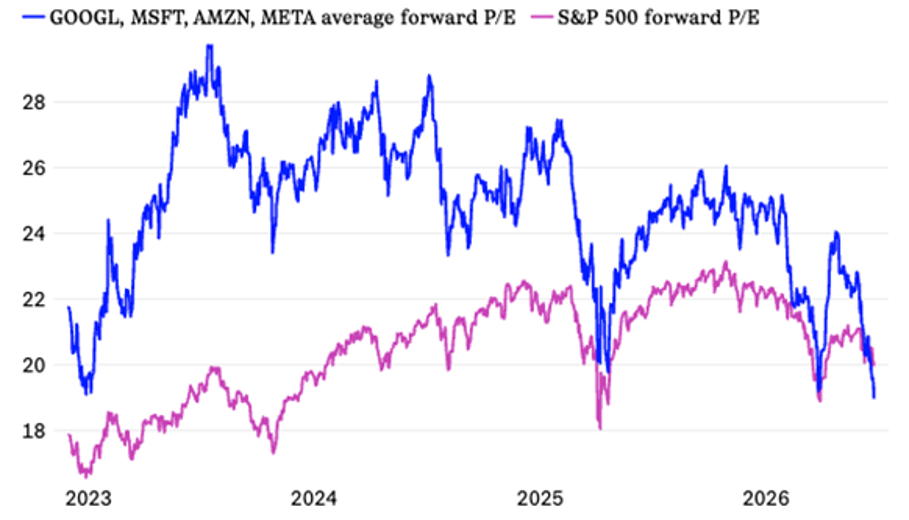 Source: Bloomberg, Sherwood

We are sorry that for legal reasons we are not able to help US citizens or Canadian residents other than in Ontario, Quebec, or Alberta. Best wishes for the future…
We are sorry that for legal reasons we are not able to help US citizens or Canadian residents other than in Ontario, Quebec, or Alberta. Best wishes for the future…
You chose the following profile. If you made a mistake, please change here USA
This marketing document has been issued by Bank Syz Ltd. It is not intended for distribution to, publication, provision or use by individuals or legal entities that are citizens of or reside in a state, country or jurisdiction in which applicable laws and regulations prohibit its distribution, publication, provision or use. It is not directed to any person or entity to whom it would be illegal to send such marketing material.
This document is intended for informational purposes only and should not be construed as an offer, solicitation or recommendation for the subscription, purchase, sale or safekeeping of any security or financial instrument or for the engagement in any other transaction, as the provision of any investment advice or service, or as a contractual document. Nothing in this document constitutes an investment, legal, tax or accounting advice or a representation that any investment or strategy is suitable or appropriate for an investor's particular and individual circumstances, nor does it constitute a personalized investment advice for any investor.
This document reflects the information, opinions and comments of Bank Syz Ltd. as of the date of its publication, which are subject to change without notice. The opinions and comments of the authors in this document reflect their current views and may not coincide with those of other
Syz Group entities or third parties, which may have reached different conclusions. The market valuations, terms and calculations contained herein are estimates only. The information provided comes from sources deemed reliable, but Bank Syz Ltd. does not guarantee its completeness, accuracy, reliability and actuality. Past performance gives no indication of nor guarantees current or future results. Bank Syz Ltd. accepts no liability for any loss arising from the use of this document.
Fading hype(rscalers) for bottlenecks
Source: Bloomberg, Sherwood
Global markets
From Friday 19 to Friday 26 June 2026, global equity markets endured a sharp but differentiated sell-off, driven by a sudden reassessment of AI-related valuations against a backdrop of a hawkish Federal Reserve pivot. The MSCI ACWI retreated 2.2%, with damage concentrated almost entirely in growth and technology. The week was defined less by what broke than by what held: healthcare, financials, consumer staples, and small-cap stocks all delivered positive or near-flat returns, pointing to a broadening of the market even as its most celebrated sub-sector came under pressure.
The trigger was a loss of confidence in the sustainability of AI capex at current valuations. High-profile talent departures from Alphabet raised uncomfortable questions about competitive moats within Big Tech, while the structural concern was broader: combined hyperscaler capex now exceeds $450 billion in 2026, yet investors find it increasingly difficult to identify a proportionate return. This fed directly into rate anxiety — the Fed had already shifted its tone at its June meeting, signalling a possible rate increase by year-end, and May PCE data offered no comfort, with core at 3.4% YoY and headline at 4.1%.
US
The divergence within US equities was stark. The Nasdaq 100 fell 4.2% and the S&P 500 declined 1.9%, but the Russell 2000 rose 1.0% and the equal-weighted S&P gained 1.6%. The S&P 500 Value index was essentially flat while Growth shed 3.7%, underscoring the sharpest style divergence of the year so far — a configuration rarely seen outside genuine regime shifts. The technology sector dropped 5.1%, semiconductors shed 7.7%, and the Magnificent Seven fell 5.9%. The beneficiaries were strikingly defensive: healthcare surged 7.9%, insurance rose 5.3%, regional banks gained 4.9%, and consumer staples added 2.5%. The anticipated delay to OpenAI's public debut reinforced concerns about the market's ability to absorb lofty AI valuations, making capital-light defensive businesses relatively more attractive. Micron's blowout fiscal third-quarter earnings provided a partial counternarrative late in the week, but were insufficient to reverse the trend for the semiconductor complex.
Europe
European equities were not spared, though the continent's more defensive index composition cushioned the blow. The STOXX Europe 600 declined 0.9% in local currency terms, with the DAX off 1.9% and the CAC 40 losing 1.1%; the FTSE MIB underperformed with a fall of 3.3%. The UK ended the period in positive territory. European semiconductor names — STMicroelectronics, Infineon, ASMI, and ASML — all suffered significant declines as the chip sell-off rippled through the region, while defence stocks also reversed sharply amid renewed uncertainty around the Middle East ceasefire. The outperformers mirrored the US rotation: staples gained 6.0% and healthcare added 5.8%. The ECB's latest consumer survey, which showed eurozone inflation expectations falling to 3.5% for the year ahead, offered a supportive backdrop for domestically oriented names, and Swiss equities rose 2.0% on the strength of their defensive weighting.
Rest of the world
Asia was the epicentre of the week's volatility. The MSCI EM index fell 4.6%, driven by the region's heavy concentration in semiconductors and technology. The South Korean KOSPI lost over 6% as AI and memory-linked shares reversed sharply; SK Hynix briefly overtook Samsung Electronics as the country's largest company by market capitalisation before both came under heavy selling pressure later in the week, with leveraged single-stock ETFs amplifying intraday moves to the point of triggering trading halts. The TAIEX fell 5.1% on Taiwan's deep semiconductor exposure, while the TOPIX declined 3.6% and MSCI China dropped 5.9%, the latter reflecting a combination of the global tech sell-off and domestic headwinds. Brazil rose 2.5%, its commodity-heavy composition proving advantageous in a week that rewarded defensives and resources. The AI trade remains structurally intact — Micron's results confirmed as much — but the market is no longer willing to grant it unconditional valuation support.
Equity asset class
We maintain equity exposure at the upper end of our neutral allocation range.
Earnings
After a strong Q1 earnings season and upward guidance revisions, 2026 earnings expectations have been revised higher across all major regions and are now running at double-digit growth rates. Operating margins have reached all-time highs and continue to accelerate.
Valuation
Although equity prices have reached new record highs, forward P/E multiples have edged lower because EPS growth has outpaced share price gains. Valuations remain above historical averages in the S&P 500 and Nikkei, while the STOXX Europe 600 and Asia ex-Japan look relatively more attractive.
Risks
The main risk to this constructive view is a renewed rise in rates and inflation expectations, which could compress multiples and pressure valuations.
This marketing document has been issued by Bank Syz Ltd. It is not intended for distribution to, publication, provision or use by individuals or legal entities that are citizens of or reside in a state, country or jurisdiction in which applicable laws and regulations prohibit its distribution, publication, provision or use. It is not directed to any person or entity to whom it would be illegal to send such marketing material. This document is intended for informational purposes only and should not be construed as an offer, solicitation or recommendation for the subscription, purchase, sale or safekeeping of any security or financial instrument or for the engagement in any other transaction, as the provision of any investment advice or service, or as a contractual document. Nothing in this document constitutes an investment, legal, tax or accounting advice or a representation that any investment or strategy is suitable or appropriate for an investor's particular and individual circumstances, nor does it constitute a personalized investment advice for any investor. This document reflects the information, opinions and comments of Bank Syz Ltd. as of the date of its publication, which are subject to change without notice. The opinions and comments of the authors in this document reflect their current views and may not coincide with those of other Syz Group entities or third parties, which may have reached different conclusions. The market valuations, terms and calculations contained herein are estimates only. The information provided comes from sources deemed reliable, but Bank Syz Ltd. does not guarantee its completeness, accuracy, reliability and actuality. Past performance gives no indication of nor guarantees current or future results. Bank Syz Ltd. accepts no liability for any loss arising from the use of this document.
Global equity markets performance between 26 June–3 July 2026 was marked by a partial unwind of an unprecedented Q2 chip rally, a softer US jobs report that eased near-term Fed tightening expectations, a European defence-and-industrials rally ahead of the NATO Ankara summit, and extreme volatility in South Korean chipmakers that dragged emerging markets sharply lower.
A weekly review of global equity markets for the period ending 12 June 2026, covering the impact of renewed US-Iran tensions and the ECB's first rate hike since 2023 on regional equity performance, the rotation away from mega-cap technology into financials and cyclicals, and the significance of the SpaceX IPO as a landmark moment for the AI infrastructure investment cycle.
Global equity markets fell broadly in the week ending 5 June 2026, with the MSCI ACWI down 2.2% as three headwinds converged simultaneously: a stronger-than-expected US jobs report that pushed Fed rate hike pricing sharply higher, Broadcom's below-consensus AI chip guidance that rattled the semiconductor complex, and renewed Middle East tensions as ceasefire efforts in Lebanon faltered. Technology and consumer discretionary bore the brunt of the selloff, while energy and financials outperformed. In Europe, defence stocks reversed sharply on de-escalation signals. South Korea was the worst-performing major market, with MSCI Korea down 5.3%, while China proved a rare exception, edging modestly higher.
Live feeds, charts, breaking stories, all day long.
Our latest research, commentary and market outlooks