
.png)
The AI Battle: Chips 1, Software 0

We are sorry that for legal reasons we are not able to help US citizens or Canadian residents other than in Ontario, Quebec, or Alberta. Best wishes for the future…
We are sorry that for legal reasons we are not able to help US citizens or Canadian residents other than in Ontario, Quebec, or Alberta. Best wishes for the future…
You chose the following profile. If you made a mistake, please change here USA
This marketing document has been issued by Bank Syz Ltd. It is not intended for distribution to, publication, provision or use by individuals or legal entities that are citizens of or reside in a state, country or jurisdiction in which applicable laws and regulations prohibit its distribution, publication, provision or use. It is not directed to any person or entity to whom it would be illegal to send such marketing material.
This document is intended for informational purposes only and should not be construed as an offer, solicitation or recommendation for the subscription, purchase, sale or safekeeping of any security or financial instrument or for the engagement in any other transaction, as the provision of any investment advice or service, or as a contractual document. Nothing in this document constitutes an investment, legal, tax or accounting advice or a representation that any investment or strategy is suitable or appropriate for an investor's particular and individual circumstances, nor does it constitute a personalized investment advice for any investor.
This document reflects the information, opinions and comments of Bank Syz Ltd. as of the date of its publication, which are subject to change without notice. The opinions and comments of the authors in this document reflect their current views and may not coincide with those of other
Syz Group entities or third parties, which may have reached different conclusions. The market valuations, terms and calculations contained herein are estimates only. The information provided comes from sources deemed reliable, but Bank Syz Ltd. does not guarantee its completeness, accuracy, reliability and actuality. Past performance gives no indication of nor guarantees current or future results. Bank Syz Ltd. accepts no liability for any loss arising from the use of this document.
The AI Battle: Chips 1, Software 0
Global markets
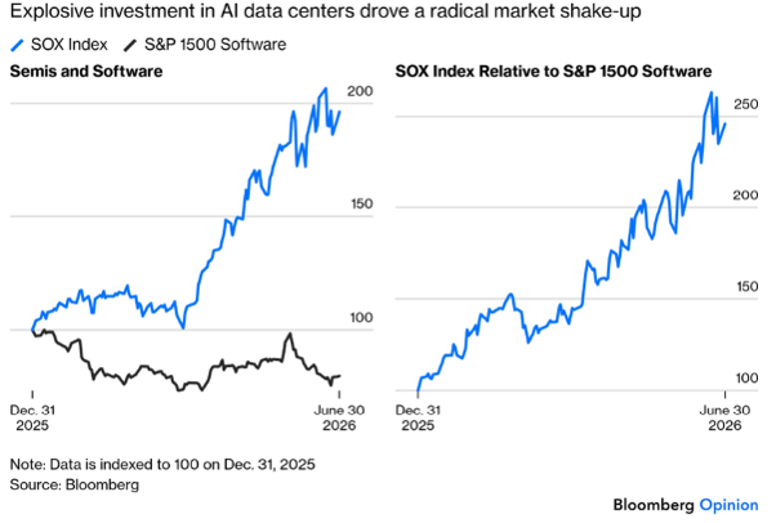
From Friday 26 June 2026 to Friday 3 July 2026, global equities posted modest aggregate gains that concealed a sharp rotation beneath the surface. The clearest signal came from factor performance: the S&P 500 Momentum index tumbled 5.5% as some of the most crowded positions of the first half - chiefly AI-linked semiconductor stocks - were aggressively unwound. Because both the week's winners (software, health care) and losers (semiconductors) sit within the Growth style, the MSCI AC World Growth (+1.1%) and Value (+0.9%) indices moved in lockstep - masking, rather than contradicting, how violent the shift was. The broader MSCI AC World index rose 1.0% in US dollar total-return terms.
The catalyst was renewed scrutiny of AI infrastructure economics. Reports that OpenAI was in talks to sell a 5% stake to the US government, alongside signs Meta might monetise surplus data-centre compute capacity, reignited hyperscaler capex-payback concerns and triggered heavy mid-week selling in semiconductors even as broader indices held up. The move also unwound part of an extraordinary second-quarter trend: chip stocks had staged their strongest quarterly rally on record through 30 June, while software lagged badly amid concerns that agentic AI could erode traditional licensing models. That the reversal emerged in the first days of a new quarter suggests rebalancing and profit-taking flows may have amplified it, alongside the genuine capex concerns.
Macro developments provided an offsetting tailwind. A softer-than-expected US June payrolls report - just 57,000 jobs against a 115,000 consensus, with material downward revisions to prior months - pushed back expectations for near-term Fed tightening and underpinned risk appetite into the holiday-shortened close. Fed Chair Kevin Warsh, speaking at the ECB's Sintra forum, reiterated that inflation remained "too high" but stopped short of signalling near-term action. Crude oil's continued retreat from above $90 a barrel in early June, as the Iran-related risk premium kept fading, eased a further inflation concern.
The rotation played out globally: MSCI Emerging Markets fell 4.0% even as the internet-focused EMQQ index gained 6.0%, underlining how a concentrated, single-country chip story - not a broad emerging-market growth scare - drove the divergence. That the STOXX Europe 600 (+1.9%) and S&P 500 (+1.7%) both advanced suggests the wobble was, for now, a rotation rather than a broad risk-off event.
US
US equities advanced over the four sessions to Thursday's close (markets were shut Friday for Independence Day), with the S&P 500 up 1.7% and the Dow gaining 1.9% to a fresh record high, aided by strength in Apple. The S&P 500 Equal-Weighted index rose 1.5%, broadly in line with the cap-weighted benchmark and indicative of participation beyond the mega-caps, while the Russell 2000 slipped 0.3%, reflecting positioning and sector mix rather than a clean read-through from softer rate expectations.
The dominant story was semiconductors. The iShares Semiconductor ETF fell 9.4% as Micron, Applied Materials and AMD were marked down on renewed concern that memory-chip capacity additions and AI capex were running ahead of near-term demand. Technology fell 2.1% overall, yet the Roundhill Magnificent Seven ETF still gained 6.6%, as strength in Apple offset a Meta decline tied to the compute-monetisation reports. Metals & Mining separately dropped 4.0%, weighed down by gold miners as bullion extended its slide on dollar strength and fading safe-haven demand - unrelated to the chip selloff. Tesla reported blowout Q2 deliveries of 480,126 vehicles, well ahead of Street estimates near 400,000, but the stock still fell as the beat met a "sell the news" reaction after shares had already rallied into the print. Health Care (+5.3%) and Insurance (+8.4%) led gains, while Cybersecurity (+14.8%) and Software (+10.4%) benefited from rotation into less crowded pockets of technology.
Europe
European equities extended their outperformance, with the MSCI Europe index up 1.9% and Germany the standout market: the DAX and MDAX both rose 4.9% in US dollar terms. Gains were led by Industrial Goods & Services (+5.6%) and defence names, with a dedicated European defence basket up 10.7% ahead of next week's NATO summit in Ankara and continuing pressure from Washington - including a Pentagon review of US force posture in Europe - for allies to accelerate rearmament spending. Italy's FTSE MIB (+3.4%) and Spain's IBEX 35 (+2.8%) also outperformed, while the UK's FTSE 100 rose 2.5% and France's CAC 40 added 2.0%.
Financials were broadly firm, with Banks up 3.7% and Financial Services up 4.6%, while Insurance (+2.5%) and Health Care (+2.8%) also advanced. Telecommunications was the region's laggard, down 3.4%, and Technology gained just 1.8% as European chip names tracked weakness in US and Asian peers. The resilience of the region's more cyclical, value-oriented sectors reflects a market rewarding diversified earnings over the concentrated AI exposure that dominated returns elsewhere in the first half of the year.
Rest of the world
Emerging markets told a starkly different story, with the MSCI Emerging Markets index down 4.0% despite gains across several major constituent markets. The divergence was overwhelmingly a South Korea story: Samsung Electronics and SK Hynix, now roughly half the Kospi's weight after this year's AI-memory rally, suffered a week of extreme swings, including multiple trading halts, as the same AI-capex concerns weighing on US semiconductors triggered aggressive foreign selling. A sharp Friday rebound - helped by the soft US payrolls print and reports that Samsung was in talks with Anthropic over custom AI chip development - was not enough to offset the week's losses, leaving MSCI Korea down 17.8% and the single largest drag on the emerging-market benchmark.
Elsewhere the picture was steadier. Taiwan's TAIEX bucked the regional chip weakness to gain 5.0%, MSCI China was little changed (-0.1%), and India (-0.5%) and Japan (-0.8%) posted only modest declines. Brazil (+1.2%) and Singapore (+2.3%) advanced. The gap between the internet-focused EMQQ index, up 6.0%, and the hardware-heavy emerging-market benchmark underscores that the week's underperformance was concentrated in AI-memory supply-chain exposure rather than broader EM fundamentals or risk appetite.
Equity asset class
We maintain equity exposure at the upper end of our neutral allocation range.
Earnings
After a strong Q1 earnings season and upward guidance revisions, 2026 earnings expectations have been revised higher across all major regions and are now running at double-digit growth rates. Operating margins have reached all-time highs and continue to accelerate.
Valuation
Although equity prices have reached new record highs, forward P/E multiples have edged lower because EPS growth has outpaced share price gains. Valuations remain above historical averages in the S&P 500 and Nikkei, while the STOXX Europe 600 and Asia ex-Japan look relatively more attractive.
Risks
The main risk to this constructive view is a renewed rise in rates and inflation expectations, which could compress multiples and pressure valuations.
This marketing document has been issued by Bank Syz Ltd. It is not intended for distribution to, publication, provision or use by individuals or legal entities that are citizens of or reside in a state, country or jurisdiction in which applicable laws and regulations prohibit its distribution, publication, provision or use. It is not directed to any person or entity to whom it would be illegal to send such marketing material. This document is intended for informational purposes only and should not be construed as an offer, solicitation or recommendation for the subscription, purchase, sale or safekeeping of any security or financial instrument or for the engagement in any other transaction, as the provision of any investment advice or service, or as a contractual document. Nothing in this document constitutes an investment, legal, tax or accounting advice or a representation that any investment or strategy is suitable or appropriate for an investor's particular and individual circumstances, nor does it constitute a personalized investment advice for any investor. This document reflects the information, opinions and comments of Bank Syz Ltd. as of the date of its publication, which are subject to change without notice. The opinions and comments of the authors in this document reflect their current views and may not coincide with those of other Syz Group entities or third parties, which may have reached different conclusions. The market valuations, terms and calculations contained herein are estimates only. The information provided comes from sources deemed reliable, but Bank Syz Ltd. does not guarantee its completeness, accuracy, reliability and actuality. Past performance gives no indication of nor guarantees current or future results. Bank Syz Ltd. accepts no liability for any loss arising from the use of this document.
Global equities advanced despite the week between 24-31 July despite some by sharp divergences. Big Tech earnings split investors between AI capex winners and losers, the Federal Reserve held rates amid its first multi-member dissent in decades, and oil extended its climb on escalating Middle East tensions. Korean and Taiwanese equities were rocked by extreme volatility as leveraged AI-related positioning unwound and then violently reversed, while resilient eurozone growth data and broad emerging-market strength helped underpin the wider advance. This report examines the key drivers behind the past week's market moves, with a focus on US mega-cap earnings dispersion, the Fed's policy signals, and the forces behind Asia's dramatic swings.
Global equity markets for the period 17–24 July 2026, covering the sell-off in AI-exposed growth stocks amid capex and cash-flow concerns, a renewed spike in oil prices following Middle East escalation, and continued strength in Q2 corporate earnings across the US, Europe, and Asia. Covers performance across major indices including the S&P 500, Nasdaq 100, STOXX 600, and MSCI Emerging Markets, with sector-level detail on energy, defence, technology, and financials.
Global equity markets sold off sharply in the week to Friday 26 June 2026, as investors reassessed AI-related valuations against a backdrop of hawkish Federal Reserve signalling and sticky inflation. The MSCI ACWI fell 2.2%, with technology and semiconductors bearing the brunt of the decline — the Nasdaq 100 lost 4.2% and the iShares Semiconductor ETF shed 7.7%. The sell-off was sharpest in AI-exposed markets across North Asia, with the KOSPI and TAIEX both falling over 5%. Defensives and small-caps outperformed globally, with healthcare, insurance, and consumer staples all posting gains. Micron's record quarterly earnings provided a late-week counterpoint, but were insufficient to reverse the broader de-rating of growth assets.
Live feeds, charts, breaking stories, all day long.
Our latest research, commentary and market outlooks