


.png)
Following last night's Fed meeting on 18 March 2026:
• The Fed kept its policy rate at 3.50–3.75% unchanged amid the current energy price surge. The committee signalled a wait-and-see approach for now as uncertainty is high and the assessment of the current shock is not possible due to the unknown duration and level of the price shock.
• There was only one dissenter, Stephan Miran, who voted once again for a rate cut, but the other “dovish” FOMC members like Waller and Bowman voted in line with the majority to keep rates stable.
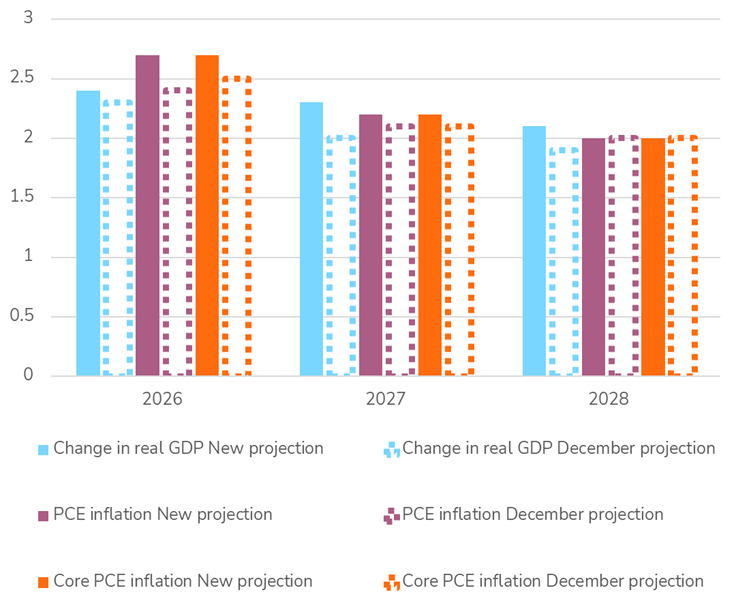
• The FOMC increased its projections for inflation tangibly, expecting now a core PCE inflation (without energy and food prices) at 2.7% instead of 2.5% in 2026. Despite this, most Fed members still expect the committee to deliver one key rate cut this year, looking through the crisis for now and indicating a somewhat dovish shift.
• Chair Powell did not fully agree to “look through” the current energy price shock at the press conference but said that as long as medium to longer-term inflation expectations will stay well anchored, theory would tell to do so.
• Interestingly, Powell explained during the press conference that he will stay at the Fed Board of Governors as long as a criminal investigation is taking place, and that he will serve as a pro-tempore Chair until Trump’s Fed Chair nominee, Kevin Warsh, is confirmed.
• Of course, the ongoing conflict in the Middle East can change the picture dramatically with any further escalation, but currently, we still expect to see a rather short-lived conflict which should allow energy prices to normalise next month and the Fed to conduct at least one rate cut this year.
Will the Fed “look through” the current energy price shock and how does it assess the conflict’s impact on the economy?
The committee left the statement barely unchanged. It added a line stating that the “implications of developments in the Middle East for the US economy are uncertain”. Later, Chair Powell emphasised the high uncertainty they must operate in. He gave no hint to where the committee currently expects the conflict to lead to, nor offered further details about how it assessed the shock. The only message was, that in theory, such shocks should be one-offs, and central banks usually look through them, seeing the light at the end of the tunnel. However, he also mentioned that the Fed is concerned about the fact that inflation is now above target for 5 years, and that it was even highly elevated in some of them. He stressed to carefully monitor inflation expectations, particularly in the medium and longer term. As long as they remain well anchored, “looking through” is possible and only time can tell how the current energy crisis will develop. If it filters into the broad economy or not.
How did the Fed’s assessment of the economic outlook change?
The Fed did adjust during the meeting its so-called summary of economic projections (SEP). Interestingly, it increased its median projection for growth only slightly from 2.3% to 2.4% in 2026, kept the unemployment rate steady at 4.4% but lifted its core inflation outlook from 2.5% to 2.7% (core PCE without energy and food prices, see chart below). Nevertheless, the committee did not change its outlook for the key rate, still expecting one rate cut this year. This indicates looking through the current energy price surge, as despite higher inflation projections the rate cut remains included in the outlook.
Does the current energy crisis make the Fed’s position even more delicate?
After 5 years of inflation readings above the Fed’s target of 2%, and in the years after the pandemic even with a peak of close to 9%, the committee is currently between a rock and a hard place. It becomes even more difficult as long as the inflationary pressures due to the Middle East conflict remain in place or get worse. The committee needs to make sure that financial markets still believe in the Fed’s ability to bring inflation back to its target. The latest escalation of the conflict due to Israel’s bombing of a large energy facility in Iran as well as Iran’s retaliation to GCCs oil fields—which pushed oil prices again higher—will increase the Fed’s worries about inflation. This on top of the still existing underlying price pressures that surfaced today in form of another producer price index that came in tangibly above markets expectations. On the other hand, Chair Powell explained today that he still sees the US labour market in gradually weakening conditions if new jobs remain so rare. He added that this is his take even though the job market seems to have found a new equilibrium so far with much less new jobs created but also equally less people searching for a job, as the steady unemployment rate signals.
How is the economy going besides the spike in energy prices?
Most economic data, which were obviously collected in February, before the outbreak of the Middel East crisis, were still reassuring. They painted a positive picture of the US economy in general – with rather mixed data on the labour market but overall good data on economic activity and business sentiment. Additionally, Powell acknowledged that by saying the “US economy is doing pretty well”.
What happens with the Fed leadership?
Although Chair Powell’s term will end in May and President Trump nominated Kevin Warsh to become the next Fed Chair, the confirmation by the US Senate might still take a while. Republican Senator Tillis, member of the Senates Banking Committee, vowed not to confirm Warsh as long as there are investigations against Powell going on. Asked about the matter, Powell stated simply that he will remain a pro-tempore Chair until Trump’s Fed Chair nominee, Kevin Warsh, is confirmed. Furthermore, he will remain on the Board of Directors until the investigations against him have been concluded. He added, that beyond that, he did not yet decide if he would serve for the whole term on the board, which would officially end at the beginning of 2028. This is important because of the potential shift in the power balance of the Board of Governors. If Powell stays on the board, there will be 4 more traditional central bankers, Barr, Jefferson, Cook and Powell, all of them less prone to deregulation. On the other side, there were 3 Governors – Miran or the new Chair, Waller and Bowman, who will likely vote in favour of a more dovish monetary policy and favour more de-regulation within the financial sector as called for by President Trump. If Powell leaves the Board, President Trump could nominate another governor and shift the power balance in his favour, 4 to 3. However, aside of the deregulation, the Fed's decision on key interest rates is made by the 12 members of the FOMC, which consists of the seven Fed governors and the five regional Fed voting members. Hence, the key interest rate decision cannot be substantially influenced with one more dovish member at the Board of Governors, even if it is the chair.
What will the Fed do next?
As we and the Fed seem to assess the US economy to be on a good underlying trajectory in terms of growth and economic activity, all eyes are currently focused on the duration and the degree of the current conflict in the Middle East. The latest escalation of the attacks on energy facilities on both sides pushed energy prices even higher. This is negative for growth and pulls inflation pressures even higher. Still, as US President Trump and the Republican party are currently facing a downward trend in the polls regarding the mid-term elections in November, we expect the US government to be willing to end the conflict rather sooner than later and to bring down energy prices. As gas prices approach the important psychological threshold of 4 USD per gallon, and amid the current “affordability crisis” among lower income households, we cannot imagine US President Trump does not feel the pressure to find a swift solution. Also, the other major geopolitical player, China, who is sourcing a lot of its oil imports from Iran, is not interested in higher energy prices for longer as well. Hence, we still expect as our baseline scenario to see a de-escalation of the conflict that should also lower energy prices substantially back to more “normal” levels closer to before the outbreak of the conflict. In this scenario, we expect the Fed to be able to deliver at least one rate cut this year. However, the longer the conflict stays, or even escalates more, the higher the probability of an inflation shock and of inflation expectations for the medium to longer term to dis-anchor. That would be the moment when we expect the Fed to pivot and to start to prepare markets for a rate hike. However, this is currently not our base case and only time can tell, in which direction we will be heading to.
Chart 1: The Fed keeps the key rate unchanged as inflation remains above the 2% target and unemployment low at 4.4%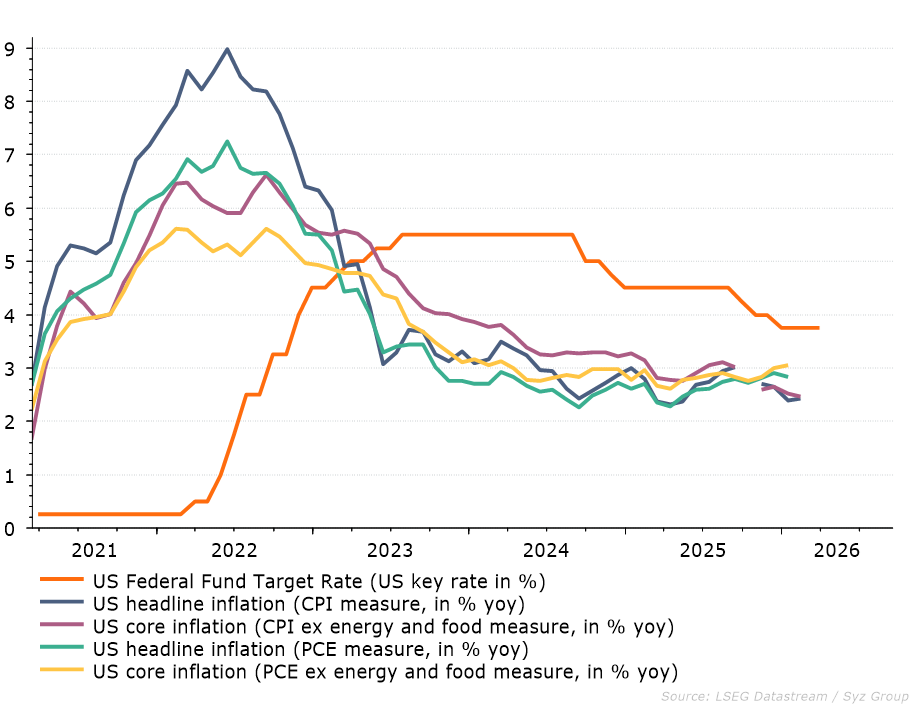
Chart 3: Short term inflation expectations surged lately, but longer-term expectations still stayed “well anchored” so far
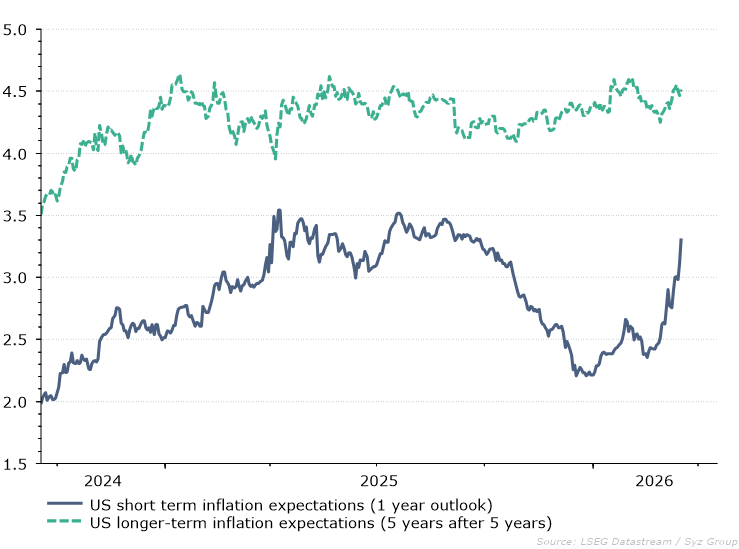
Chart 2: The Fed member’s economic projections signal more inflation and growth but still one rate cut during 2026
Disclaimer
This marketing document has been issued by Bank Syz Ltd. It is not intended for distribution to, publication, provision or use by individuals or legal entities that are citizens of or reside in a state, country or jurisdiction in which applicable laws and regulations prohibit its distribution, publication, provision or use. It is not directed to any person or entity to whom it would be illegal to send such marketing material. This document is intended for informational purposes only and should not be construed as an offer, solicitation or recommendation for the subscription, purchase, sale or safekeeping of any security or financial instrument or for the engagement in any other transaction, as the provision of any investment advice or service, or as a contractual document. Nothing in this document constitutes an investment, legal, tax or accounting advice or a representation that any investment or strategy is suitable or appropriate for an investor's particular and individual circumstances, nor does it constitute a personalized investment advice for any investor. This document reflects the information, opinions and comments of Bank Syz Ltd. as of the date of its publication, which are subject to change without notice. The opinions and comments of the authors in this document reflect their current views and may not coincide with those of other Syz Group entities or third parties, which may have reached different conclusions. The market valuations, terms and calculations contained herein are estimates only. The information provided comes from sources deemed reliable, but Bank Syz Ltd. does not guarantee its completeness, accuracy, reliability and actuality. Past performance gives no indication of nor guarantees current or future results. Bank Syz Ltd. accepts no liability for any loss arising from the use of this document.
Related Articles
Meanwhile, hedging allows oil producers to lock in profits. Each week, the Syz investment team takes you through the last seven days in seven charts.
Meanwhile, precious metals are plummeting. Each week, the Syz investment team takes you through the last seven days in seven charts.
The hot commodity of the week: oil. Each week, the Syz investment team takes you through the last seven days in seven charts.