
Charles-Henry Monchau

Chief Investment Officer

Chart #1 — 

Nvidia becomes the 1st company to hit the $5.5 trillion market cap 

Nvidia remains the global leader in terms of market capitalisation.

Over the past seven trading sessions, Nvidia’s stock has risen by roughly 20%, briefly surpassing a $5.5 trillion market cap mid-week and moving toward $6 trillion on Thursday, an unprecedented level for any company. Several factors explain this surge. The most immediate is geopolitical. Jensen Huang has joined President Trump’s Beijing delegation for talks with Xi Jinping. At the same time, Reuters reported that Washington has authorised Alibaba, Tencent, and around eight other Chinese firms to purchase Nvidia’s H200 chips. This effectively repositions China from a constrained market to a meaningful upside optionality. On the financial side, Wall Street has reinforced the bullish momentum. Bank of America raised its price target to $320 from $300, citing an expanded AI data centre TAM of $1.7 trillion by 2030. UBS also upgraded its outlook to $275, projecting Q1 revenues of $81 billion and forward guidance near $91 billion, compared with a $79 billion consensus.

Attention is now focused on earnings scheduled for May 20. Polymarket assigns a 97% probability of an earnings beat, with market expectations centred on strong guidance around Vera Rubin and hyperscaler capex projected at $650–725 billion in 2026.
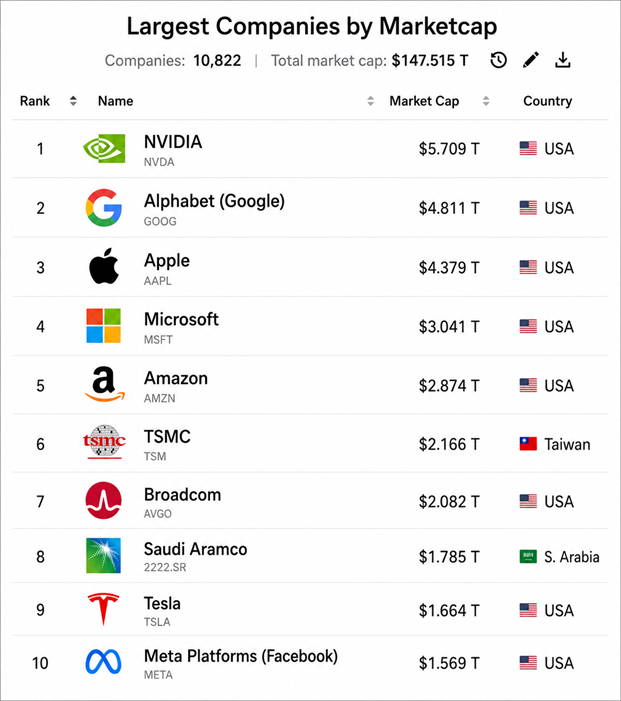

Chart #2 — 

Welcome to the K-shaped economy! 

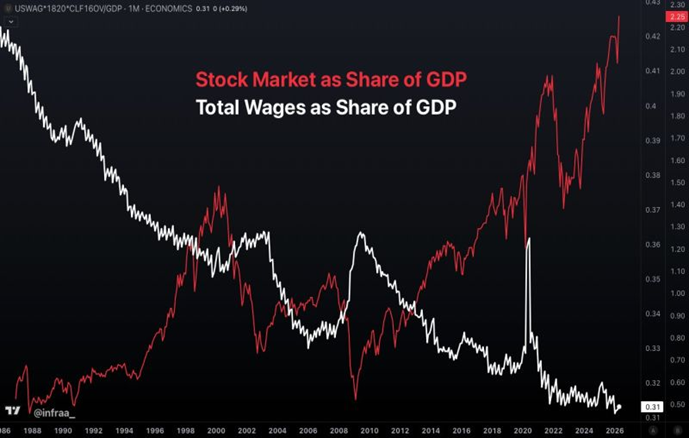
The chart below compares US stock market capitalisation as a share of US GDP (red line) with total wages as a share of GDP (white line).

The key insight is a widening divergence. For individuals relying on labour income, their share of GDP has never been lower. In contrast, those accumulating capital assets are capturing an ever-larger portion of GDP, reaching record highs.


Source: Robert infra


Chart #3 — 

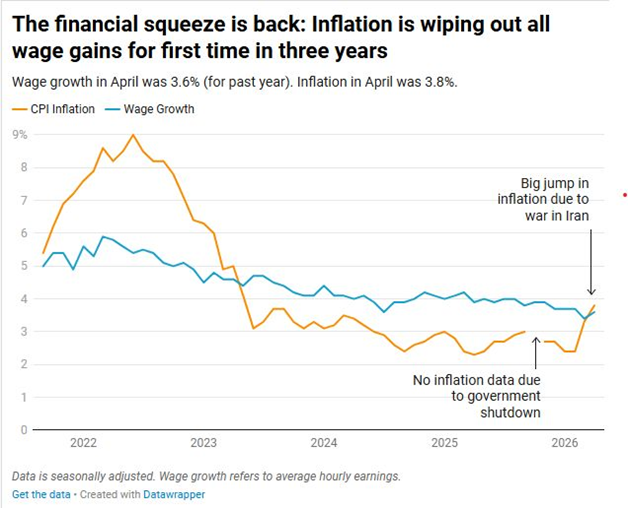
US Inflation is now outpacing wages in America for the first time in 3 years 

Before the US-Iran conflict escalated in late February, inflation stood at 2.4%. It has since climbed to 3.8% within two months, largely driven by the energy shock linked to the war.

Real average hourly wages declined by 0.5% in April alone and are now down 0.3% year-on-year. While nominal earnings are increasing, purchasing power is falling, meaning households are effectively earning more dollars but able to buy less.


Source: Bull Theory 


Chart #4 — 

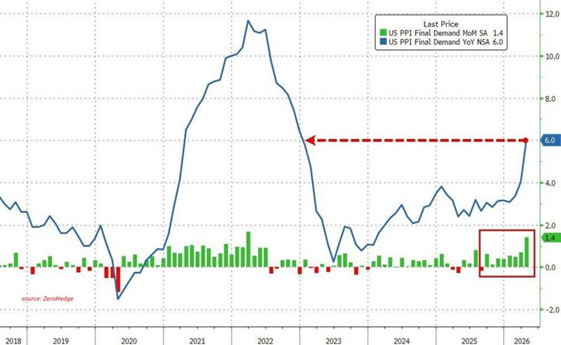
US Producer Prices are exploding 

The US Producer Price Index rose 6.0% year-on-year in April, the highest level since January 2023 and well above the 4.9% consensus forecast. On a monthly basis, prices increased by 1.4%, nearly three times the expected 0.5%. Core PPI also surged 1.0% month-on-month versus a 0.3% consensus estimate. On an annual basis, core PPI inflation is running at 5.2%, also significantly above expectations. Both headline and core readings are now at three-year highs.

Excluding food, energy, and trade, producer prices recorded their strongest annual gain in five years, signalling that upstream inflation pressures are likely to continue feeding into consumer prices. As a result, the US 30-year Treasury yield has climbed to 5.042%, just below its 19-year peak, as markets rapidly reassess the probability of future Fed rate hikes. Bond markets are increasingly pricing in a regime where inflation remains persistent. 


Source: Global Markets Investor,  www.zerohedge.com 


Chart #5 — 

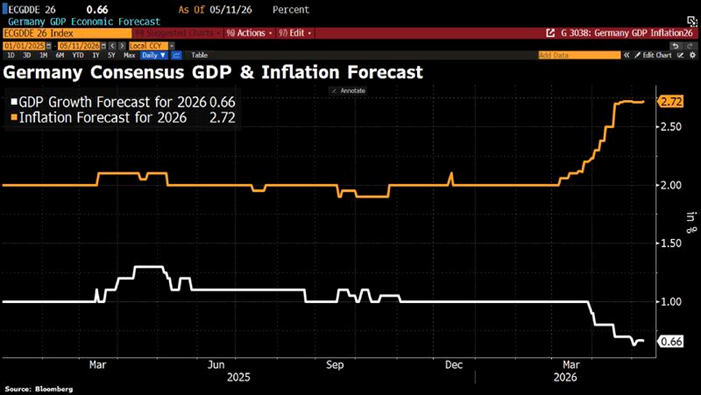
Germany appears to be heading towards stagflation 

Consensus GDP growth forecasts for 2026 have been revised downward from above 1% to just 0.66%. At the same time, expectations of inflation have increased to above 2.7%. In this environment, markets are pricing in at least two additional interest rate hikes from the ECB, reflecting growing concerns about persistent inflation combined with weak growth.


Source: HolgerZ, Bloomberg


Chart #6 —

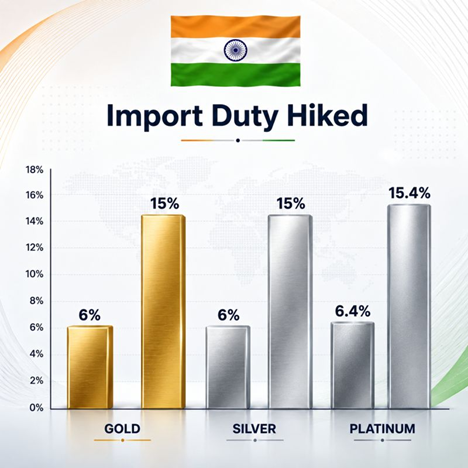
India hikes import duty on precious metals

India has increased import duties on gold and silver from 6% to 15%, as a weakening rupee and surging imports place pressure on external balances.

Gold imports reached a record $71.98 billion in FY26, while silver imports surged by 162%. The policy is expected to reduce foreign exchange outflows by $10–15 billion. However, potential side effects include higher incentives for smuggling, increased reliance on recycled supply, and stronger demand for gold-backed loans. With financial market participation rising, the move may also encourage households to shift savings away from physical gold toward financial assets, signalling a broader structural transition in savings behaviour. 


Chart #7 — 

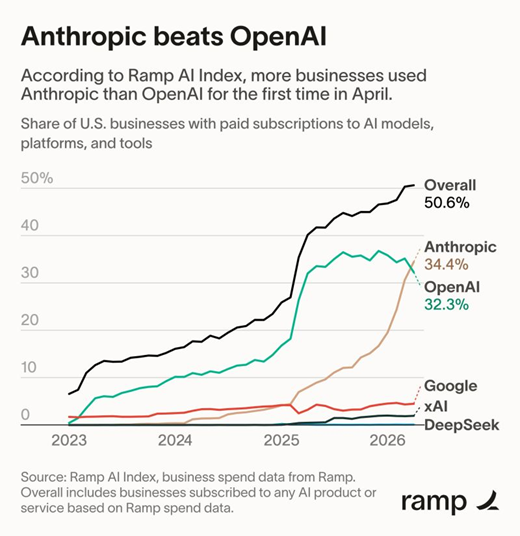
Anthropic beats OpenAI in business adoption for the first time 

An update of the Ramp AI Index shows that Anthropic is now used by 34.4% of businesses, surpassing OpenAI at 32.3%. Adoption of Anthropic has quadrupled over the past year, while OpenAI’s usage has increased only marginally by 0.3%, marking a notable shift in enterprise AI preferences. 


Source:  Ara Kharazian, Ramp


Disclaimer

This marketing document has been issued by Bank Syz Ltd. It is not intended for distribution to, publication, provision or use by individuals or legal entities that are citizens of or reside in a state, country or jurisdiction in which applicable laws and regulations prohibit its distribution, publication, provision or use. It is not directed to any person or entity to whom it would be illegal to send such marketing material. This document is intended for informational purposes only and should not be construed as an offer, solicitation or recommendation for the subscription, purchase, sale or safekeeping of any security or financial instrument or for the engagement in any other transaction, as the provision of any investment advice or service, or as a contractual document. Nothing in this document constitutes an investment, legal, tax or accounting advice or a representation that any investment or strategy is suitable or appropriate for an investor's particular and individual circumstances, nor does it constitute a personalized investment advice for any investor. This document reflects the information, opinions and comments of Bank Syz Ltd. as of the date of its publication, which are subject to change without notice. The opinions and comments of the authors in this document reflect their current views and may not coincide with those of other Syz Group entities or third parties, which may have reached different conclusions. The market valuations, terms and calculations contained herein are estimates only. The information provided comes from sources deemed reliable, but Bank Syz Ltd. does not guarantee its completeness, accuracy, reliability and actuality. Past performance gives no indication of nor guarantees current or future results. Bank Syz Ltd. accepts no liability for any loss arising from the use of this document.

Read More

Straight from the Desk

Syz the moment

Live feeds, charts, breaking stories, all day long.

Thinking out loud

Sign up for our weekly email highlighting the most popular posts.

Follow us

Thinking out loud

Investing with intelligence

Our latest research, commentary and market outlooks