

-
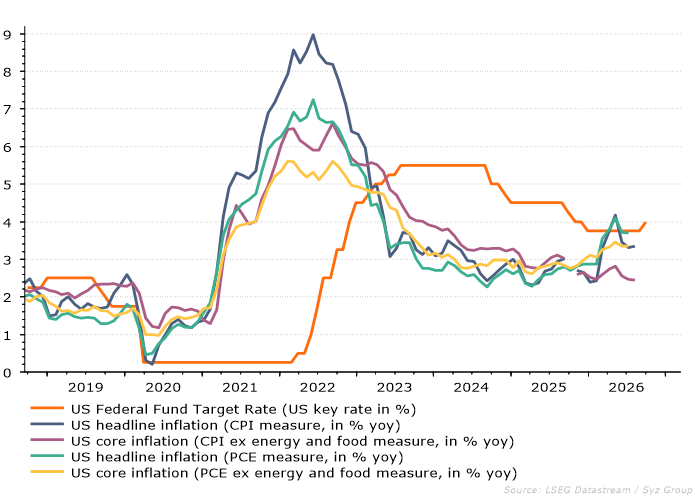
Fed decision: the FOMC unanimously raised the federal funds target range by 25 basis points to 3.75%–4.00%. The statement retained a solid growth assessment and signalled that tighter policy should help return inflation to 2%.
-
Press conference: Chair Warsh delivered a hawkish message, stressing that inflation remains “too high, and has been there for too long.” Strong growth, employment and investment give the Fed room to manoeuvre, but Warsh avoided providing any forward guidance.
-
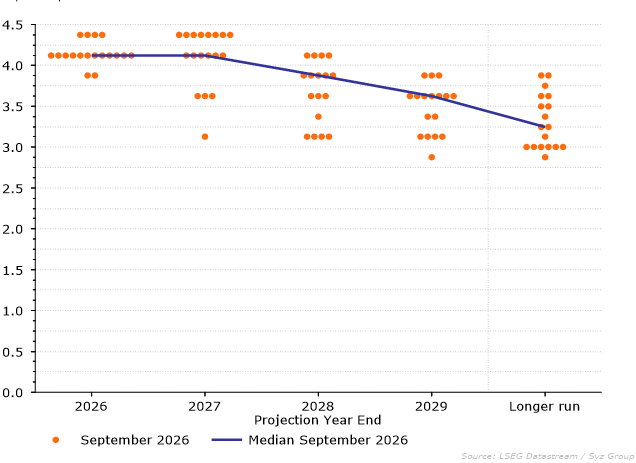
Dot plot: the projections of the FOMC members indicate one additional 25-basis-point hike in 2026, taking the median year-end rate to 4.00%–4.25%. In 2027, rates are projected to remain unchanged, while stronger growth and higher core inflation reinforce the overall message.
-
Market reaction: Warsh’s hawkish rhetoric partly surprised markets. From before the Fed decision and press conference to afterwards, the 2-year Treasury yield rose by around 7 basis points, while the 10-year yield moved back above the 5.00% threshold. The US Dollar Index gained around 0.5%, while US equities initially fell before recovering somewhat.
-
Our take: we expect one further rate hike this year, supported by resilient domestic demand, business investment and a solid labour market. However, we see this as a limited removal of accommodation, rather than the start of an aggressive hiking cycle.
The FOMC raised the federal funds target range by 25bp to 3.75%–4.00%, with the decision receiving unanimous support after three members had already favoured a hike in July. The statement maintained a solid growth assessment and highlighted resilient domestic spending and robust capital investment. At the same time, the Fed removed July’s references to energy-related supply shocks and explicitly stated that tighter policy would support a timelier return of inflation to 2%.
What Chair Warsh said at the press conference
During the press conference, Federal Reserve Chair Warsh delivered a clear message: inflation remains “too high, and has been for too long.” Recent data have provided little reassurance. Warsh noted that “this summer’s inflation readings do not tell me that underlying trends have meaningfully improved”. He added that price increases remain broad across numerous CPI and PPI categories. According to Warsh, three factors explain the shift from July’s decision to keep rates unchanged to September’s unanimous increase. Economic activity and the labour market have remained strong, inflation has stayed persistently elevated, and geopolitical developments have altered the outlook. Together, these considerations produced what Warsh called a “firm unanimous decision.”
The Chair also stressed that the US economy appears to be strengthening. New hiring, private-sector earnings and business capital investment have improved, while credit flows to companies remain robust. Moreover, Warsh reiterated his sentence from the Fed conference at Jackson Hole that he would be “hard-pressed to describe broad financial conditions as restrictive.” Later he added that this resilience gives the Fed room to remove some monetary accommodation without necessarily undermining the expansion. Warsh described price stability as “foundational to economic growth” and presented the rate increase as an important step towards restoring it. However, he deliberately avoided committing to another move, stating that he is “not in the forward guidance business.” The message is therefore clearly focused on inflation but not pre-committed: further tightening remains possible but any drop in inflation could stop it. The timing and extent of additional action will depend on incoming economic data.
The federal reserve conducted a key rate hike amid elevated inflationary pressures
No forward guidance by Warsh but the FOMC’s dot plot is providing some insights
The Federal Reserve’s new dot plot signals that most FOMC participants expect some additional monetary tightening, but not the start of an aggressive hiking cycle. Following September’s 25-basis-point increase, two participants expect September’s move to be the only hike this year, 12 anticipate one additional increase, and four foresee two more hikes. This places the median policy-rate projection at 4.00–4.25% at year-end, implying one further 25-basis-point step. However, the projected path then flattens: the median rate remains unchanged in 2027 before declining to 3.75–4.00% in 2028 and 3.50–3.75% in 2029. The longer-run rate estimate also rose from 3.06% to 3.25%, suggesting that officials may see the neutral rate as structurally higher. Chair Warsh again did not submit projections.
The updated economic forecasts combine stronger growth with slightly more persistent inflation. Compared with June, median GDP growth was raised by 0.1 percentage point to 2.3% in 2026 and 2.4% in 2027. Meanwhile, the core PCE inflation projection increased by 0.1 percentage point to 3.4% for 2026 and to 2.2% for 2028, while remaining at 2.5% in 2027. Overall, the projections convey a moderately hawkish near-term message but still envisage stable rates next year and gradual easing thereafter.
The latest dot plot shows one additional rate hike for this year but no further rate hike beyond 2026
The market was a bit surprised by Warsh’s rhetoric
Although today’s rate hike was widely anticipated, the relatively tough rhetoric on inflation and the positive assessment of the US labour market and the economy’s underlying strength appear to have partially surprised markets. From before the Fed decision and press conference to afterwards, the US Dollar Index rose by around 0.5%, while the two-year US government bond yield increased by around 7 basis points and the ten-year yield moved back above 5.00%. The US stock market initially declined by around 100 points to just above 7,500 points, before recovering somewhat later in the day.
And what comes next?
After today’s unanimous decision to raise its key interest rate by 25 basis points, Fed Chair Warsh made clear at the press conference that he is fully focused on the inflation mandate. He considers the Fed’s other mandate of full employment to be currently met, given the low unemployment rate and low level of jobless claims. Warsh’s statements that the underlying growth trend has strengthened indicated that he sees the US economy as robust enough to absorb higher policy rates while inflation is being tackled.
Although he again refused to provide any forward guidance, we now expect another rate hike this year, given the solid underlying momentum in domestic demand, as reflected in August’s retail sales figures, and the continued strength of investment spending by US companies. Both factors were also highlighted in today’s FOMC statement, which noted that “domestic spending has been resilient” and that “capital investment is robust.” However, we do not view this rate-hike cycle as a normal or aggressive tightening cycle. Rather, we see it as an effort to remove some degree of monetary accommodation, given the current strength of the US economy and its labour market.
Disclaimer
This marketing document has been issued by Bank Syz Ltd. It is not intended for distribution to, publication, provision or use by individuals or legal entities that are citizens of or reside in a state, country or jurisdiction in which applicable laws and regulations prohibit its distribution, publication, provision or use. It is not directed to any person or entity to whom it would be illegal to send such marketing material. This document is intended for informational purposes only and should not be construed as an offer, solicitation or recommendation for the subscription, purchase, sale or safekeeping of any security or financial instrument or for the engagement in any other transaction, as the provision of any investment advice or service, or as a contractual document. Nothing in this document constitutes an investment, legal, tax or accounting advice or a representation that any investment or strategy is suitable or appropriate for an investor's particular and individual circumstances, nor does it constitute a personalized investment advice for any investor. This document reflects the information, opinions and comments of Bank Syz Ltd. as of the date of its publication, which are subject to change without notice. The opinions and comments of the authors in this document reflect their current views and may not coincide with those of other Syz Group entities or third parties, which may have reached different conclusions. The market valuations, terms and calculations contained herein are estimates only. The information provided comes from sources deemed reliable, but Bank Syz Ltd. does not guarantee its completeness, accuracy, reliability and actuality. Past performance gives no indication of nor guarantees current or future results. Bank Syz Ltd. accepts no liability for any loss arising from the use of this document.
Related Articles
Nothing seems to curb the 10-year Treasury yield’s rise. Meanwhile, Japan’s currency defense is drying up it’s FX reserves and the S&P 500 is hiding something important. Each week, the Syz investment team takes you through the last seven days in seven charts.
Meanwhile, European countries are having their own bond crisis. Each week, the Syz investment team takes you through the last seven days in seven charts.
Victoria’s Secret is back: a $100,000 investment has quadrupled since the Fashion Show’s return was announced. Each week, the Syz investment team takes you through the last seven days in seven charts.


