
.png)
 Source: www.ft.com

We are sorry that for legal reasons we are not able to help US citizens or Canadian residents other than in Ontario, Quebec, or Alberta. Best wishes for the future…
We are sorry that for legal reasons we are not able to help US citizens or Canadian residents other than in Ontario, Quebec, or Alberta. Best wishes for the future…
You chose the following profile. If you made a mistake, please change here USA
This marketing document has been issued by Bank Syz Ltd. It is not intended for distribution to, publication, provision or use by individuals or legal entities that are citizens of or reside in a state, country or jurisdiction in which applicable laws and regulations prohibit its distribution, publication, provision or use. It is not directed to any person or entity to whom it would be illegal to send such marketing material.
This document is intended for informational purposes only and should not be construed as an offer, solicitation or recommendation for the subscription, purchase, sale or safekeeping of any security or financial instrument or for the engagement in any other transaction, as the provision of any investment advice or service, or as a contractual document. Nothing in this document constitutes an investment, legal, tax or accounting advice or a representation that any investment or strategy is suitable or appropriate for an investor's particular and individual circumstances, nor does it constitute a personalized investment advice for any investor.
This document reflects the information, opinions and comments of Bank Syz Ltd. as of the date of its publication, which are subject to change without notice. The opinions and comments of the authors in this document reflect their current views and may not coincide with those of other
Syz Group entities or third parties, which may have reached different conclusions. The market valuations, terms and calculations contained herein are estimates only. The information provided comes from sources deemed reliable, but Bank Syz Ltd. does not guarantee its completeness, accuracy, reliability and actuality. Past performance gives no indication of nor guarantees current or future results. Bank Syz Ltd. accepts no liability for any loss arising from the use of this document.
Jakub Dubaniewicz
Source: www.ft.com
Global markets
Global markets experienced a week of significant volatility and regional divergence. On the one hand, the "Greenland Shock" transitioned into a more manageable, albeit simmering, diplomatic framework. But this shift allowed investors to refocus on a mixed set of fundamentals, including a high-stakes Federal Reserve meeting and the peak of the quarterly earnings season.
While the MSCI ACWI rose 0.7%, both Europe and Emerging Markets outperformed with gains of 1.6% and 1.8% respectively (in USD), leaving the US lagging behind. Performance was highly fragmented, characterized by a notable rotation out of software into hardware plays alongside a continued appetite for hard assets and selective cyclicals.
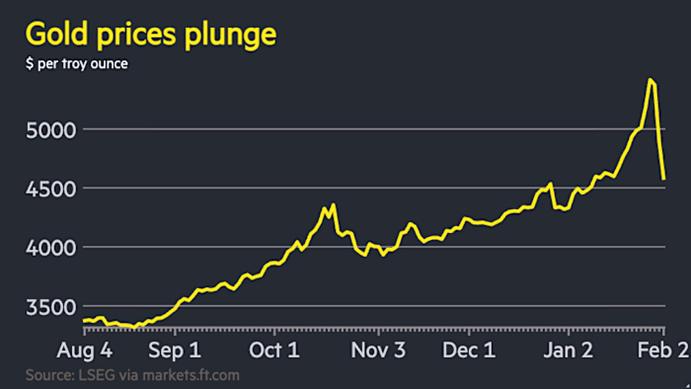
The week concluded with the nomination of a new Fed Chair, an announcement that sparked a choppy Friday session and triggered further volatility over the weekend, including the sharp reversal in gold and silver prices.
US
US indices finished the period on a mixed note as investors balanced corporate results against shifting monetary policy expectations. On 28 January, the Federal Reserve opted for a "hawkish hold," maintaining the federal funds rate at 3.50%–3.75%. Although Chair Powell expressed confidence in the 2026 growth outlook, the emergence of a "hawk-trio" consisting of Miran, Waller, and the newly nominated Kevin Warsh suggested that further rate cuts are unlikely in the first quarter. This sentiment pushed the 10-year Treasury yield back toward 4.30%.
The earnings season brought intense scrutiny to Big Tech, where Microsoft fell 10% after its Azure growth failed to accelerate despite a significant surge in capital expenditure. Conversely, Meta jumped 10.4% as record advertising revenue reassured investors, even as the company hiked its own spending guidance. Apple reported a strong beat on iPhone sales, yet the share price reaction remained muted due to ongoing concerns over rising costs. The weekend was further complicated by the anticipated nomination of Kevin Warsh as Fed Chair. Markets initially moved toward a "strong dollar" trade on the news, as Warsh is viewed as more hawkish than his predecessors, leading to a temporary squeeze in leveraged equities and a sharp unwinding of the weekly rallies in gold and silver.
Europe
European equities ended the week broadly flat in local currencies, though in USD terms, they benefitted from weaker dollar. The initial temporary relief provided by the Greenland truce began to subside as a string of weak corporate reports hit the software and luxury sectors. Mirroring the US tech trend, Germany’s software giant SAP plunged 16% on 29 January, marking its worst single-day drop in years after cloud backlog signals disappointed analysts. This weighed heavily on the DAX as the "AI premium" faced a reality check. In contrast, the semiconductor giant ASML surged on bullish 2026 guidance fuelled by resilient AI infrastructure demand.
The luxury sector continued to struggle, with LVMH sinking 7.9% following a cautious Q4 report that highlighted broader challenges in consumption. In the banking sector, Deutsche Bank faced selling pressure amid news of police searches related to a legacy money-laundering probe, which hampered the broader STOXX Banks index.
Throughout this period, the UK market proved more resilient, benefiting from its heavy weighting in "Old Economy" cyclicals and miners which acted as a natural hedge against the tech-led volatility seen elsewhere.
Rest of the world
Emerging Markets led last week, supported by a rotation into hard assets and a continued "quiet quitting" of US dollar-denominated assets. As the trade rift over Greenland eroded trust in the dollar's stability, central banks and institutional investors rotated heavily into precious metals as a hedge against potential inflationary tariffs. This momentum saw Gold breach $5,500/oz and Silver approach $120/oz, driving record inflows into commodity-exporting economies and gold miners in China and South Africa. However, we note that this trend faced a sharp correction over the weekend following the announcement of the new Fed Chair.
Asian markets were further supported by favourable policy decisions in China. The ending of the "three red lines" policy, which removed strict debt-ratio caps for developers, effectively signalled the end of a five-year liquidity squeeze. This sparked a relief rally across the real estate and banking sectors. Furthermore, new regulatory guidance aimed at ending "vicious price competition" among internet platforms allowed Chinese tech giants to outperform the broader regional index, providing a robust finish to the month
POSITIVE in the current environment
We shift to a Negative stance on government bonds. Positive global growth dynamics, price pressures in the US and profligate fiscal policies reduce the attractiveness of long-term government bonds as a potential hedge for economic downturn and increase the risk of higher long-term yields. Limited prospects of further central banks’ rate cuts and unattractive yield curve slopes at the front-end also reduce the attractiveness of government bonds on short-to-medium term maturities.
POSITIVE as breath to increase
Earnings remain a tailwind for equities, supported by a strong third-quarter earnings season and expectations that growth will accelerate and broaden in 2026. Technology stocks should continue to deliver robust performance, while the “old economy” is set to recover.
NEUTRAL as US large caps remain expensive
US technology stocks remain expensive, although growth and profitability provide some support while international equities are more reasonably valued. Equity risk premia remains low in both the US and Europe.
This marketing document has been issued by Bank Syz Ltd. It is not intended for distribution to, publication, provision or use by individuals or legal entities that are citizens of or reside in a state, country or jurisdiction in which applicable laws and regulations prohibit its distribution, publication, provision or use. It is not directed to any person or entity to whom it would be illegal to send such marketing material. This document is intended for informational purposes only and should not be construed as an offer, solicitation or recommendation for the subscription, purchase, sale or safekeeping of any security or financial instrument or for the engagement in any other transaction, as the provision of any investment advice or service, or as a contractual document. Nothing in this document constitutes an investment, legal, tax or accounting advice or a representation that any investment or strategy is suitable or appropriate for an investor's particular and individual circumstances, nor does it constitute a personalized investment advice for any investor. This document reflects the information, opinions and comments of Bank Syz Ltd. as of the date of its publication, which are subject to change without notice. The opinions and comments of the authors in this document reflect their current views and may not coincide with those of other Syz Group entities or third parties, which may have reached different conclusions. The market valuations, terms and calculations contained herein are estimates only. The information provided comes from sources deemed reliable, but Bank Syz Ltd. does not guarantee its completeness, accuracy, reliability and actuality. Past performance gives no indication of nor guarantees current or future results. Bank Syz Ltd. accepts no liability for any loss arising from the use of this document.
Fed and BoJ hikes, an oil-driven inflation scare, and an AI-safety debate drove sector rotation across global equities over the past week.
Global equities fell on oil, inflation and trade risk, while a Korea-led memory-chip rally offset losses in EM and rotated tech away from Nvidia.
Global equities were roughly flat over the week to 4 September 2026, as a much stronger than expected US August jobs report and renewed US-Iran tensions pushed oil prices and bond yields higher, reviving the case for a September Fed rate hike. The repricing hit European equities harder than the US, with German and French markets underperforming on rate- and energy-sensitive exposure, while banks and energy stocks outperformed globally. Within US tech, a sharp divergence emerged inside the Magnificent Seven, driven by company-specific news at Meta and Nvidia rather than a shared theme. Brazil was the standout market of the week, rallying on rate-cut expectations and firmer oil prices.
Live feeds, charts, breaking stories, all day long.
Our latest research, commentary and market outlooks