
.png)

We are sorry that for legal reasons we are not able to help US citizens or Canadian residents other than in Ontario, Quebec, or Alberta. Best wishes for the future…
We are sorry that for legal reasons we are not able to help US citizens or Canadian residents other than in Ontario, Quebec, or Alberta. Best wishes for the future…
You chose the following profile. If you made a mistake, please change here USA
This marketing document has been issued by Bank Syz Ltd. It is not intended for distribution to, publication, provision or use by individuals or legal entities that are citizens of or reside in a state, country or jurisdiction in which applicable laws and regulations prohibit its distribution, publication, provision or use. It is not directed to any person or entity to whom it would be illegal to send such marketing material.
This document is intended for informational purposes only and should not be construed as an offer, solicitation or recommendation for the subscription, purchase, sale or safekeeping of any security or financial instrument or for the engagement in any other transaction, as the provision of any investment advice or service, or as a contractual document. Nothing in this document constitutes an investment, legal, tax or accounting advice or a representation that any investment or strategy is suitable or appropriate for an investor's particular and individual circumstances, nor does it constitute a personalized investment advice for any investor.
This document reflects the information, opinions and comments of Bank Syz Ltd. as of the date of its publication, which are subject to change without notice. The opinions and comments of the authors in this document reflect their current views and may not coincide with those of other
Syz Group entities or third parties, which may have reached different conclusions. The market valuations, terms and calculations contained herein are estimates only. The information provided comes from sources deemed reliable, but Bank Syz Ltd. does not guarantee its completeness, accuracy, reliability and actuality. Past performance gives no indication of nor guarantees current or future results. Bank Syz Ltd. accepts no liability for any loss arising from the use of this document.
Jakub Dubaniewicz
Global markets
The trading week spanning the market closes of 16 and 23 January 2026 was defined by extraordinary "V-shaped" volatility. Global markets grappled with a high-stakes diplomatic standoff over Greenland alongside a crucial pivot in the US quarterly earnings season. The previous week ended with a surge driven by semiconductor optimism. Over the weekend sentiment quickly descended into a state of alarm over potential transatlantic trade dismantling, only to conclude with a dramatic relief rally following de-escalatory signals from the World Economic Forum in Davos. Investors performance was dictated by the ability to navigate "geopolitical tail risk" while tracking a significant rotation into domestic cyclicals and international value.
US
United States equities endured a tumultuous five-session stretch, with the S&P 500 ending the week broadly flat. The defining moment of the week was "Tariff Tuesday" on 20 January, which saw the index suffer a sharp (-2.06%) single-day sell-off as the White House floated 25% tariffs on European allies as leverage for the Greenland acquisition. However, sentiment pivoted on Wednesday following a keynote address in Davos that signalled a shift toward a multilateral framework, effectively triggering a rush back into risk assets that carried through to the Friday close.
On the corporate front, the earnings narrative was mixed. While Netflix reported a headline beat, the result failed to impress the market; shares tumbled as investors focused on cautious 2026 outlook, and the bid for Warner Bros. Discovery. Technology sentiment was further dampened late in the week by Intel, which plunged 13% after issuing a grim Q1 forecast - a stark reminder that the semiconductor recovery remains uneven. Conversely, the Russell 2000 reached an all-time high, reflecting a healthy rotation into domestic cyclicals as US Real GDP growth estimates for 2026 remain pinned above 2%.
Europe
Europe sat at the epicentre of the week's trade volatility. The STOXX Europe 600 closed the week 1% lower (and flat in USD terms). This modest weekly drop masks a significant mid-week drawdown, as "Anti-Coercion Instrument" (ACI) discussions in Brussels heightened fears of a trade war.
The week ended on a stronger note as the luxury sector, led by LVMH, saw stabilising demand from a recovering Chinese consumer base, while Ericsson shares surged 12% following a robust profit beat.
Despite the geopolitical noise, the "Davos pivot" on Thursday allowed European indices to snap a four-day losing streak, suggesting that fundamental growth expectations for the Eurozone remain intact.
Rest of the world
The MSCI Emerging Markets Index was the week's standout performer, gaining 2.7%. This outperformance was driven by Asian technology stocks which were boosted by prior week's TSMC bullish investment guidance, and maintained their momentum throughout the week as a "safe harbour" from Western trade disputes. In China, tech sentiment was challenged mid-week as Trip.com faced heavy selling pressure following an antitrust probe. However, broader index support from the PBoC and a rotation into Korean memory chip manufacturers allowed the region to decouple from the "Greenland Risk" affecting the West.
POSITIVE in the current environment
We shift to a Negative stance on government bonds. Positive global growth dynamics, price pressures in the US and profligate fiscal policies reduce the attractiveness of long-term government bonds as a potential hedge for economic downturn and increase the risk of higher long-term yields. Limited prospects of further central banks’ rate cuts and unattractive yield curve slopes at the front-end also reduce the attractiveness of government bonds on short-to-medium term maturities.
POSITIVE as breath to increase
Earnings remain a tailwind for equities, supported by a strong third-quarter earnings season and expectations that growth will accelerate and broaden in 2026. Technology stocks should continue to deliver robust performance, while the “old economy” is set to recover.
NEUTRAL as US large caps remain expensive
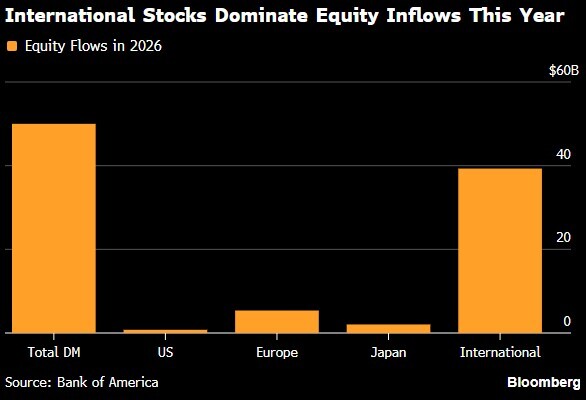
US technology stocks remain expensive, although growth and profitability provide some support while international equities are more reasonably valued. Equity risk premia remains low in both the US and Europe.
This marketing document has been issued by Bank Syz Ltd. It is not intended for distribution to, publication, provision or use by individuals or legal entities that are citizens of or reside in a state, country or jurisdiction in which applicable laws and regulations prohibit its distribution, publication, provision or use. It is not directed to any person or entity to whom it would be illegal to send such marketing material. This document is intended for informational purposes only and should not be construed as an offer, solicitation or recommendation for the subscription, purchase, sale or safekeeping of any security or financial instrument or for the engagement in any other transaction, as the provision of any investment advice or service, or as a contractual document. Nothing in this document constitutes an investment, legal, tax or accounting advice or a representation that any investment or strategy is suitable or appropriate for an investor's particular and individual circumstances, nor does it constitute a personalized investment advice for any investor. This document reflects the information, opinions and comments of Bank Syz Ltd. as of the date of its publication, which are subject to change without notice. The opinions and comments of the authors in this document reflect their current views and may not coincide with those of other Syz Group entities or third parties, which may have reached different conclusions. The market valuations, terms and calculations contained herein are estimates only. The information provided comes from sources deemed reliable, but Bank Syz Ltd. does not guarantee its completeness, accuracy, reliability and actuality. Past performance gives no indication of nor guarantees current or future results. Bank Syz Ltd. accepts no liability for any loss arising from the use of this document.
The week was shortened by holidays (US Presidents’ Day and Lunar New Year in Asia) which resulted in thinner liquidity and heightened volatility. It opened under the shadow of softer macro data and hawkish Fed signals but ended on a strong note following the US Supreme Court’s landmark ruling on tariffs.
The week from 6 to 13 February 2026 saw U.S. tech drag global equities lower, as renewed pressure on mega-cap names weighed on sentiment and lifted volatility. In contrast, Asian equities outperformed, supported by strong gains in Japan, Korea, and Taiwan.
The week of 23-30 January 2026 was marked by sharp moves in Big Tech, ongoing outperformance of non-US equities and record high prices of gold and silver
Live feeds, charts, breaking stories, all day long.
Our latest research, commentary and market outlooks