
.png)
 Source: www.ft.com

We are sorry that for legal reasons we are not able to help US citizens or Canadian residents other than in Ontario, Quebec, or Alberta. Best wishes for the future…
We are sorry that for legal reasons we are not able to help US citizens or Canadian residents other than in Ontario, Quebec, or Alberta. Best wishes for the future…
You chose the following profile. If you made a mistake, please change here USA
This marketing document has been issued by Bank Syz Ltd. It is not intended for distribution to, publication, provision or use by individuals or legal entities that are citizens of or reside in a state, country or jurisdiction in which applicable laws and regulations prohibit its distribution, publication, provision or use. It is not directed to any person or entity to whom it would be illegal to send such marketing material.
This document is intended for informational purposes only and should not be construed as an offer, solicitation or recommendation for the subscription, purchase, sale or safekeeping of any security or financial instrument or for the engagement in any other transaction, as the provision of any investment advice or service, or as a contractual document. Nothing in this document constitutes an investment, legal, tax or accounting advice or a representation that any investment or strategy is suitable or appropriate for an investor's particular and individual circumstances, nor does it constitute a personalized investment advice for any investor.
This document reflects the information, opinions and comments of Bank Syz Ltd. as of the date of its publication, which are subject to change without notice. The opinions and comments of the authors in this document reflect their current views and may not coincide with those of other
Syz Group entities or third parties, which may have reached different conclusions. The market valuations, terms and calculations contained herein are estimates only. The information provided comes from sources deemed reliable, but Bank Syz Ltd. does not guarantee its completeness, accuracy, reliability and actuality. Past performance gives no indication of nor guarantees current or future results. Bank Syz Ltd. accepts no liability for any loss arising from the use of this document.
Jakub Dubaniewicz
Source: www.ft.com
Global markets
The week was shortened by holidays (US Presidents' Day on Monday, Lunar New Year closures in Asia), leading to thinner liquidity and amplified volatility. The week began under the shadow of softer economic data, hawkish Fed signals, or geopolitical tensions. But as the week ended, stocks rallied on the landmark legal ruling on trade policy. The MSCI ACWI ultimately ended the week with a modest upward bias (+1.1%), though the underlying narrative remained one of cautious recalibration.
US
Wall Street had a positive week, with the S&P 500 up 1.1% and Nasdaq 100 +1.15%. The sentiment at the start of the week was set by the January Consumer Price Index (CPI) print the prior week; the CPI arrived at a stubborn 3.4% YoY, significantly higher than the consensus forecast. This data provided immediate ammunition for the "hawk-trio" within the Fed, with Chair Warsh hinting in a midweek speech that the central bank remains "unconvinced" that inflation has been fully tamed. Consequently, the 10-year Treasury yield surged to 4.45%, its highest level since the previous autumn, creating a significant headwind for growth-oriented sectors.
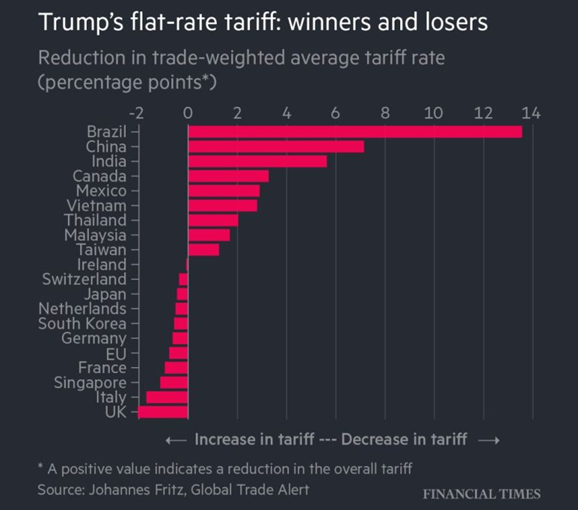
The early-week pressure was offset by a significant relief rally on Friday, triggered by a Supreme Court ruling that struck down several of the administration’s more controversial tariff proposals. This legal hurdle for the "Great Freeze" trade policy provided immediate oxygen to the multinational industrials and consumer discretionary sectors, which had been pricing in a much bleaker trade environment.
Within the technology space, the atmosphere was one of cautious consolidation ahead of the high-stakes Nvidia earnings report (scheduled for February). The financial sector also showed resilience as the "higher-for-longer" rate environment bolstered net interest margin expectations for the major money-centre banks.
Europe
The European stock market was the week’s undisputed champion, with the STOXX 600 surging 2.2% in EUR terms (1.3% in USD) to hit a new record close on Friday. This outperformance was underpinned by a dramatic upside surprise in German manufacturing activity and a suite of well-received earnings from heavyweights like Nestle and BAE Systems. The lifting of immediate tariff threats from the US served as a massive tailwind for the Eurozone’s export-oriented giants, allowing the DAX and CAC 40 to break through key resistance levels that had held since the start of the year.
The UK market delivered a standout performance, with the FTSE 100 gaining 2.3% in GBP (1.1% in USD). The London benchmark was supported by a combination of solid retail sales growth and steady performance in the defence and energy sectors: BAE Systems’ optimistic earnings outlook and Brent crude’s stabilisation above $65 per barrel (reaching $71.8 on Friday) reinforced the UK's position as a preferred destination for value-oriented capital in a world of high-duration risk.
Rest of the world
Emerging Markets have lagged Europe and the US, with the MSCI EM Index rising 0.8%. However, the mainland China markets (Shanghai/Shenzhen) remains closed for Lunar New Year (from February 16-24), while Hong Kong had partial/thinner trading.
Geopolitical tensions over Iran (stalled nuclear talks, US military positioning) acted as a mild headwind on risk appetite but were offset by the positive catalyst of the US Supreme Court ruling on Trump's tariffs. This eased near-term trade uncertainty for export-oriented EM economies, contributing to late-week stabilization and modest upside in EM currencies/stocks. Latin American resource exporters and Asian tech proxies showed relative resilience, though overall EM lagged developed markets like Europe in weekly gains.
In the commodities space, gold and silver showed stability and modest gains amid ongoing volatility. Gold traded in the ~$4,988–$5,100/oz range, reclaiming and holding above $5,000 late in the week (up slightly overall), driven primarily by safe-haven demand from escalating US-Iran tensions. Silver saw sharper intraday moves but finished positively in line with its role as a hedge.
Broader commodity trends reflected continued investor interest in "hard assets" amid rotations away from speculative tech/AI amid fatigue concerns, though the week's moves were more geopolitically driven (e.g., oil stabilizing/gaining on Iran risks) than a fresh orderly shift.
POSITIVE in the current environment
We shift to a Negative stance on government bonds. Positive global growth dynamics, price pressures in the US and profligate fiscal policies reduce the attractiveness of long-term government bonds as a potential hedge for economic downturn and increase the risk of higher long-term yields. Limited prospects of further central banks’ rate cuts and unattractive yield curve slopes at the front-end also reduce the attractiveness of government bonds on short-to-medium term maturities.
POSITIVE as breath to increase
Earnings remain a tailwind for equities, supported by a strong third-quarter earnings season and expectations that growth will accelerate and broaden in 2026. Technology stocks should continue to deliver robust performance, while the “old economy” is set to recover.
NEUTRAL as US large caps remain expensive
US technology stocks remain expensive, although growth and profitability provide some support while international equities are more reasonably valued. Equity risk premia remains low in both the US and Europe.
This marketing document has been issued by Bank Syz Ltd. It is not intended for distribution to, publication, provision or use by individuals or legal entities that are citizens of or reside in a state, country or jurisdiction in which applicable laws and regulations prohibit its distribution, publication, provision or use. It is not directed to any person or entity to whom it would be illegal to send such marketing material. This document is intended for informational purposes only and should not be construed as an offer, solicitation or recommendation for the subscription, purchase, sale or safekeeping of any security or financial instrument or for the engagement in any other transaction, as the provision of any investment advice or service, or as a contractual document. Nothing in this document constitutes an investment, legal, tax or accounting advice or a representation that any investment or strategy is suitable or appropriate for an investor's particular and individual circumstances, nor does it constitute a personalized investment advice for any investor. This document reflects the information, opinions and comments of Bank Syz Ltd. as of the date of its publication, which are subject to change without notice. The opinions and comments of the authors in this document reflect their current views and may not coincide with those of other Syz Group entities or third parties, which may have reached different conclusions. The market valuations, terms and calculations contained herein are estimates only. The information provided comes from sources deemed reliable, but Bank Syz Ltd. does not guarantee its completeness, accuracy, reliability and actuality. Past performance gives no indication of nor guarantees current or future results. Bank Syz Ltd. accepts no liability for any loss arising from the use of this document.
Global equity markets recorded their strongest weekly performance in months as driven by geopolitical de-escalation bolstered investor sentiment.
The Iran conflict and resulting oil shock completely reshaped markets last week, driving a broad risk off move, sharply higher energy prices, and heightened caution across cyclicals.
The week from 6 to 13 February 2026 saw U.S. tech drag global equities lower, as renewed pressure on mega-cap names weighed on sentiment and lifted volatility. In contrast, Asian equities outperformed, supported by strong gains in Japan, Korea, and Taiwan.
Live feeds, charts, breaking stories, all day long.
Our latest research, commentary and market outlooks