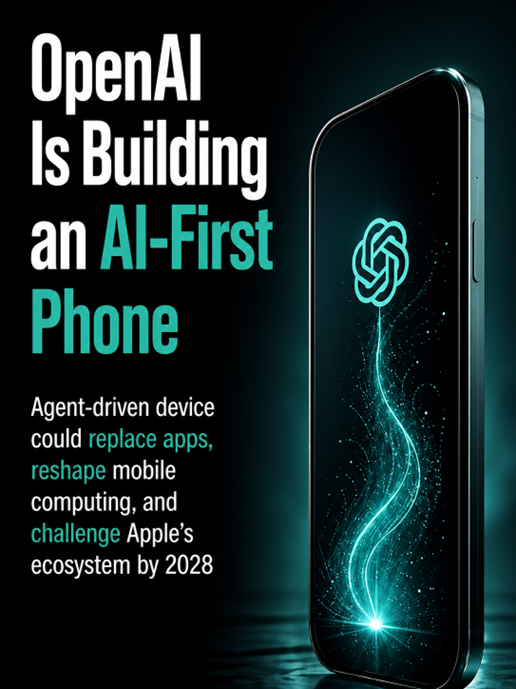
.png)
The story traces back to Ming-Chi Kuo (TF International Securities) — the same analyst whose Apple supply-chain intelligence has made him the most closely followed hardware analyst in the industry. That is precisely why the report moved markets.
Qualcomm surged 13% on the news.
Kuo's supply-chain checks point to OpenAI working with MediaTek, Qualcomm, and Luxshare — the latter being the company that builds AirPods. Specifications and suppliers are expected to be finalized by late 2026 or Q1 2027, with mass production targeted for 2028. The stated ambition: 300–400 million annual shipments at scale.
The core concept
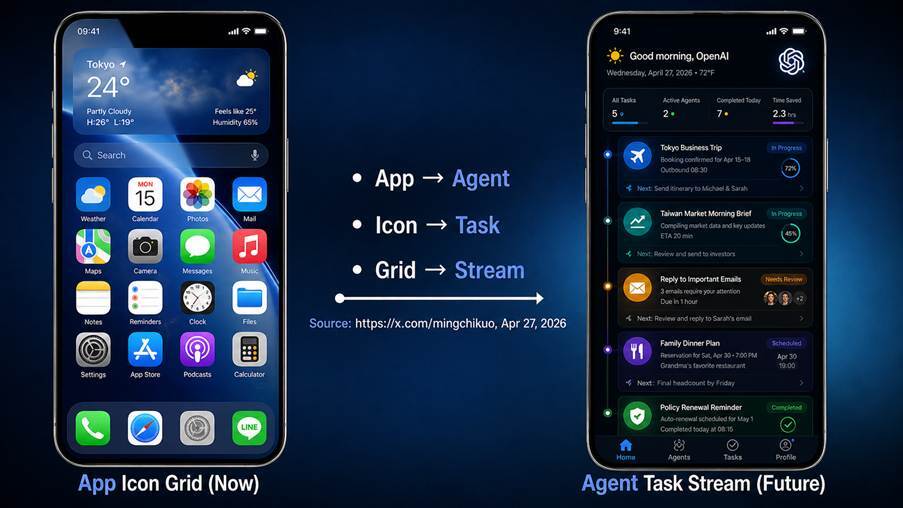
OpenAI is trying to turn the smartphone from an app launcher into an agent launcher.
Today, your phone is built around icons: banking, calendar, Uber, Gmail, Slack, Maps. Kuo framed the shift on X:
“Users are not trying to use a pile of apps. They are trying to get tasks done and fulfil needs through the phone.”
The next interface is not “open the app” — it is “do the thing.” Concept art shows the home screen replaced by live agent activity: book a flight, compile market data, update an itinerary — all executed across services without ever tapping an icon.
The architecture
- Custom SoCs optimised for AI agents
- On-device small-model execution combined with cloud offload for heavy inference
- “Full real-time state” — continuous context drawn from sensors, location, activity and communication
- OpenAI subscriptions bundled directly into the hardware
- A developer ecosystem built around agents, not apps
Why the phone matters
Agents are weak when they live inside someone else's sandbox. iOS and Android were built for apps, permissions, notifications and controlled access. An AI agent, by contrast, wants memory, context, tools, sensors, identity, payments — and the permission to act on the user's behalf.
That is an operating system problem. Not a chatbot problem.
By owning the hardware stack, OpenAI could bypass the system-level restrictions Apple and Google currently impose. With ChatGPT nearing a billion weekly users, a daily-use device fits the consumer-reach ambition.
The advantage: no legacy. A clean-slate interaction model. The disadvantage: users may not actually want a clean slate. Many would likely prefer their existing apps with AI assistance layered on top, which is precisely what Samsung, Google and Apple already offer.
How this fits OpenAI's broader hardware push
This is OpenAI's second hardware track. It is separate from the Jony Ive collaboration via io, which is reportedly developing a non-phone device — a smart speaker with a camera first, then glasses, a lamp, and earbuds.
Chief Global Affairs Officer Chris Lehane has stated that OpenAI's first hardware product will be announced in H2 2026, with several reports suggesting that initial device may be earbuds.
Reasons for scepticism
The credibility gap is large. OpenAI has never shipped hardware. Every previous AI-first device has failed — the Humane AI Pin lasted nine months before being permanently disabled. Rabbit R1 went the same way.
The real question is not whether OpenAI can build a phone. They probably can. The question is whether people will switch, considering:
- ecosystems are sticky,
- carrier deals are tough,
- hardware is hard for a reason, and
- Apple and Google will not sit still.
Investment takeaway
Beyond the headline, the more durable thesis here is the one Qualcomm CEO Cristiano Amon has been articulating all year:
AI agents will replace the mobile OS and apps as the primary interaction layer — and hardware must be redesigned from scratch for continuous, power-efficient AI inference, not retrofitted with NPUs bolted on.
Whether OpenAI's specific device ships or not, that architectural thesis is what is driving capex across the smartphone silicon supply chain, and it is what explains the 13% Qualcomm move on what is, fundamentally, still a rumour.
Note: OpenAI has not commented on the report. Source: Ming-Chi Kuo (TF International Securities), April 27, 2026.