
.png)
S&P 500 capex as a share of cash flows is still lower than the dotcom era
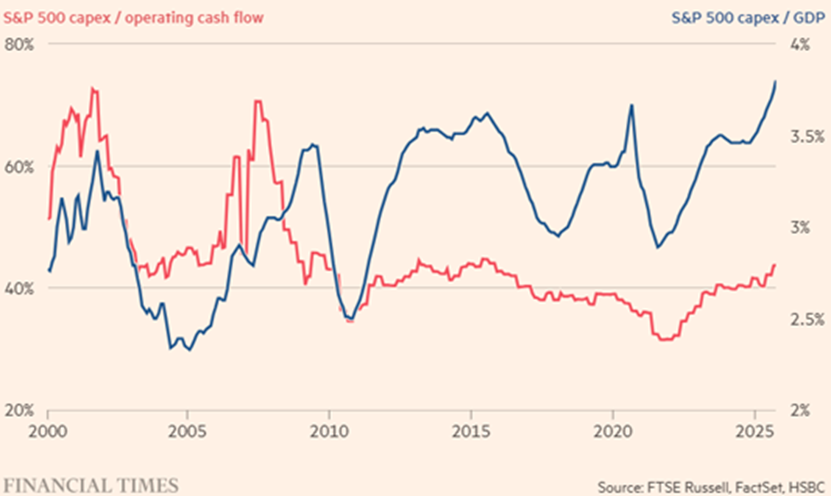
Source: Financial Times (FTSE Russell, Factset, HSBC)

We are sorry that for legal reasons we are not able to help US citizens or Canadian residents other than in Ontario, Quebec, or Alberta. Best wishes for the future…
We are sorry that for legal reasons we are not able to help US citizens or Canadian residents other than in Ontario, Quebec, or Alberta. Best wishes for the future…
You chose the following profile. If you made a mistake, please change here USA
This marketing document has been issued by Bank Syz Ltd. It is not intended for distribution to, publication, provision or use by individuals or legal entities that are citizens of or reside in a state, country or jurisdiction in which applicable laws and regulations prohibit its distribution, publication, provision or use. It is not directed to any person or entity to whom it would be illegal to send such marketing material.
This document is intended for informational purposes only and should not be construed as an offer, solicitation or recommendation for the subscription, purchase, sale or safekeeping of any security or financial instrument or for the engagement in any other transaction, as the provision of any investment advice or service, or as a contractual document. Nothing in this document constitutes an investment, legal, tax or accounting advice or a representation that any investment or strategy is suitable or appropriate for an investor's particular and individual circumstances, nor does it constitute a personalized investment advice for any investor.
This document reflects the information, opinions and comments of Bank Syz Ltd. as of the date of its publication, which are subject to change without notice. The opinions and comments of the authors in this document reflect their current views and may not coincide with those of other
Syz Group entities or third parties, which may have reached different conclusions. The market valuations, terms and calculations contained herein are estimates only. The information provided comes from sources deemed reliable, but Bank Syz Ltd. does not guarantee its completeness, accuracy, reliability and actuality. Past performance gives no indication of nor guarantees current or future results. Bank Syz Ltd. accepts no liability for any loss arising from the use of this document.
Jakub Dubaniewicz
S&P 500 capex as a share of cash flows is still lower than the dotcom era
Source: Financial Times (FTSE Russell, Factset, HSBC)
Global markets
Shutdown ends, volatility follows
The week of 10–14 November 2025 saw global equity markets deliver a mixed performance amidst a significant rise in volatility in the U.S.
The end of the prolonged 43-day U.S. government shutdown provided a positive start to the week, easing systemic concerns. However, the initial relief quickly pivoted to anticipation and anxiety over the imminent return of delayed key economic data (like CPI and PPI), which would finally clarify the true inflation and growth picture.
U.S. markets were characterized by a sharp selloff in riskier (higher beta) stocks and the Technology sector, which had been the year's leaders (e.g., in AI-linked names). This was driven by mounting valuation concerns and the swift drop in market expectations for a near-term Federal This high-beta selloff triggered a pronounced rotation of capital into YTD laggard and defensive sectors such as Healthcare and Energy, which showed notable gains and resilience.
AI-driven market nervousness is palpable, with recent news flow providing ample fodder for bears. Key developments included the Microsoft CEO signaling a potential slowdown in capex, OpenAI's controversial mention of needing government subsidies, and Coreweave's missing quarterly earnings targets due to a project delay. Adding to the negative sentiment were the reports of Softbank selling its stake in Nvidia and hedge-fund manager Michael Burry disclosing significant short bets against several AI winners. Given that AI positioning was, and largely remains, crowded even after the recent correction, all investor attention is now focused on Nvidia's quarterly report this Wednesday.
Despite the U.S. tech turbulence, international equities showed greater stability. The STOXX Europe 600 advanced on strength in energy and healthcare sectors, while Asian markets stabilized, supported by better-than-expected inflation data and hopes for domestic stimulus.
US
CoreWeave was one of the highly scrutinized companies that reported last week. The AI-infrastructure player delivered a stellar Q3 with revenue of ~$1.36 bn (up ~134% YoY) but narrowed its full-year guidance after citing delays from a third-party data-center builder; it also saw a steep increase in debt-driven interest expense despite a $55bn backlog. The delay was not well taken by the market and the stock finished the week down double digit.
Cisco beat expectations, raised its fiscal-year outlook, and highlighted surging demand for its AI infrastructure hardware (particularly networking gear) reinforcing confidence in its long-term role in AI data-centers. The stock was up during the week.
Disney posted an EPS beat ($1.11) but its revenue fell short, dragged by weakness in its legacy linear-TV business while parks results were soft; the company also raised its dividend and plans to double its 2026 buyback.
Europe
Richemont posted resilient FY 2025 results with sales up ~4%, driven by strong Jewelry Maisons, though operating profit declined and margin compressed; it ended the year with a very healthy net cash position (~€8.3 bn).
Siemens: Siemens reported Q3 results roughly in line with forecasts, with modest revenue growth but headwinds from currency translation; the company reaffirmed its FY 2025 outlook while highlighting strong free cash flow and a solid order book. The stock saw some profit taking as FX remains a headwind to margin increase.
Infineon closed FY 2025 roughly in line with expectations despite weak end markets, but is increasingly betting on AI-center demand — raising its 2026 target for power-supply revenue to ~€1.5 bn.
Rest of the world
Emerging-market equities faced a risk-off week as global stocks — especially tech — sold off amid concerns about stretched AI valuations. Sentiment weakened further as expectations for a December U.S. Fed rate cut faded following hawkish commentary, which supported the dollar and pressured EM currencies. Equity fund inflows slowed sharply, indicating growing caution, while EM hard-currency bonds underperformed early in the week with wider spreads. China-growth worries resurfaced and added to the softer tone across Asian markets. A pullback in U.S. technology shares spilled over into EM, prompting broader de-risking. Investor surveys highlighted that EM remained vulnerable if the Fed refrained from cutting rates.
POSITIVE in the current environment
We shift to a Negative stance on government bonds. Positive global growth dynamics, price pressures in the US and profligate fiscal policies reduce the attractiveness of long-term government bonds as a potential hedge for economic downturn and increase the risk of higher long-term yields. Limited prospects of further central banks’ rate cuts and unattractive yield curve slopes at the front-end also reduce the attractiveness of government bonds on short-to-medium term maturities.
POSITIVE as breath to increase
Earnings remain a tailwind for equities, supported by a strong third-quarter earnings season and expectations that growth will accelerate and broaden in 2026. Technology stocks should continue to deliver robust performance, while the “old economy” is set to recover.
NEUTRAL as US large caps remain expensive
US technology stocks remain expensive, although growth and profitability provide some support while international equities are more reasonably valued. Equity risk premia remains low in both the US and Europe.
This marketing document has been issued by Bank Syz Ltd. It is not intended for distribution to, publication, provision or use by individuals or legal entities that are citizens of or reside in a state, country or jurisdiction in which applicable laws and regulations prohibit its distribution, publication, provision or use. It is not directed to any person or entity to whom it would be illegal to send such marketing material. This document is intended for informational purposes only and should not be construed as an offer, solicitation or recommendation for the subscription, purchase, sale or safekeeping of any security or financial instrument or for the engagement in any other transaction, as the provision of any investment advice or service, or as a contractual document. Nothing in this document constitutes an investment, legal, tax or accounting advice or a representation that any investment or strategy is suitable or appropriate for an investor's particular and individual circumstances, nor does it constitute a personalized investment advice for any investor. This document reflects the information, opinions and comments of Bank Syz Ltd. as of the date of its publication, which are subject to change without notice. The opinions and comments of the authors in this document reflect their current views and may not coincide with those of other Syz Group entities or third parties, which may have reached different conclusions. The market valuations, terms and calculations contained herein are estimates only. The information provided comes from sources deemed reliable, but Bank Syz Ltd. does not guarantee its completeness, accuracy, reliability and actuality. Past performance gives no indication of nor guarantees current or future results. Bank Syz Ltd. accepts no liability for any loss arising from the use of this document.
The week was shortened by holidays (US Presidents’ Day and Lunar New Year in Asia) which resulted in thinner liquidity and heightened volatility. It opened under the shadow of softer macro data and hawkish Fed signals but ended on a strong note following the US Supreme Court’s landmark ruling on tariffs.
The week from 6 to 13 February 2026 saw U.S. tech drag global equities lower, as renewed pressure on mega-cap names weighed on sentiment and lifted volatility. In contrast, Asian equities outperformed, supported by strong gains in Japan, Korea, and Taiwan.
The week of 23-30 January 2026 was marked by sharp moves in Big Tech, ongoing outperformance of non-US equities and record high prices of gold and silver
Live feeds, charts, breaking stories, all day long.
Our latest research, commentary and market outlooks