Charles-Henry Monchau

Chief Investment Officer

Chart #1 — 

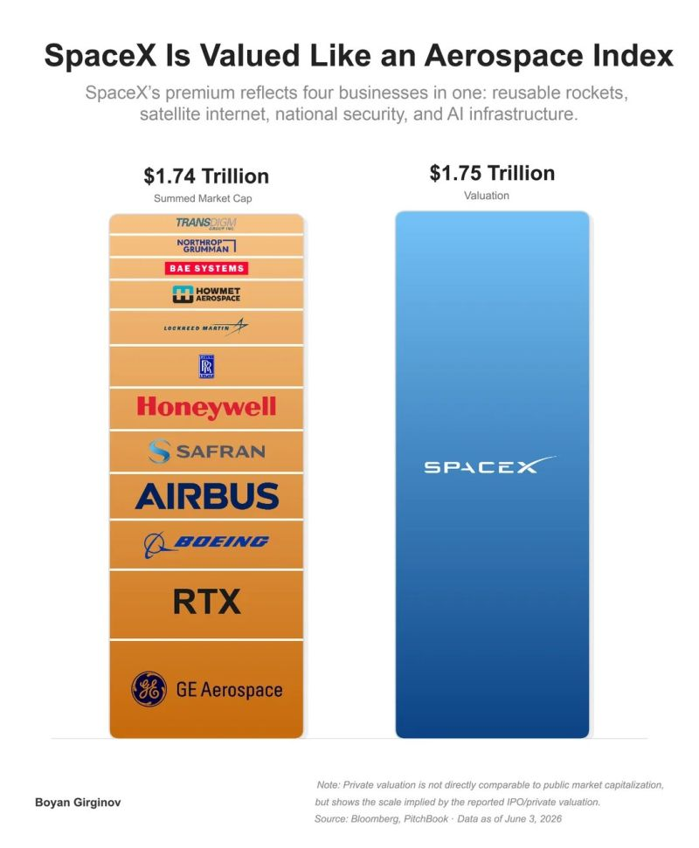
SpaceX is worth a whole aerospace index 

With a valuation of approximately $1.77 trillion, SpaceX is now worth roughly the same as the combined market value of the leading aerospace and defense firms, whose total valuation stands at about $1.7 trillion. This group includes companies such as Airbus, Boeing, RTX, GE Aerospace, and Lockheed Martin.

Although aerospace industry indexes include major corporations that together produce more than $500 billion in annual revenue, SpaceX’s valuation is driven by a fundamentally different investment thesis, one that places greater emphasis on future growth expectations and long-term potential rather than current revenue levels.


Source: Markets & Mayhem 


Chart #2 — 

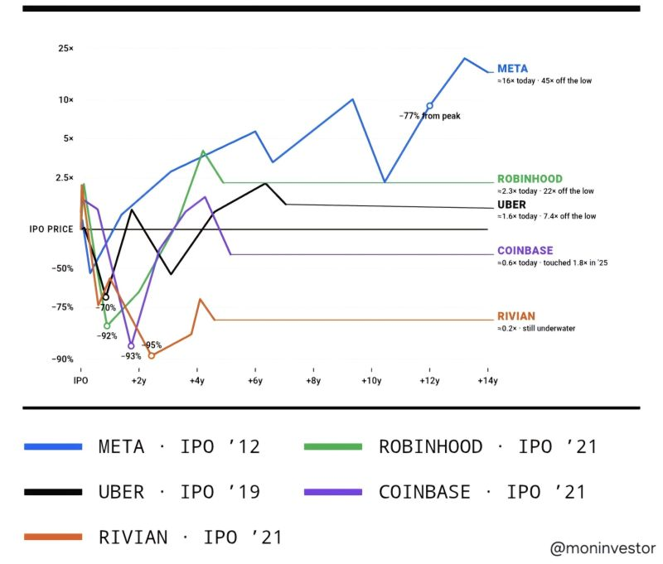
This chart is why you should be careful with the SpaceX IPO 

Five of the most anticipated IPOs over the past 15 years have all experienced significant declines after going public.

  • Uber dropped 70% below its IPO price.
  • Meta Platforms fell 77% from their peak.
  • Robinhood declined 92%.
  • Coinbase lost 93%.
  • Rivian plunged 95%.

In many cases, investor excitement was fully reflected in the stock price from the moment trading began. Those who bought into initial enthusiasm often faced steep losses.

The largest gains, however, came much later, after sentiment had turned negative and interest had faded. From their lows, Robinhood surged 22-fold, Meta climbed 45-fold, and Uber rose 7-fold.

The lesson is that patience often outperforms hype. That said, Rivian serves as a reminder that not every company eventually recovers, regardless of how long investors wait.

SpaceX is likely to be one of the most closely watched IPOs of this decade. Based on past examples, there may be little reason to rush in on the first day. If the business proves exceptional, more attractive entry points could emerge over time.

If history is any guide, the IPO won't be the opportunity, the correction might be.


Source: @moninvestor


Chart #3 — 

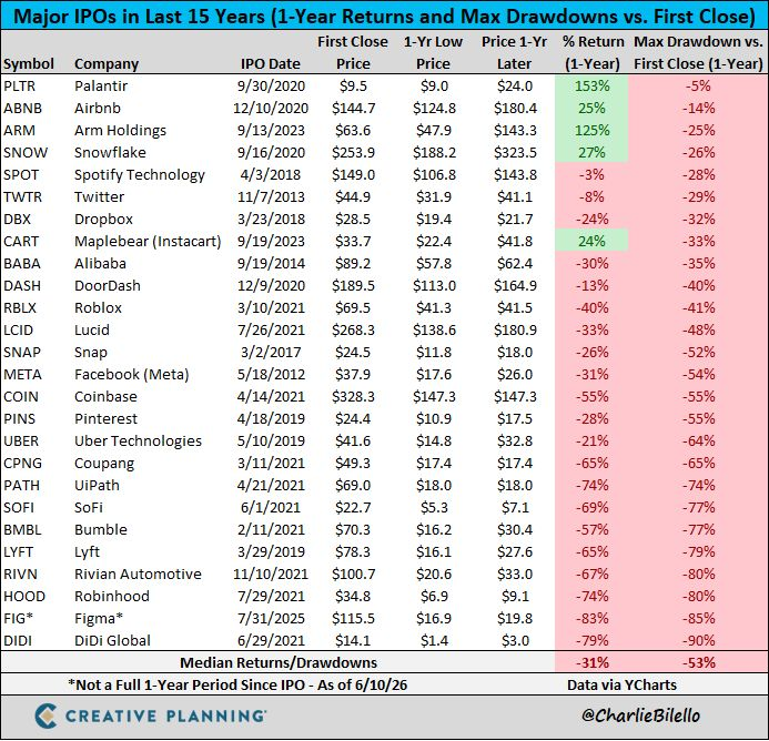
How did major IPOs perform in the past?  

With investor appetite for what could be the biggest IPO ever reaching unprecedented levels, it's worth keeping one key lesson in mind: a great business is not necessarily a great investment at any valuation. Historically, the median major IPO declined 31% during its first year as a public company and experienced a 53% drawdown at some point along the way.


Source: Charlie Bilello


Chart #4 — 

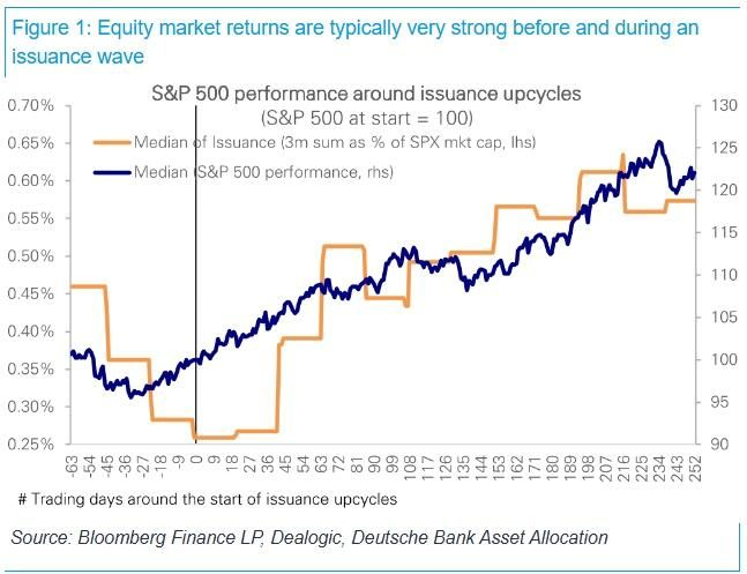
Equity market returns are typically very strong before and during an issuance wave 

One of the biggest concerns on Wall Street today is that the recent surge in IPOs and equity issuance could lead to a market sell-off. However, according to Deutsche Bank strategists Jim Reid, Binky Chadha, and Parag Thatte, issuance waves have historically occurred because market conditions are strong, not because a downturn is imminent. Companies tend to raise capital when investor demand is robust, earnings momentum is positive, and risk appetite is elevated. Looking back at previous issuance cycles, median market returns were +8% over the following three months and +20% over the next twelve months. The primary exception was 2008, when the financial crisis overwhelmed broader market trends. The key takeaway is that strong investor demand continues to absorb the increase in supply.


Source: Zerohedge, DB


Chart #5 — 

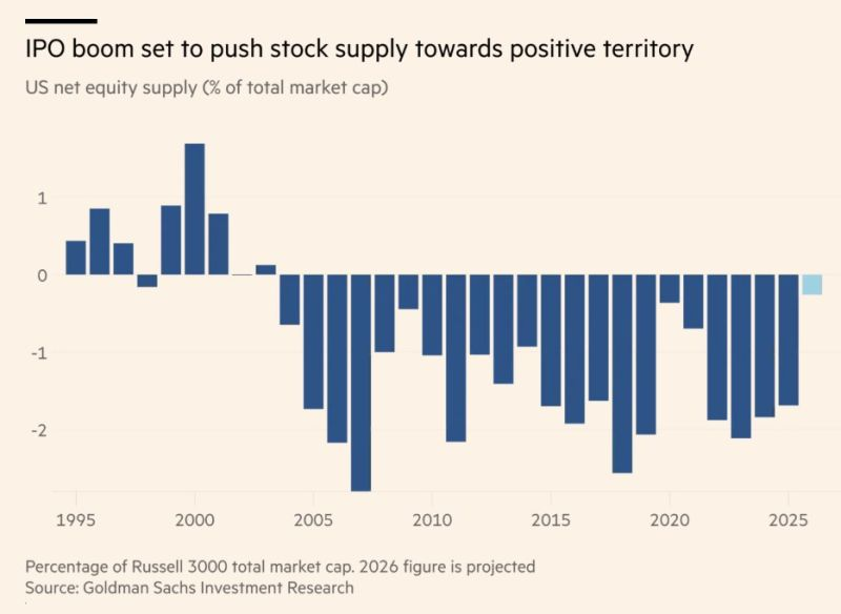
IPO boom set to push stock supply towards positive territory

Since 2003, US equities have benefited from an unprecedented period of negative net supply, with companies repurchasing more shares than were created through IPOs and new equity issuance. This combination of shrinking supply and persistent investor demand helped drive one of the strongest bull markets in history. That trend may now be coming to an end. For the first time in 23 years, net supply in the US stock market is expected to stop declining. A major reason is the escalating cost of the AI race, which is prompting large technology companies to consider substantial share sales to fund massive investments in AI infrastructure. At the same time, high-profile private companies such as SpaceX, OpenAI, and Anthropic could eventually add significant new supply if they enter public markets. According to Goldman Sachs, net equity supply could become flat in 2026 after more than two decades of remaining negative.


Source:  FT


Chart #6 —

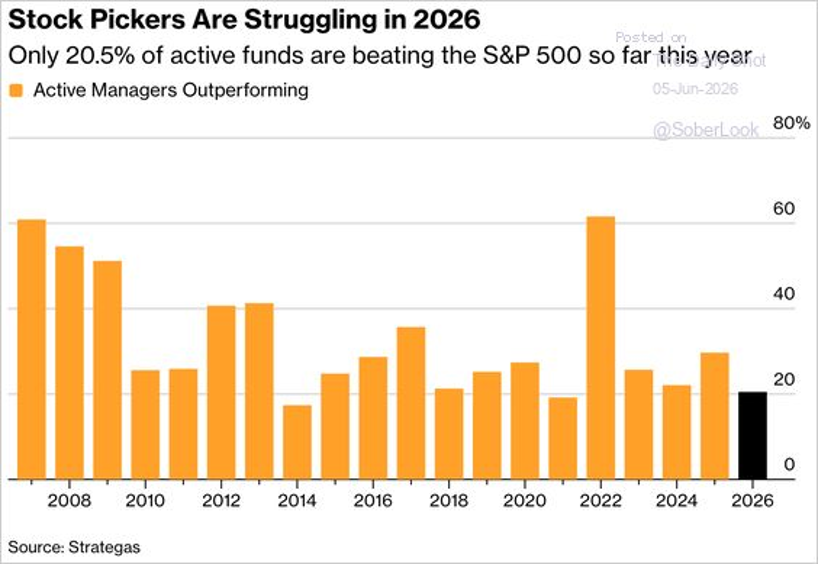
Stock pickers are struggling in 2026

Active large-cap equity managers have found it difficult to match the performance of a technology-driven market rally, with just 20.5% managing to outperform the S&P 500 so far this year.


Source: Strategas, The Daily Shot


Chart #7 — 

Talking about inflation…

How USA 2026 Ticket Prices Compare to Qatar 2022.


Source: World Cup 2026 Daily, TotalFootball


Disclaimer

This marketing document has been issued by Bank Syz Ltd. It is not intended for distribution to, publication, provision or use by individuals or legal entities that are citizens of or reside in a state, country or jurisdiction in which applicable laws and regulations prohibit its distribution, publication, provision or use. It is not directed to any person or entity to whom it would be illegal to send such marketing material. This document is intended for informational purposes only and should not be construed as an offer, solicitation or recommendation for the subscription, purchase, sale or safekeeping of any security or financial instrument or for the engagement in any other transaction, as the provision of any investment advice or service, or as a contractual document. Nothing in this document constitutes an investment, legal, tax or accounting advice or a representation that any investment or strategy is suitable or appropriate for an investor's particular and individual circumstances, nor does it constitute a personalized investment advice for any investor. This document reflects the information, opinions and comments of Bank Syz Ltd. as of the date of its publication, which are subject to change without notice. The opinions and comments of the authors in this document reflect their current views and may not coincide with those of other Syz Group entities or third parties, which may have reached different conclusions. The market valuations, terms and calculations contained herein are estimates only. The information provided comes from sources deemed reliable, but Bank Syz Ltd. does not guarantee its completeness, accuracy, reliability and actuality. Past performance gives no indication of nor guarantees current or future results. Bank Syz Ltd. accepts no liability for any loss arising from the use of this document.

Read More

Straight from the Desk

Syz the moment

Live feeds, charts, breaking stories, all day long.

Thinking out loud

Sign up for our weekly email highlighting the most popular posts.

Follow us

Thinking out loud

Investing with intelligence

Our latest research, commentary and market outlooks