.png)
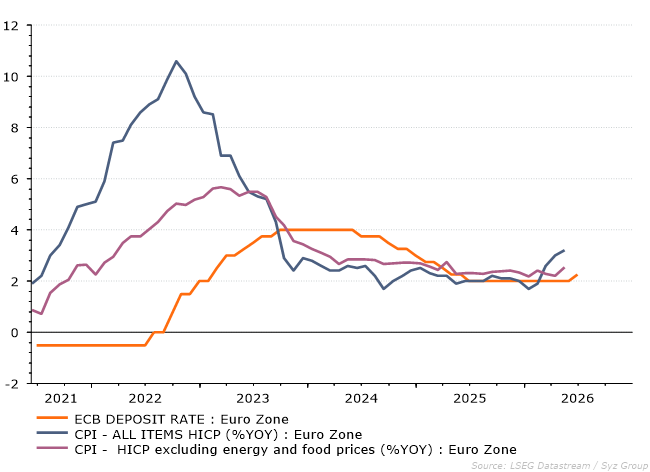
- The ECB raised all three key rates by 25bp in June, lifting the deposit rate from 2.00% to 2.25%. President Lagarde said the decision was unanimous and that the revised macroeconomic forecasts were approved by all Governing Council members.
- The rate hike was mainly justified by higher inflation projections and more second round effects pushing not only headline but also core inflation projections higher.
- The ECB continues to see downside risks to growth and upside risks to inflation, with financial conditions still tighter than before the war but broadly unchanged since the last meeting. It also added more explicit risks around tighter credit supply, food prices, climate-related shocks and financial stability.
- Lagarde stressed that the hike was not merely an “insurance hike” and described it as robust across alternative scenarios, but the ECB did not pre-commit to a hiking cycle.
- Our base case remains somewhat more positive than the ECB’s “benign” oil price scenario as we expect oil prices to fall faster. Therefore we do not expect another ECB key rate hike in 2026 at this point. However, if oil prices do not remain at lower levels into summer, a further rate hike in July seems likely. Uncertainty remains high, as news flow around the Iran war stays very volatile.
What happened?
The ECB moved from keeping rates unchanged in April to raising all three key rates by 25bp in June. The deposit rate rose from 2.00% to 2.25%. President Lagarde stated during the press conference that the decision had been taken unanimously and that the revised macroeconomic forecasts had been approved by all members.
Why did the ECB decide to conduct a rate hike now?
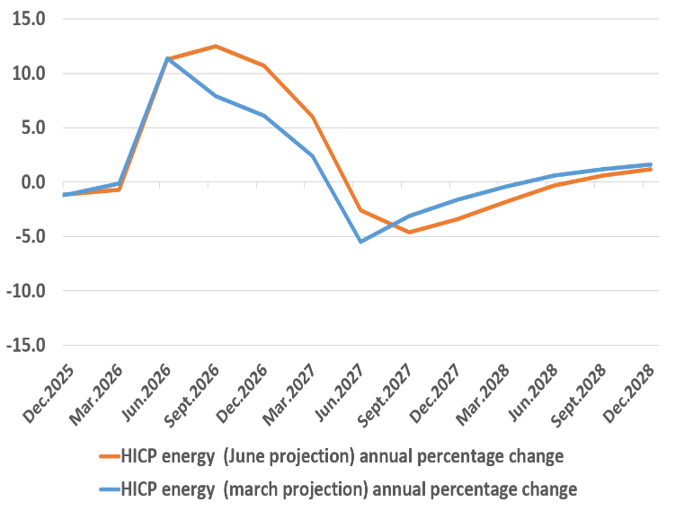
In its statement, the ECB argued that the rate hike was necessary because of its upward revision of the inflation outlook, mostly due to the energy prices remaining high:
Compared with the March staff projections that were still the latest projection set in the April document, the June projections revised headline inflation higher to 3.0% in 2026 and 2.3% in 2027, from 2.6% and 2.0% previously. Core inflation was also revised higher, to 2.5% in both 2026 and 2027, from 2.3% and 2.2%.
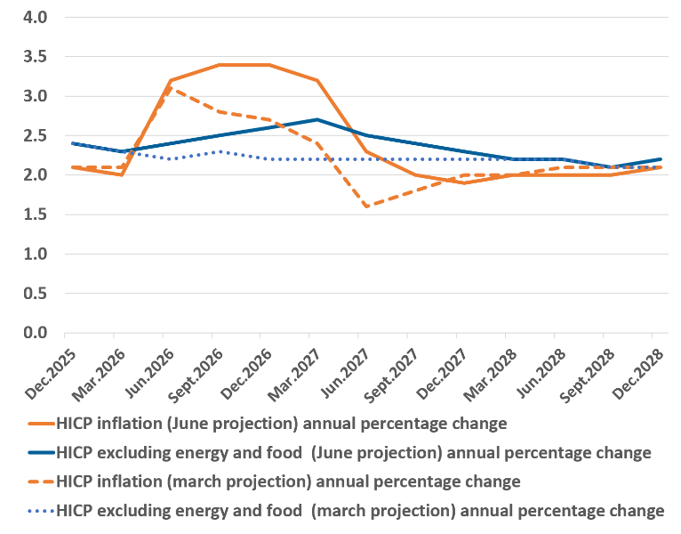
The inflation revisions were more substantial than the small downward revisions by only 0.1 percentage points for GDP growth, down to 0.8% in 2026 and 1.2% in 2027. Hence, the ECB saw the pivot towards rate hikes as justified.
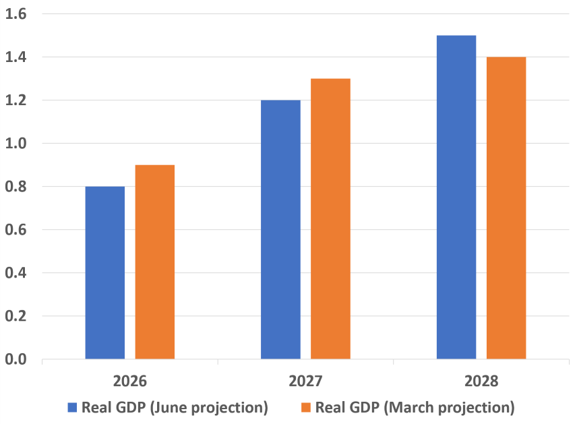
The reasoning for lower growth and higher inflation projections was straight forward: the ECB explicitly linked the upward inflation revision to a higher path for energy prices, which is expected to feed into food, goods and services inflation– although the adaptation of the economy and energy markets to the crisis was better than earlier expected. The downward growth revision for 2026 and 2027 was attributed to the more pronounced impact of the Middle East war on commodity markets, real incomes and confidence.
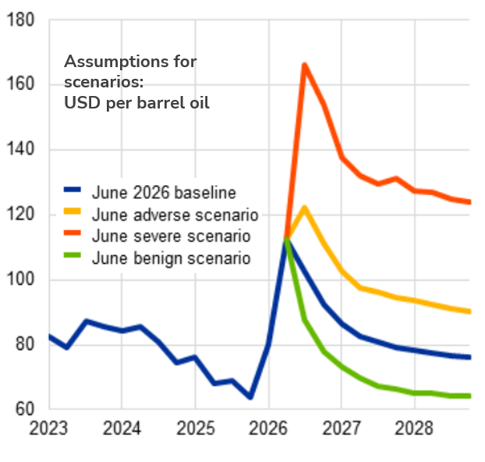
The ECB still sees risk levels elevated and financial conditions broadly unchanged since last meeting?
Compared to its latest assessment from April, the broad risk balance remained the same: downside risks to growth and upside risks to inflation, mainly due to the Middle East war and energy-price shock. Compared with April, the June text added more explicit downside channels, including a tighter supply of credit, and added extreme weather events and climate/nature crises as possible upside risks to food prices; it also reframed the upside growth scenario around faster adaptation of the economy and energy markets or a prompt and sustainable resolution of the war.
Similarly, the ECB did not change the assessment of financial conditions in the Eurozone: in April, the ECB said the war had caused significant market volatility and that financial conditions were tighter than before the war; it also referred to credit standards tightening in Q1. In June, the ECB said financial conditions were broadly unchanged since its previous meeting, though still tighter than before the war. It noted slightly higher market-based debt financing costs and bank lending to firms, and introduced a new financial stability assessment, warning that while euro area banks remain resilient, a sharp fall in asset prices and worsening asset quality in energy- and trade-sensitive sectors could pose risks.
Not an “insurance hike” but neither the start of a rate hiking cycle?
President Lagarde made it clear that this was not an “insurance rate hike”, i.e. a hike that is just a one-off in order to signal that the ECB is ready to react if necessary. But she also refrained from describing it as the start of a rate hiking cycle. Furthermore, President Lagarde emphasised that the rate hike was “robust across a range of scenarios” and, hence, even supported in a mild energy price scenario, were the crisis in the Middle East relaxes swiftly and the currently elevated energy prices would drop rather quickly from today’s quarterly average of close to 100 USD/bbl[RC1] down to 88 and 64 in the third and fourth quarter. Even in such a scenario, the ECB would see the average inflation to stay at 2.9% in 2026 and the price measure excluding energy and food prices also at 2.4%, both only 0.1pp below the “baseline scenario”. Hence, the ECB president argued that the decision was a “robust” one and the correct adjustment of the key rate even taking into account that the growth and inflation outlook is subject to high uncertainty. She played down that the demand within the Eurozone growth is under the threat of higher energy prices and mentioned the still robust growth outlook. In an adverse scenario were oil prices would move higher to 120 USD/bbl again in the summer and then fall back to 99 USD in Q4, the ECB growth estimate for the Eurozone stays close to the baseline projection, with 0.7% growth rate in 2026 instead of 0.8% and 0.9% instead of 1.2%. Finally, she agreed that it was still unclear to what extent the current price pressures in the underlying inflation trend were attributable to so-called ‘second-wave’ effects of the energy price shock, or whether they represented genuine pressures stemming from generally higher demand.
There was no significant market reaction due to the ECBs decision
With markets already highly anticipating a rate hike before the meeting, the ECB’s move did not trigger any substantial market reaction. The Euro did not strengthen nor weaken tangibly against the US dollar nor versus the Swiss franc and the 10-year German government bond stayed around levels of slightly above 3.00%.
Where to go from here?
As usual, the ECB and President Lagarde stressed that policy remains data-dependent and that the Governing Council is not pre-committing to any specific rate path. However, today’s communication and the updated macroeconomic projections suggest that the probability of another rate hike – or even more than one – has increased, rather than this being seen as a one-off move. The ECB’s line of argument currently appears consistent with another rate increase in July, unless energy prices fall faster than assumed in its benign scenario, namely, a decline to USD 90 in June followed by a gradual further easing during Q3 to bring the quarterly average to 88 USD. Our baseline view remains for now that the Middle East crisis should de-escalate sustainably over the course of this month and into July, allowing energy prices to decline further. On this basis, we do not expect an additional rate hike at that point.