


.png)

Source: Voronoi, Visual Capitalist
Chart #2 —
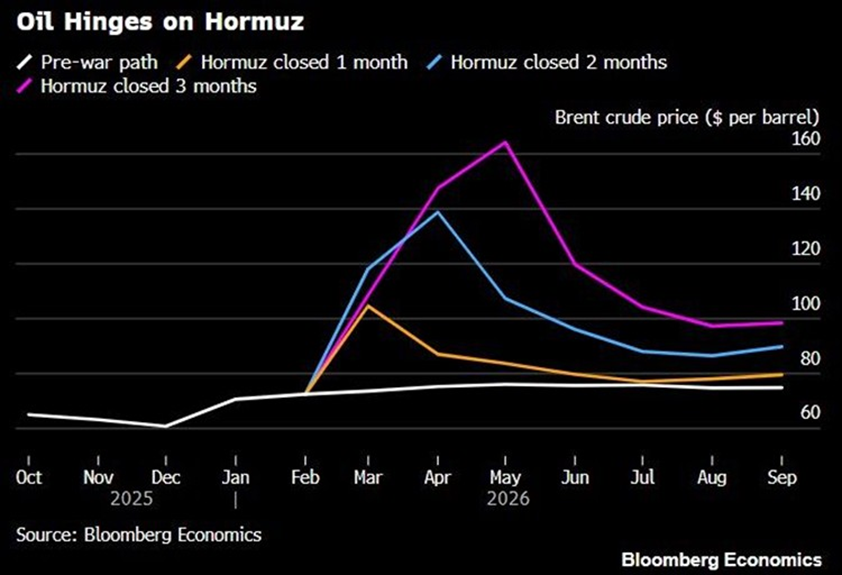
Potential oil price surges if the strait of Hormuz closes
According to Bloomberg Economics, oil prices could rise sharply as a function of how long the Strait of Hormuz remains closed. Projections point to approximately $105 per barrel after one month, $140 after two months, and around $165 after three months. These figures reflect the outsized and irreplaceable role this corridor plays in the global oil supply chain.
Source: Bloomberg
Chart #3 —
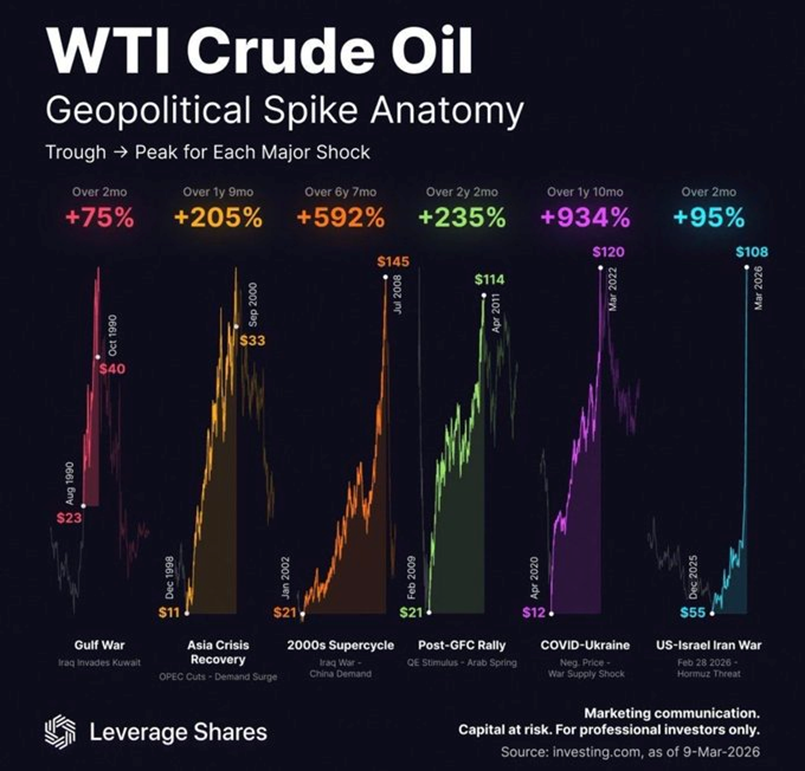
Oil spikes up to 934% during past geopolitical shocks
Energy markets move in cycles, often triggered by geopolitical crises, which consistently cause sharp oil price spikes. Historical patterns show major surges: Gulf War 1990 (+75%), Asian Crisis recovery 1998 -2000 (+205%), 2000s commodity super cycle (+592%), post-financial crisis rebound (+235%), and COVID/Ukraine shocks (+934%). Today, the US/Israel -Iran conflict in 2026 has already pushed oil up 95%. Prices react swiftly because a few regions control most exports, and tensions near key chokepoints like the Strait of Hormuz force immediate repricing. Geopolitical shocks in these critical areas directly ripple through global energy.
Source: Jack Prandelli on X, Leverage Shares
Chart #4 —
The IEA has proposed the largest release of oil reserves in its history
The International Energy Agency has proposed releasing nearly 400 million barrels from strategic oil reserves to counter the price surge caused by the US/Israel-Iran conflict. This would exceed the previous record intervention of 182 million barrels released in 2022 after Russia’s invasion of Ukraine. However, the math suggests it may not be enough. G7 countries hold about 1.1 billion barrels in reserves, including roughly 450 million in the United States. Before the conflict, around 20 million barrels per day flowed through the Strait of Hormuz; today flows are close to zero, creating a potential supply gap of 18-20 mb/d. Even if 400 million barrels were released over six months, it would add only about 2.2 mb/d to the market. That would offset only a small share of the disruption. Strategic reserves can slow price spikes, but they cannot replace lost supply on this scale.

Source: WSJ, Bloomberg - Joumanna Bercetche
Chart #5 —
US vs EU natural gas prices—a sharp divergence
Natural gas markets are far more regional in nature than oil markets, and this dynamic is on full display in current pricing. US natural gas prices are down on the year, while European prices have nearly doubled a stark illustration of Europe's far greater dependence on imported supply.

Source: Blackrock
Chart #6 —
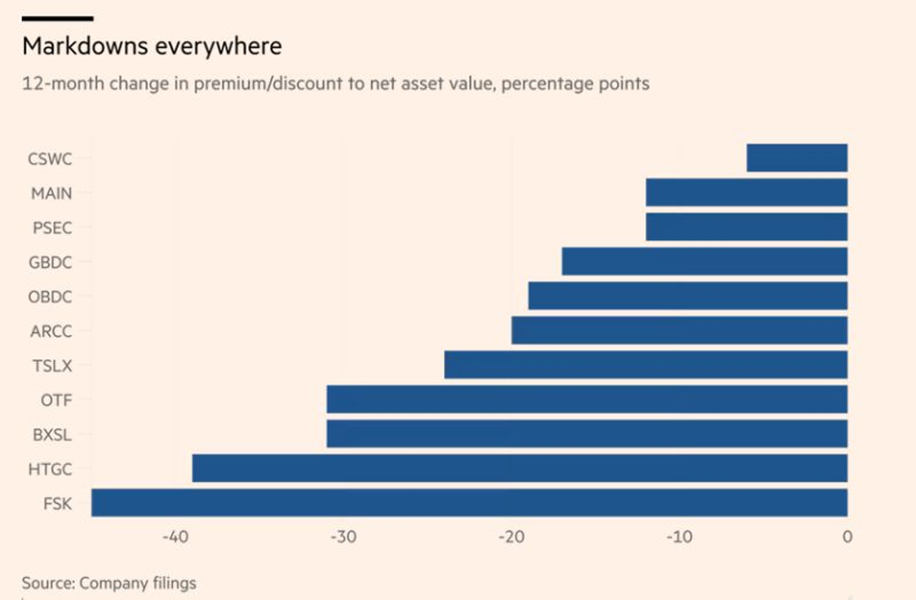
Rising redemption pressure in US private credit
The pullback from US private credit is speeding up. Cliffwater limited redemptions to 7% after investors requested 14%. Morgan Stanley capped withdrawals at 5% from its North Haven Private Income Fund, and BlackRock imposed limits when requests hit 9.3%. At the same time, JPMorgan Chase is marking down software-linked loans and tightening lending standards, signalling worries about credit quality, asset values, and AI-driven market disruption. Publicly traded business development companies are also under pressure, with FS KKR Capital Corp. and Hercules Capital Inc. both declining. Overall, both private and public credit markets are showing signs of stress, highlighting investor caution and rising concerns over risk.
Source: Financial Times
Chart #7 —
The rise of US national debt since 1981
Every US president since Jimmy Carter has promised to rein in government spending and reduce the federal deficit. Carter warned in 1978 that the government could not keep spending more than it collected. Ronald Reagan spoke in 1981 of decades of accumulated deficits mortgaging the nation's future. George Bush Sr. called for bringing the deficit under control in 1989. Bill Clinton pledged to restore fiscal order in 1993. George Bush Jr. promised in 2001 to pay down a large portion of the national debt. Barack Obama argued in 2010 that the federal government should tighten its belt, just as American families were doing. Donald Trump vowed in 2016 to balance the budget and reduce debt. Joe Biden claimed in 2022 that his plan would cut the deficit. And President Trump, again in 2024, promised to balance the federal budget.

Source: Charlie Bilello
Disclaimer
This marketing document has been issued by Bank Syz Ltd. It is not intended for distribution to, publication, provision or use by individuals or legal entities that are citizens of or reside in a state, country or jurisdiction in which applicable laws and regulations prohibit its distribution, publication, provision or use. It is not directed to any person or entity to whom it would be illegal to send such marketing material. This document is intended for informational purposes only and should not be construed as an offer, solicitation or recommendation for the subscription, purchase, sale or safekeeping of any security or financial instrument or for the engagement in any other transaction, as the provision of any investment advice or service, or as a contractual document. Nothing in this document constitutes an investment, legal, tax or accounting advice or a representation that any investment or strategy is suitable or appropriate for an investor's particular and individual circumstances, nor does it constitute a personalized investment advice for any investor. This document reflects the information, opinions and comments of Bank Syz Ltd. as of the date of its publication, which are subject to change without notice. The opinions and comments of the authors in this document reflect their current views and may not coincide with those of other Syz Group entities or third parties, which may have reached different conclusions. The market valuations, terms and calculations contained herein are estimates only. The information provided comes from sources deemed reliable, but Bank Syz Ltd. does not guarantee its completeness, accuracy, reliability and actuality. Past performance gives no indication of nor guarantees current or future results. Bank Syz Ltd. accepts no liability for any loss arising from the use of this document.
Related Articles
Meanwhile, earnings growth, not valuation expansion, is doing the heavy lifting behind the S&P 500’s rally. Each week, the Syz investment team takes you through the last seven days in seven charts.
Meanwhile, what does Anthropic’s $2tn valuation assume about future growth? Each week, the Syz investment team takes you through the last seven days in seven charts.
Meanwhile, US earnings growth leaves the rest of the world behind. Each week, the Syz investment team takes you through the last seven days in seven charts.