



.png)
Why did Starmer resign and what comes next?
The resignation follows growing pressure inside the Labour party after weak local election results, poor approval ratings and the return of Andy Burnham to Parliament. Burnham, the former Mayor of Greater Manchester, is currently seen as the frontrunner to take over from Starmer. Other potential rivals may still emerge, but some senior Labour figures have already moved behind him. If Labour MPs unite around one candidate, the transition could be much faster and may be completed already in July.
The process is an organised handover within the ruling party. Labour is expected to open nominations for a new leader on 9 July and close them on 16 July. If there is a contested race, a new leader should be in place before Parliament returns in September.
The UK system and the formal process
The key point is that the UK Prime Minister is not directly elected by voters. Voters elect Members of Parliament. The Prime Minister is the person who can command confidence in the House of Commons. As Labour still holds a majority in Parliament, it can choose a new leader without calling a general election. This is normal in the UK system. It has happened several times before, including during recent Conservative governments.
The formal process is clear. Labour first selects its new leader under party rules. A candidate needs the support of 20% of Labour MPs, as well as support from constituency parties or affiliated groups. If only one candidate qualifies, that person becomes leader without a wider vote. If several candidates qualify, Labour members and affiliated supporters vote under a one-person-one-vote system.
Once Labour has chosen its leader, Starmer will formally resign to the King. The King will then invite the new Labour leader to form a government. This is a constitutional formality, as long as the new leader can command a Commons majority. The new Prime Minister would then go to Downing Street and appoint or reshuffle the Cabinet.
So far, snap elections are not our base case, but ….
Constitutionally, there is no need for a general election. Indeed, the change of Prime Minister without going to the polls is a well-trodden path in recent times. That said, if the new Prime Minister voluntarily sought a fresh mandate, or if the government lost the confidence of the House of Commons, this could become a reality. For now, our base case is a change of leadership without an election. Even though the political uncertainty is real, the well-established institutional process should limit the risk of a disorderly transition.
Although it would be a bit of a gamble, we think that a general election should not be completely ruled out at this point. There could be several reasons for a new PM, most likely Andy Burnham, to call for snap general election:
- If an election was held, the new Labour PM would receive a full, clear, mandate from the voters should they wish to deviate from the Starmer manifesto on which the previous Government was elected.
- It is important to also consider the way in which politics operates in the UK: Burnham has repeatedly called on Conservative governments to hold a general election whenever there is a change of leader. While this may be seen as effective opposition, it could also come back to haunt him if he were ever to become Prime Minister.
- It can be argued that this moment in time could be well chosen. The Makerfield by-election in a traditional Labour area on June 18 highlighted a split within the right-leaning electorate between the Conservatives, Reform UK and Restore Britain, with recent polling indicating growing momentum for Restore Britain from a low base. Such fragmentation could be seen as advantageous for the sitting government. The earlier elections are called, the less time opposition parties have to organise themselves. Running a by-election is very different from contesting more than 600 constituencies, where selecting credible candidates and mobilising local volunteers are critical in a first-past-the-post system. As time passes, opposition parties gain the organisational strength needed to mount more effective campaigns, increasing the likelihood that they can challenge an already embattled Labour Party even more.
So we can see a plausible scenario in which a new Labour PM would risk sacrificing some of the (admittedly large) majority that they hold in the House of Commons but still hold the base case that the UK does not host a General Election.
Market’s macroeconomic concerns: it’s a fiscal policy question
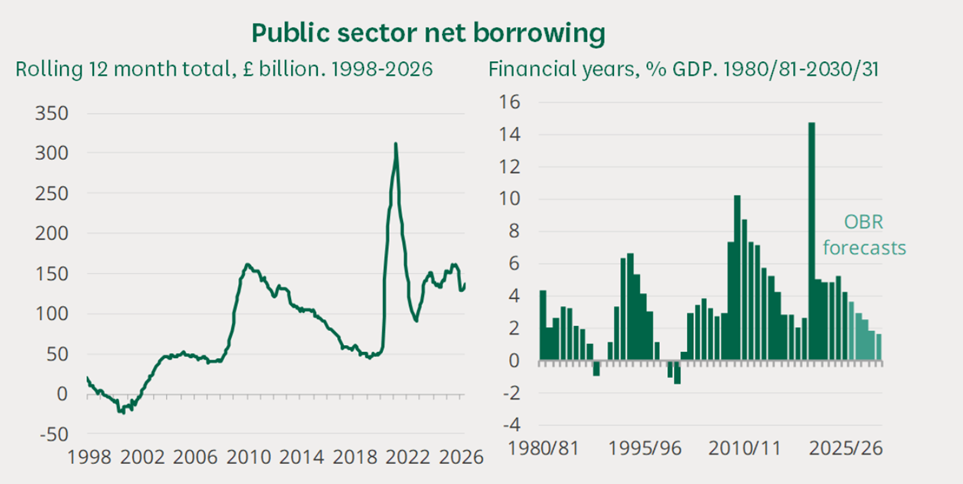
The concern is that Labour has already made policy choices markets see as costly under Starmer. His first budget kept public spending elevated and relied partly on borrowing, pushing up interest rates and crowding out some private activity. At the same time, sharp increases in the minimum wage and payroll taxes raised labour costs, squeezed margins, and contributed to persistent inflation and softer employment. The economy had begun to recover from these effects before the latest geopolitical shock. A renewed leftward shift risks repeating these dynamics, tilting the outlook towards weaker growth, higher inflation, tighter financial conditions, and, in a downside scenario, pressure on capital flows.
Source: ONS statistical office
Any new Prime Minister will, however, already be aware of the delicate fiscal position, and the discipline imposed by financial markets should help limit this risk. First, Labour’s electoral challenge now lies on the right: Reform UK benefited most from the recent backlash, while many Labour MPs must defend marginal seats won from Conservatives. A marked leftward move would therefore carry clear political risks, even if some overlapping policies, support for lower-income households and higher spending, remain tempting. Second, bond markets are likely to enforce fiscal discipline. With borrowing costs already high and fiscal space constrained, any slippage would quickly push up gilt yields and mortgage rates, limiting rather than expanding spending capacity. Leadership uncertainty may weigh on UK assets in the near term, but the key determinant remains policy credibility: fiscal discipline, not personalities, anchors the outlook. And it appears that Andy Burnham, a potential future Prime Minister, has already moderated his earlier stance on increased spending and on moving “beyond being in hock to the bond market,” as he once famously put it. Our base case remains: the new Labour government knows about the importance of acting fiscally responsible and we therefore do not expect markets to react strongly to the change in leadership. Also, we keep our view that the Bank of England could still cut its key rate towards the end of the year, on the back of a weaker economy and lower inflationary pressures.
What if there were new elections?
A general election, however, could give Burnham or another Labour politician a mandate to pursue a more expansionary fiscal policy, which the markets would probably not welcome. In particular, until the country’s new fiscal policy direction becomes clear, the markets could suffer from increased uncertainty. Therefore, markets also focus closely on any signs for a new potential finance minister and how fiscally disciplined they will likely act.
This is also likely to become relevant for the Bank of England, as a more expansionary fiscal policy, particularly measures that directly boost domestic demand through construction and infrastructure spending (as signalled by Andy Burnham, now a leading contender) or that increase household incomes through higher welfare and subsidies, could support stronger consumption growth. All of this could potentially lead to more domestic demand and investment and push inflationary pressures higher. This would at some point also incentivise the Bank of England to restrict their monetary policy in order to fight against any new inflationary pressures.
What could the pound do?
During the weeks since the regional elections on 7 May, the British pound depreciated further, mostly reflecting the decrease in expected key rate hikes by the bank of England but also incorporating some of the latest political risks. In particular, against the US dollar, the Fed’s latest hawkish shift in rhetoric has contributed to further depreciation of sterling. Although not our base case, a signal from the new leadership that fiscal policy could be loosened further would likely revive market concerns.
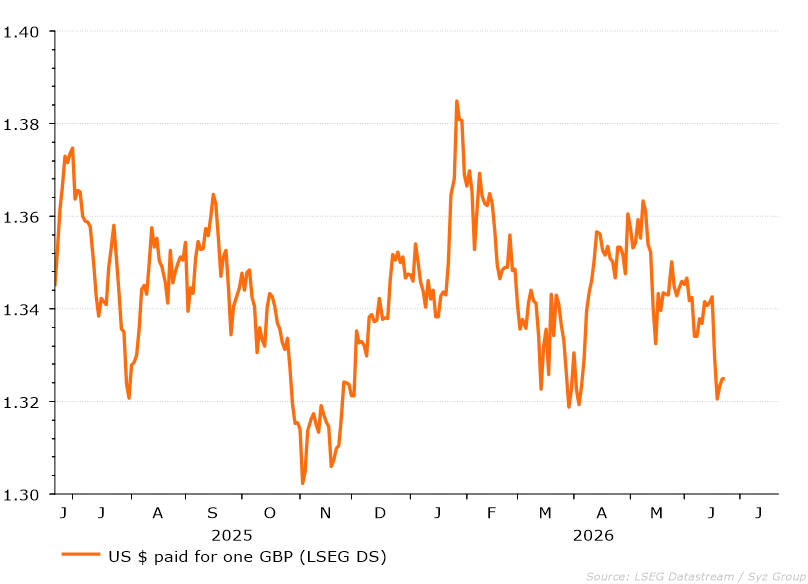
In our view, any fiscally irresponsible messaging from either the current or a future UK leadership team would put renewed downward pressure on the sterling against both the US dollar and the euro. The disciplining role of gilt markets should limit the scope for extreme policy shifts, but even a perceived weakening in fiscal credibility could be enough to weigh on the pound. Any signals for a potential snap election would likely increase volatility and keep to downward pressure on the sterling.
What does this mean for the bond markets?
Short-term market impact: The sterling bond market took Starmer's resignation in its stride. Gilts were broadly unchanged at the time of the announcement, a muted reaction that shows most of the political risk premium had already been discounted in the past weeks. With Burnham the clear favourite to take over by mid-July, the near-term uncertainty is less about the leadership itself, than about the choice of the Chancellor and the policy direction that follows. For now, markets appear to treat a swift, orderly transition as the base case.
Rate outlook: The more interesting story sits across the curve. At the front end, futures expect the Bank of England to implement at least one 25bp hike by the end of the year, but the scenario of BoE rate cut described above would leave room for the short end to rally. The long end is a different matter: a Burnham-led government points to looser fiscal policy, more gilt issuance and a term premium that is likely to stay sticky. With the front end anchored lower and the long end pressured by supply, the balance of probabilities points toward a steeper sterling curve into year-end.
While short-term rates can remain anchored by the BoE, upside risks prevail for GBP long-term rates. Markets still have vivid memories of the “Liz Truss moment” in 2022.
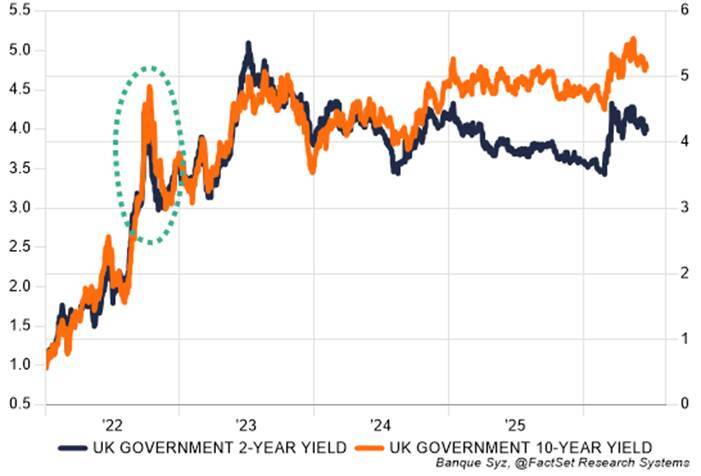
Debt sustainability questions add a long-term risk: Beyond the cycle, the UK carries a structural risk that bears directly on long-dated gilts. It is arguably the developed world's most exposed sovereign: real rates have converged on growth, structural pressures from health, defence and pensions persist, and foreign investors hold roughly 30% of gilts, leaving the market vulnerable to a sudden stop, as the 2022's LDI episode showed when Leveraged Liability-Driven Investment (LDI) funds used by pension schemes were forced into emergency asset sales when gilt yields spiked, forcing the Bank of England to temporarily intervene. This is not yet a solvency problem, but a credibility one with a long fuse, and it adds a persistent upward bias to long-term yields.
Sterling credit: Corporate bonds appear to be the cleaner opportunity. Sterling investment grade offers attractive all-in yields. We favour short-to-medium maturities, where the yield pick-up is most compelling and exposure to rate volatility is contained. Selectivity still matters: domestic banks, homebuilders and real estate names are more sensitive to rates, tax and regulation than globally diversified issuers, so we lean toward quality and resilient cash flows.
Conclusion: The recent developments reinforce a cautious approach to duration exposure and a negative view on long-dated gilts, which in the current regime add more volatility than performance and no longer reliably hedge equities in multi-asset portfolios. The public-debt overhang only sharpens that caution. Carry is to be favoured over duration risk, short-to-medium GBP investment grade over outright long-end exposure. Political clarity may trigger tactical relief at the long end, but the fundamental backdrop of positive nominal growth, sticky inflation and elevated borrowing costs is unchanged, and continues to favour the front-to-belly of the curve.
Implications for Equities
The equity implications remain clearly split between internationally exposed companies and domestically focused businesses. .
The FTSE 100 derives more than three-quarters of its revenues from outside the UK, making it one of the most internationally exposed major equity indices globally. As a result, UK political developments typically have only a limited direct impact on aggregate earnings. For many constituents, global growth, commodity prices, interest rates and currency movements matter far more than domestic policy changes. A weaker pound would, if anything, provide an additional tailwind through the translation of overseas earnings into sterling.
The valuation backdrop also remains supportive. At roughly 12.5x forward earnings, the FTSE 100 trades close to its 20-year average and at a substantial discount to major US equity indices. This leaves the market relatively insulated from a significant compression in valuation multiples, even if political uncertainty or higher gilt yields weigh on investor sentiment. Unlike more expensive markets, the FTSE 100 is not priced for perfection.
By contrast, UK domestically exposed sectors, including mid-caps, real estate, homebuilders, utilities and certain financials, remain significantly more sensitive to the domestic macroeconomic environment. The transmission mechanism operates primarily through financing costs, long-term interest rates and potential changes in taxation or regulation.
While valuations across many domestic sectors already reflect a subdued growth outlook, they remain vulnerable to any renewed increase in gilt yields or signs of fiscal slippage. Utilities warrant particular attention given their direct exposure to potential changes in government policy and the broader debate around public ownership and regulation.
Our preference remains for internationally exposed UK equities over domestic cyclicals. Political clarity may support short-term sentiment and trigger tactical relief rallies in domestically focused sectors. However, the fundamental investment backdrop remains unchanged: slow growth, sticky inflation and elevated borrowing costs continue to favour large-cap international businesses over UK domestic exposures.