



-
Democrats won a decisive sweep and are projected to control both chambers of Congress. They are on track for more than 250 House seats and a Senate majority built on flips that include Texas. The breadth of the shift, including traditionally Republican states, amounts to a substantial rejection of the administration halfway through Trump’s second term.
-
The main domestic consequence is gridlock rather than a reversal of Trump’s agenda. Democrats can block legislation, lead investigations and constrain appointments, including Fed governors, but they cannot override presidential vetoes. New fiscal stimulus is unlikely, while healthcare, financials, fossil fuels and data centres face greater political scrutiny.
-
Trump keeps substantial executive power over foreign and trade policy, so tariffs are unlikely to disappear. Heavy Republican losses may, however, increase pressure to end the Iran conflict and lower energy prices, and Congress should be more supportive of Ukraine.
- The market reaction has been contained. Before partly recovering, equity futures fell, led by technology and likely triggered by worries about tighter data centre permitting requirements. Treasuries rallied on expectations of gridlock and less fiscal stimulus, the expected Fed path shifted lower, and the dollar weakened.
- We see the result as slightly negative for growth, but potentially positive for inflation, rates and household purchasing power if energy prices ease. Markets have largely priced the weaker fiscal stimulus in, and fundamentals such as the AI capex cycle, broader investment, wage dynamics and consumer spending matter more. Less inflation could help over time and finally lead to more consumption and growth at some point.
A Democratic sweep puts Congress firmly in opposition to the White House
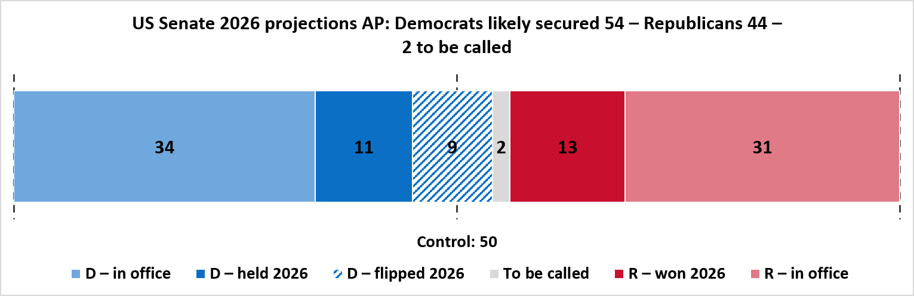
The 2026 midterm elections delivered a strong result for the Democrats. Although polling and betting markets had pointed to substantial Democratic gains, financial markets nevertheless appear to have been surprised by the decisiveness of the verdict at the ballot box. Most importantly, the Democrats are now projected to control both chambers of Congress when the new session convenes in January. In the House of Representatives, the Democratic victory is no longer simply a narrow change of control: current projections point to a comfortable majority of more than 250 seats, well above the 218 seats required, although counting continues and the final composition remains uncertain. This confirms a broad national swing towards the Democrats and suggests gains well beyond the handful of seats needed to capture the chamber. The Senate result is even more significant. Democrats have secured control after flipping several Republican-held seats, including in Iowa, Kansas, Maine, North Carolina, Ohio, South Carolina and Texas, while successfully defending important seats elsewhere. Texas delivered perhaps the most striking results: Democrat James Talarico won the Senate race, while Democrat Gina Hinojosa is projected to defeat Republican Governor Greg Abbott. Democrats also made important gains in gubernatorial contests in Ohio, Iowa and Georgia. Taken together, the results amount to a substantial rejection of the Republican administration halfway through President Trump’s second term. They give Democrats considerably greater legislative and oversight power for the next two years, although they do not provide the supermajorities required to impose their agenda against presidential opposition. The scale and geographic breadth of the shift, including victories in traditionally Republican states, also suggest that the election was driven by more than normal midterm dissatisfaction.
Domestic policy: gridlock, greater oversight and a shift in sectoral risks
The most immediate domestic consequence will probably be more political gridlock rather than a wholesale reversal of Trump’s economic agenda. Democrats can now block new Republican legislation, control congressional committees and investigations, and use their Senate majority to constrain presidential appointments, including Cabinet members, Supreme Court justices and Federal Reserve governors. President Trump nevertheless retains the power to veto legislation, which Congress can override only with a two-thirds majority in both chambers. Fiscal policy could therefore become increasingly confrontational. A new fiscal stimulus appears unlikely, while negotiations over appropriations, government shutdowns and especially the debt ceiling could provide Democrats with considerable bargaining leverage. At the sector level, healthcare is likely to face renewed political attention, with Democrats seeking to protect Medicaid and Affordable Care Act subsidies while pushing further on drug pricing and Medicare Advantage. Financial companies and fossil-fuel producers could face tougher congressional scrutiny and attempts to slow the deregulatory agenda, although executive agencies in Republican hands will retain considerable regulatory authority. Another important battleground will be AI infrastructure and data centres. Democratic governors elected in several important data-centre states favour greater restrictions, while congressional Democrats may challenge favourable tax treatment. Texas is particularly significant, given estimates that roughly one-quarter of the US data-centre pipeline is connected to the state. Concerns over electricity prices, grid investment, water consumption and the allocation of infrastructure costs could therefore become increasingly important constraints on the AI investment boom.
Foreign policy: greater constraints, but considerable executive power remains
Foreign policy is more nuanced because a Democratic Congress does not turn Trump into a powerless president. The White House retains substantial authority over foreign affairs and Trump remains commander-in-chief, although Congress can constrain his room for manoeuvre through appropriations, oversight and legislation. The Iran conflict is particularly important economically because elevated oil and petrol prices were closely linked to voters’ concerns about living costs. The Democratic victory, and heavy Republican electoral losses, may therefore increase domestic pressure on Trump to find an exit from the conflict and to lower energy prices. A political settlement could allow crude oil and gas prices to decline materially over the coming quarters, although this should be regarded as a scenario and not a forecast certainty. Negotiating signals from Tehran have recently contributed to lower oil prices, but Iranian officials have simultaneously cautioned that substantial disagreements remain. Ukraine represents another geopolitical fault line. A Democratic Congress should be more supportive of assistance to Kyiv, while the weakening of Trump’s authority within the Republican Party could limit attempts to force Ukraine into an unfavourable settlement. However, important executive powers remain with the president, including considerable influence over the timing and implementation of support. Finally, trade policy may prove surprisingly resistant to the electoral shift. Democrats can investigate Trump’s tariff policy and attempt legislative rollbacks, but presidential veto power and the administration’s ability to use executive trade authorities mean that tariffs are unlikely simply to disappear.
Markets: initially lower equities, but bonds rally as fiscal expectations soften
The initial market reaction has been visible but, so far, relatively contained. US equity futures fell as the scale of the Democratic gains became apparent, with technology leading the decline amid concerns that AI, data-centre investment and large technology companies could face greater congressional and state-level scrutiny. S&P 500 and Nasdaq 100 futures initially moved lower, although they subsequently recovered part of their early losses. The more pronounced move has been in fixed income: expectations of congressional gridlock and less fiscal stimulus supported Treasury prices, pushing two-year and ten-year yields moderately lower. The expected path for Federal Reserve policy also shifted slightly downwards, while the US dollar weakened.
Economic outlook: less fiscal impetus, but likely more pressure on Trump government to reduce energy prices
For the US economy, the election result creates two opposing forces. The first is weaker support for growth. With Democrats controlling Congress and President Trump having his veto power, the chances of another significant tax-cut or spending package fall considerably. The gridlock lowers the probability of further fiscal stimulus but raises the risk of disruptive debt-ceiling negotiations or temporary government shutdowns. More importantly for equities, Democratic victories in key data-centre states, notably Texas, Georgia and Ohio, could lead to tighter permitting requirements and higher development costs. While this introduces additional uncertainty for AI infrastructure investment beyond 2027, the near-term capex cycle appears largely intact. Stricter rules on data-centre construction and a possible review of tax incentives, however, could dampen one of the strongest drivers of US investment growth over time. This comes on top of existing headwinds. Elevated prices are holding back real wage growth, which points to slower business and consumer demand in 2027. Tighter immigration policy constrains labour-supply growth, although it has also helped keep the labour market remarkably resilient over the past two years.
The second force is a potential supply-side offset. If political pressure helps end the Iran conflict, a sustained fall in oil and petrol prices would lower headline inflation, raise households’ real disposable income and ease pressure on the Federal Reserve. The initial decline in Treasury yields and in expected Fed tightening already points tentatively in this direction, besides a lower probability of more fiscal impetus.
Overall, we see the midterms as slightly negative for growth, through weaker fiscal and investment momentum. They could, however, help bring inflation down, lower interest rates and support household purchasing power if geopolitical tensions and energy prices ease materially. Yet other fundamentals matter more. These include the global AI capex cycle and the manufacturing upturn it drives; a broader investment cycle that includes non-AI infrastructure; wages that keep pace with prices without triggering a wage-price spiral; consumer sentiment and spending; and, last but not least, fiscal spending outside the US.
Chart 1: Current projections for the seats in the House of Representatives calls for more than 250 Democratic seats
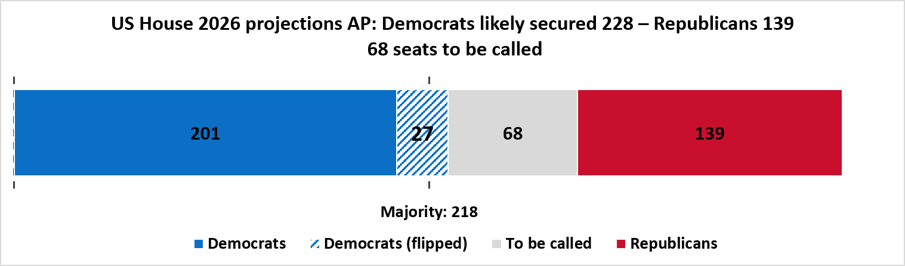
Chart 2: Current projection by Associated Press for the US Senate, calls for 54 Democratic seats
Disclaimer
This marketing document has been issued by Bank Syz Ltd. It is not intended for distribution to, publication, provision or use by individuals or legal entities that are citizens of or reside in a state, country or jurisdiction in which applicable laws and regulations prohibit its distribution, publication, provision or use. It is not directed to any person or entity to whom it would be illegal to send such marketing material. This document is intended for informational purposes only and should not be construed as an offer, solicitation or recommendation for the subscription, purchase, sale or safekeeping of any security or financial instrument or for the engagement in any other transaction, as the provision of any investment advice or service, or as a contractual document. Nothing in this document constitutes an investment, legal, tax or accounting advice or a representation that any investment or strategy is suitable or appropriate for an investor's particular and individual circumstances, nor does it constitute a personalized investment advice for any investor. This document reflects the information, opinions and comments of Bank Syz Ltd. as of the date of its publication, which are subject to change without notice. The opinions and comments of the authors in this document reflect their current views and may not coincide with those of other Syz Group entities or third parties, which may have reached different conclusions. The market valuations, terms and calculations contained herein are estimates only. The information provided comes from sources deemed reliable, but Bank Syz Ltd. does not guarantee its completeness, accuracy, reliability and actuality. Past performance gives no indication of nor guarantees current or future results. Bank Syz Ltd. accepts no liability for any loss arising from the use of this document.
Related Articles
Meanwhile, France’s debt problem has no clear political owner, and Europe’s housing markets are moving in different directions. Each week, the Syz investment team takes you through the last seven days in seven charts.
Meanwhile, France’s debt problem has no clear political owner, and Europe’s housing markets are moving in different directions. Each week, the Syz investment team takes you through the last seven days in seven charts.
US inflation is accelerating, yet Treasury yields are tumbling, raising fresh questions about bond market risks as hyperscaler debt issuance surges. Each week, the Syz investment team takes you through the last seven days in seven charts.