

Charles-Henry Monchau, CFA, CMT, CAIA

Chief Investment Officer

Grand Theft Auto VI arrived on 19 November with expectations few entertainment releases have ever faced. Ahead of launch, Sensor Tower, a market research firm, estimated 17 million pre-orders worth USD 1.65 billion, more than double the USD 800 million generated by GTA V on its first day in 2013. Nearly one in five US salaried workers surveyed planned to take the day off for the release. Logitech went a step further, offering its 7,300 employees worldwide an additional day off to play video games, a clever marketing move that also generated publicity for the brand. Few entertainment releases can generate billions before launch and influence working calendars across the globe. The game has also lived up to the hype. GTA VI opened with a Metacritic score of 99 out of 100 from more than 140 reviews, matching the record held since 1998 by The Legend of Zelda: Ocarina of Time. Yet as millions of players return to Vice City, the industry behind the game continues to cut jobs, close studios and are concerned with rising development costs. 


GTA VI is a defining moment for Take-Two

After thirteen years and two delays, GTA VI finally reached PlayStation 5 and Xbox Series X|S on 19 November. The standard edition carries a USD 79.99 price tag, with no PC release announced. Expectations could hardly be higher. GTA V has sold nearly 230 million copies across three console generations, contributing to nearly 500 million sales for the entire franchise. The launch was reportedly record-breaking, with approximately 24.6 million copies sold by Thursday evening, generating an estimated USD 2.36 billion in revenue according to Sensor Tower. The rollout was nevertheless marred by a PSN outage and some bugs.

Rockstar's parent company, Take-Two Interactive, maintained its forecast of USD 8.0-8.2 billion in net bookings for the fiscal year ending March 2027, approximately 20% above the previous year. The December quarter alone should generate USD 3.35–3.5 billion, nearly twice the USD 1.76 billion recorded a year earlier, a year without any major game releases. Chief executive Strauss Zelnick said pre-orders had reached unprecedented levels and were tracking far above initial expectations.

Early estimates already suggest an exceptional debut. According to Sensor Tower, roughly 75% of digital console pre-orders came from PlayStation 5, with almost 90% of buyers opting for the more expensive Ultimate Edition, which adds exclusive vehicles, weapons and outfits to the standard version.
These estimates exclude copies sold through the retail market and have yet to receive official confirmation from Take-Two. For perspective, GTA V recorded approximately 7 million pre-orders in 2013 before selling 11 million copies on its first day. GTA VI had already more than doubled that pre-order figure before launch. At the time of writing, Take-Two has not published any numbers of its own.
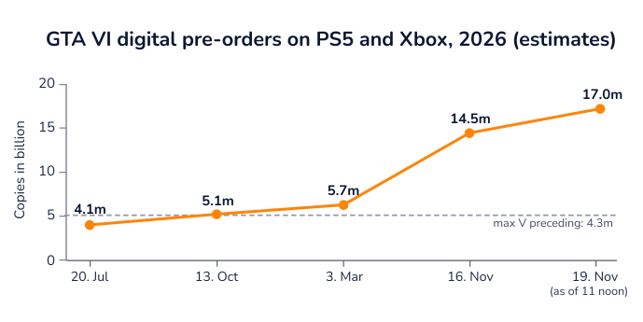
Source: Sensor Tower


Bigger than Hollywood and the music industry combined

The scale of GTA VI becomes easier to understand when looking at the industry behind it. Consumers spent about USD 202 billion on video games in 2025, according to Newzoo, a market research firm specialising in video games. By comparison, cinema ticket sales worldwide reached USD 33.6 billion and recorded music USD 31.7 billion. The gaming market is worth roughly three times the combined value of both industries.

Even entertainment’s biggest hits look small next to GTA VI. Its pre-orders alone, at USD 1.65 billion, exceed the USD 1.34 billion that Harry Potter and the Deathly Hallows: Part 2, the most successful film in the series, earned over its entire worldwide cinema run, according to Box Office Mojo. They are also worth 16 times the USD 103 million that Mariah Carey’s “All I Want for Christmas Is You” is estimated to have generated since 1994, according to Manatt, Phelps & Phillips, the music-industry law firm.


No longer a teenage hobby

The audience has changed as much as the market. The average American player is now 37 years old, up from 29 about two decades ago, and half of all players are 35 or older, according to the Entertainment Software Association. Unlike previous generations, many gamers have continued playing well into adulthood, with younger generations joining an increasingly broad audience. This gradual expansion across age groups gives gaming a demographic dimension that few would have associated with the industry twenty years ago.

In total, 212 million Americans, two thirds of the population, play at least one hour a week. The stereotype of the teenage boy no longer holds either. Men account for just 53% of players, and three-quarters of American parents play weekly.

This matters economically for two reasons. First, the people who bought GTA V as students in 2013 are now in their thirties, with higher incomes and fewer hours to spare. A USD 80 or USD 100 game therefore competes for a different consumer budget than it did thirteen years ago and explains the strong uptake of premium editions. Second, an adult audience spends differently. Instead of buying many new games, players increasingly spend years within the same gaming environments, purchasing additional content, virtual currencies and upgrades. At Take-Two, recurrent consumer spending, meaning in-game purchases, virtual currency and add-on content, already accounts for 81% of net bookings. GTA Online, launched in 2013, is the clearest example, it turned a one-off sale into a revenue stream that has lasted more than a decade. Much of GTA VI’s long-term value will depend on whether Rockstar can repeat that. 


Record revenues, but an industry under pressure 

Behind the headline numbers, the industry is under strain. The industry continues to experience layoffs, studio closures and declining profitability. The ASGC layoffs tracker counted almost 11,000 job losses in 2026 by late October, already more than in the whole of 2025, and around 35 studio closures.
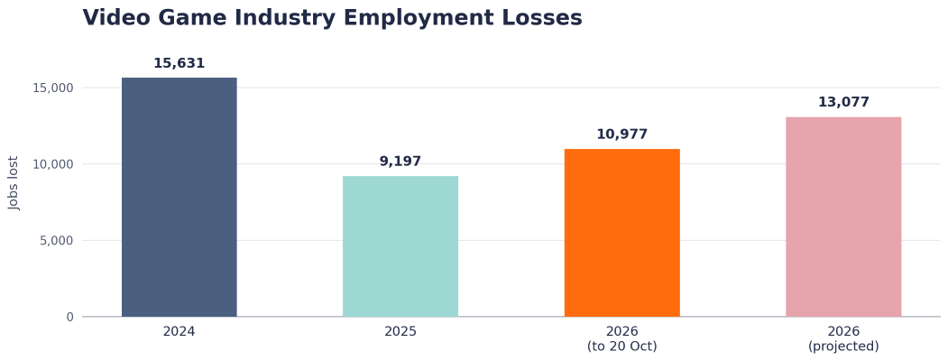
Several forces explain the gap between revenue and health. The most fundamental is competition for attention. Players’ free time is limited, and games now fight for it with short-video apps such as TikTok, sports betting apps and AI-powered entertainment. The rivalry runs both ways. As early as 2019, Netflix told its shareholders that it competed with Fortnite, and lost to it, more than it did with HBO, and it has since added games to its subscription. In this contest, even the industry’s hits take players from one another. Sensor Tower expects daily player numbers on other games to fall by more than 10% after GTA VI’s release. One company’s blockbuster can quickly become another’s problem.

This pressure collides with rising costs. Development budgets for large games have risen fast and the gains are increasingly concentrated. Roblox alone captured about two thirds of the industry’s net growth in 2025. Hardware is also getting more expensive, as a global memory shortage driven by artificial intelligence pushes up component costs. Sony raised the recommended US price of its PlayStation 5 to USD 649.99 in April, raising the cost of entry for new players.

The question extends beyond Take-Two. Large games take years to develop, consume cash long before they earn any, and can slip badly, as GTA VI did twice. That model sits uneasily with quarterly reporting and daily share price. In August, Electronic Arts, the publisher of EA Sports FC (formerly FIFA) and The Sims, left the stock market, taken private for USD 55 billion by Saudi Arabia’s Public Investment Fund, Silver Lake and Affinity Partners. Partly financed with USD 20 billion of debt, it is the largest private equity buyout on record. Away from public markets, EA can absorb delays more easily, though its debt adds pressure of its own.

GTA VI may generate billions in additional revenue, but its success could also come at the expense of competitors. Sensor Tower anticipates that daily player numbers across other games could decline by more than 10% following its release. In an industry competing for a finite amount of consumer attention, one company's blockbuster can quickly become another's problem. 

Take-Two: How much is priced in? 

For Take-Two, few product launches have carried stakes this high. As of 19 November, the company's valuation reflects the enormous expectations surrounding GTA VI. With much of its near-term growth tied to a single release, Take-Two faces a level of concentration rarely seen among large listed companies. Its position is arguably closer to that of a biotech awaiting the launch of a blockbuster drug than that of a diversified media group.

The company may be setting expectations below what the game can ultimately deliver. Take-Two booked USD 2.99 billion in the first half of the fiscal year, which implies USD 5.0 to 5.2 billion between October and March, against USD 3.34 billion a year earlier. The step-up of about USD 1.7 to 1.9 billion is mostly GTA VI. Even after deducting the roughly 30% fee that Sony and Microsoft take on digital sales, pre-sales estimate alone would cover a large part of that amount before the game is even released. This is why analysts asked on the earnings call why guidance had not been raised. Take-Two appears to be adopting a cautious approach to guidance, potentially leaving room to exceed expectations once actual sales figures become available.
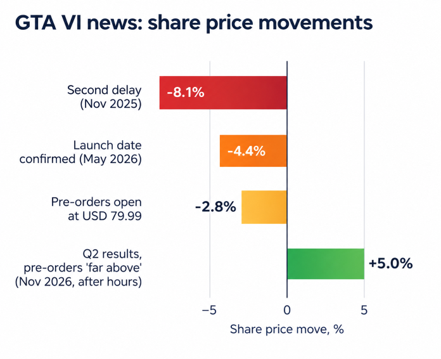
Source: Bloomberg


Who is exposed along the value chain 

Take-Two is not the only beneficiary. Sony stands among the main beneficiaries, collecting commissions on digital sales through PlayStation, which accounts for most GTA VI pre-orders. With nearly 98 million PS5 consoles shipped, the launch could also support hardware demand. Digital purchases already represent 78% of Sony's full-game sales, up from 72% a year earlier.

Other companies face a more complex outlook. Roblox, Netflix and YouTube compete for consumers' attention, while Unity and AppLovin depend on gaming development and advertising. Artificial intelligence adds another layer of uncertainty. When Google unveiled Project Genie, a tool generating interactive 3D environments, Unity fell 24%, Roblox 13% and Take-Two 7.9% in a single session. Although the technology cannot yet produce complete games, the reaction highlighted concerns about AI's potential to disrupt the industry.

AI could reshape the industry's economics by lowering development costs. However, it could also reduce barriers to entry, allowing smaller studios to produce increasingly sophisticated titles and intensifying competition for players' time. The key question is whether cost savings outweigh the competitive pressure. Established publishers may retain an advantage through strong franchises, loyal communities and distribution networks, while hardware suppliers such as AMD, Nvidia and Logitech could also benefit from sustained gaming demand. For investors, the longer-term opportunity extends beyond GTA VI to companies best positioned to capture value as the industry becomes increasingly digital and AI-driven. 


Conclusion

Video games have evolved into a mainstream form of entertainment, supported by an audience that has grown older, gained purchasing power and developed lasting gaming habits. GTA VI illustrates how major franchises can command higher prices, capture consumer attention and generate revenues long after their initial release. Yet its thirteen-year development cycle and estimated billion-dollar budget also highlight the rising costs and risks of producing blockbuster games. As development becomes increasingly expensive, fewer companies can afford projects of this scale. Artificial intelligence could help reduce production costs, but established franchises, loyal player communities and immersive gaming worlds may prove harder to replicate. Ultimately, GTA VI reflects both the enormous commercial potential of gaming and the growing challenges of sustaining success in an increasingly concentrated industry.


Disclaimer

This marketing document has been issued by Bank Syz Ltd. It is not intended for distribution to, publication, provision or use by individuals or legal entities that are citizens of or reside in a state, country or jurisdiction in which applicable laws and regulations prohibit its distribution, publication, provision or use. It is not directed to any person or entity to whom it would be illegal to send such marketing material. This document is intended for informational purposes only and should not be construed as an offer, solicitation or recommendation for the subscription, purchase, sale or safekeeping of any security or financial instrument or for the engagement in any other transaction, as the provision of any investment advice or service, or as a contractual document. Nothing in this document constitutes an investment, legal, tax or accounting advice or a representation that any investment or strategy is suitable or appropriate for an investor's particular and individual circumstances, nor does it constitute a personalized investment advice for any investor. This document reflects the information, opinions and comments of Bank Syz Ltd. as of the date of its publication, which are subject to change without notice. The opinions and comments of the authors in this document reflect their current views and may not coincide with those of other Syz Group entities or third parties, which may have reached different conclusions. The market valuations, terms and calculations contained herein are estimates only. The information provided comes from sources deemed reliable, but Bank Syz Ltd. does not guarantee its completeness, accuracy, reliability and actuality. Past performance gives no indication of nor guarantees current or future results. Bank Syz Ltd. accepts no liability for any loss arising from the use of this document.

Read More

Straight from the Desk

Syz the moment

Live feeds, charts, breaking stories, all day long.

Thinking out loud

Sign up for our weekly email highlighting the most popular posts.

Follow us

Thinking out loud

Investing with intelligence

Our latest research, commentary and market outlooks