

Introduction
Long-end government bond yields are at levels most investors in this market have never worked through. The US 30-year briefly cleared 5.33% this week, a 19-year high, and last week’s auction stopped at 5.216%, making it the most expensive 30-year money the Treasury has raised since 2001. France is at post-2008 highs, Germany at 2011 levels, 30-year gilts approaching 6%, and 30-year JGBs close to their all-time high.
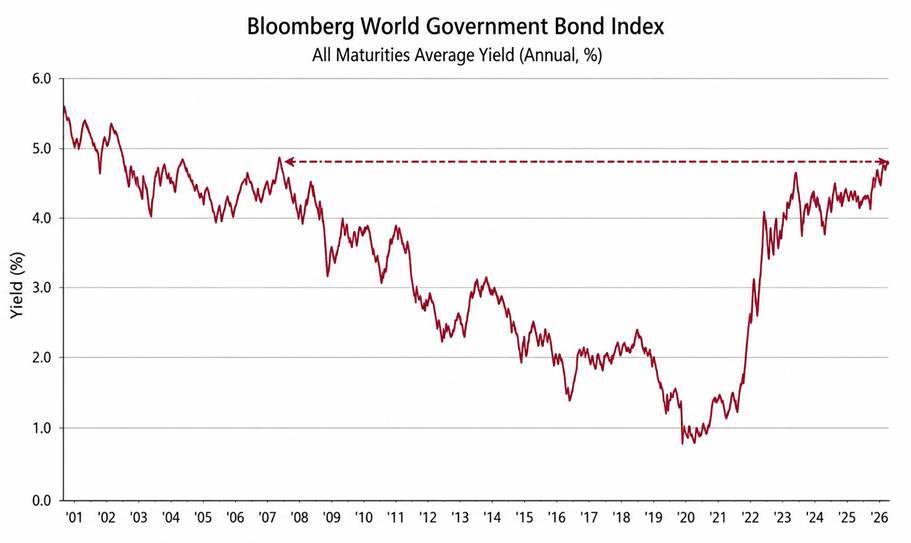
So what is actually going on? Three explanations are well rehearsed. The fourth, in our view, is the one that matters.
Part I — The supply problem
The three familiar answers
Energy and the war. Brent is around $90, up roughly a quarter from pre-conflict levels. With Hormuz transits still constrained and the EIA assuming Middle East production does not normalise until early 2027, the inflation impulse is persistent enough to keep inflation expectations elevated.
A Fed being tested. Fed funds have been held at 3.50–3.75% for five meetings, the June dots put the 2026 median at 3.8% with nine of eighteen pencilling in a hike, and the new Chair does not intend to guide markets. Less guidance means more rate volatility, which is itself a term-premium tax. At 4.18%, the 2-year is not pricing only a rate hike cycle, it is also pricing the uncertainty around a reaction function it does not yet know.
Elevated nominal growth. This deserves less handwringing than it gets. S&P 500 revenues grew 15% in Q2 and consensus has 2026 earnings up 30%. If nominal GDP is running hot, nominal yields belong higher. A 5% long bond alongside double-digit nominal growth is arithmetic, not distress. and is compatible with equities performing well.
None of that explains the shape of the move. Yields have refused to fall on softer data, and the curve has steepened from the long end rather than the short end and long dated breakevens have stayed anchored: the repricing has come almost entirely through real yields. For the time being, this is neither a structural inflation scare nor a long-term credibility problem.
Rates are increasingly a supply problem, not a central bank discipline problem.
Two claimants, one pool of savings
The world is being asked to absorb two structural waves of long-duration paper at once, and they compete with each other.
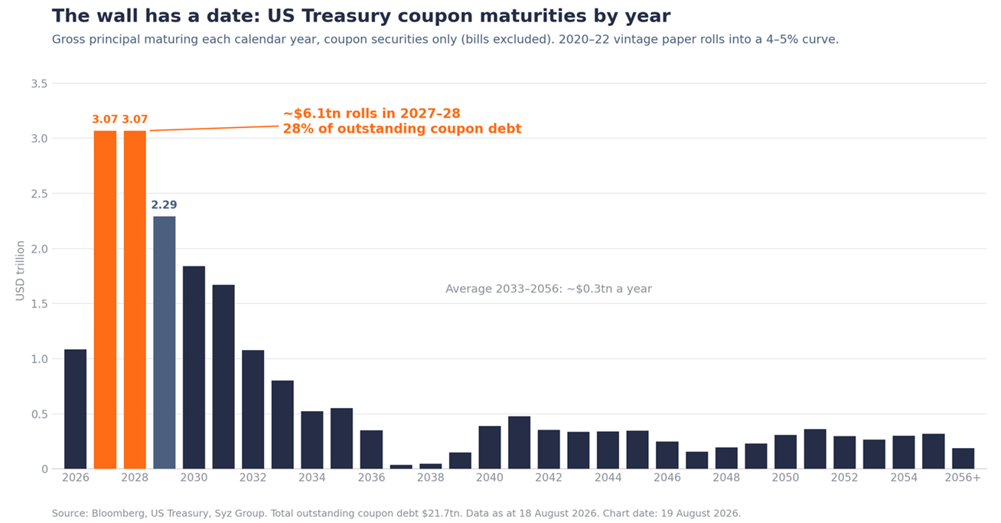
The first is sovereign. OECD central governments issued around $17tn in 2025 and are on track for roughly $18tn this year. US interest expense has reached $1.17tn ten months into fiscal 2026, up 15% year-on-year, against an average rate on outstanding debt of 3.44% — every refinancing is a step up. The refinancing wall is also unusually large: around $6.1tn of US government debt is scheduled to mature in 2027–28 and will need to be rolled over, much of it at higher rates. Treasury has so far held coupon sizes flat and pushed the burden into bills, but TBAC estimates that, if current auction/coupon sizes remain unchanged, it could still face roughly a $1.45tn financing gap over FY2027–28. The maturity wall is the gross refinancing challenge; the financing gap is the additional supply that existing auction sizes cannot absorb. Deferred duration supply, not absent duration supply.
The second is the AI build-out, and it is new. Goldman Sachs’ credit team counts roughly $489bn of AI-related supply so far this year, already well beyond their full-year 2025 estimate of $322bn. The five largest hyperscalers issued around $159bn of US corporate bonds in the first five months alone, against a 2020–24 average of $28bn a year. Goldman Sachs Asset Management puts hyperscaler issuance at 16–23% of gross year-to-date supply across the USD investment-grade, high-yield and leveraged loan markets. Big-five capex is tracking above $600bn, increasingly debt-funded as free cash flow stops covering it.
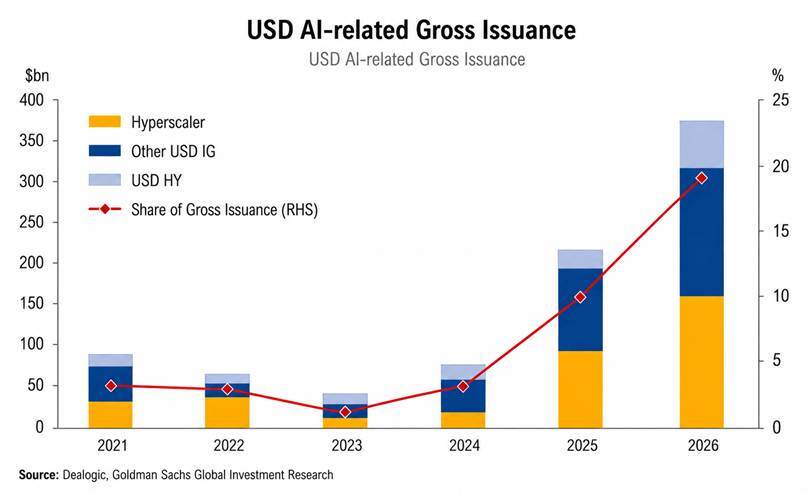
This is long-duration paper by design: the assets are long-lived and their economics do not vary with the cycle, so borrowers want fixed-rate liabilities far out the curve. The Dallas Fed has made the point explicitly. AI issuance is now a material source of duration supply, and it partly substitutes for, or crowds out, other investment-grade borrowers.
And the visible bond market is the smaller half of the story: private credit to AI borrowers has gone from near zero to over $200bn, and the big five carry some $662bn of data-centre leases not yet commenced, off balance sheet. The claim on global savings is larger than the league tables show.
Why the clearing price is the real yield
The mechanism is straightforward. There is a finite pool of global savings, and two enormous issuers are bidding for it at the long end just as the price-insensitive buyer base retreats: central banks are shrinking balance sheets, defined-benefit demand for long-dated matching assets is fading, and foreign official ownership of Treasuries is giving way to return-sensitive private investors — a shift to which Barclays attributes some 90bp of 30-year term premium.
When the marginal buyer is price-sensitive, the same quantity of paper requires a larger concession to clear. That concession is the real yield. It is not a judgement about inflation and not a verdict on the Fed, it is the price at which the world agrees to reallocate savings into data centres and deficits.
That leaves less for everyone else.
That process is already visible in the primary market. Last week’s 30-year auction saw indirect bidders take 66.8%, down from 77.7% in July, and five of the previous seven 20-year auctions have tailed. Order books for hyperscaler deals covered nearly five times the amount offered in February; by July, below two. Nobody has failed to raise money. Everybody is paying more for it.
There is a policy sting in the tail. Easing into this does not obviously lower long real yields. TThe constraint is the quantity of duration, not the price of overnight money, which may simply steepen the curve. The uncomfortable corollary is that re-anchoring the back end could require a Fed that is tighter, not looser, even into softening data.
Part II — One big trade
Look across the 2026 rally and it appears well diversified: equities at record highs, credit spreads through the floor, volatility subdued, gold firm above $4,400, EM carry performing. Different assets, different geographies, different risk factors.
They are not different trades. They are one trade expressed five ways, each a claim that the long-run real cost of capital is going to fall from here.
The market is trading the destination — lower real rates — and not the starting point, which is higher real rates.
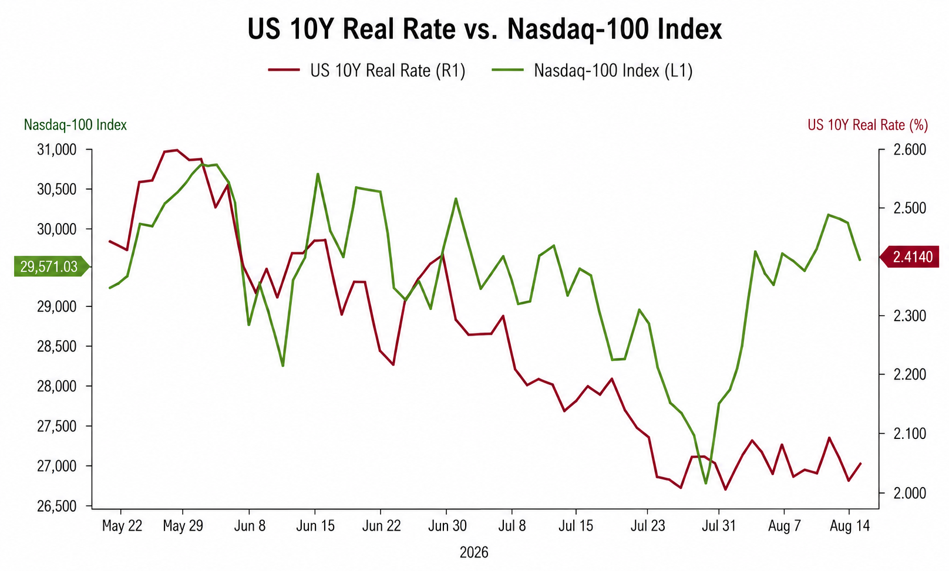
The numbers make the point uncomfortable. US high yield entered August around 271–281bp, in the richest decile of its history against a long-run median near 450bp; investment grade sits at 81bp. The S&P 500 printed a record 7,815 in mid-August on a forward multiple of 20x, with VIX around 15. Against all of that, July’s 10-year TIPS auction cleared at 2.438%, the highest at auction since October 2008, and the 30-year real yield is near 2.9%.
The bond market is pricing a materially higher equilibrium cost of capital than the equity and credit markets are. One of them is wrong.
The asymmetry
At these levels the payoff is brutally skewed. High yield has perhaps 40–50bp of compression available before all-time tights, against many hundreds of basis points of widening in any genuine downturn. With spread duration near 3.2 years, a 100bp move wipes out roughly five and a half months of carry; investment grade needs only about 70bp to erase a full year of income. The equity version is simpler: a 20x forward multiple is a statement about the discount rate, and the earnings growth doing the heavy lifting sits in precisely the companies issuing the debt.
The correlation trap
The diversification also fails in exactly the state of the world where it is needed. If long real yields grind higher on supply, bonds and equities fall together — 2022 again, different cause, same consequence. Investors holding duration as their equity hedge are covered against a growth shock but not a supply shock, which is the wrong insurance policy given where the pressure is coming from.
One leg of the complex has already broken ranks, which is instructive. The dollar has firmed rather than softened, precisely because US real rates rose. FX has repriced to the higher-real-rate world. Credit and equity have not. That is not proof, but it is a tell.
How this is resolved
There are only two clean endings. Either real rates fall towards where equities and carry assets already think they should be, validating the rally, or those assets reprice to a world of structurally higher real rates. Real rates are the tiebreaker, and one side gets proven right.
What makes the set-up unstable is that it is not a clean, soft landing: softening growth, moderating inflation, robust risk appetite and still-restrictive real rates, all at once. Markets treat slower growth as a reason to own risk, assuming it delivers an easing cycle. But if the binding constraint on long real yields is the quantity of paper rather than the stance of policy, slower growth delivers weaker earnings without the lower discount rate meant to compensate for them.
What we are watching
- Auction internals over auction headlines. Indirect share, tails and dealer take-down at the 20- and 30-year points say more than the stop-out yield does.
- Hyperscaler order books. Coverage falling from 5x toward 2x, and the size of new-issue concessions, is the cleanest read on where competition for capital binds.
- The 10-year real yield around 2.60%. Pinned at or above that level, risk assets are relying on an easing cycle visible in expectations but absent from discount rates.
- Treasury’s issuance mix. Lifting coupon sizes rather than pushing further into bills converts deferred duration supply into present supply, and the FY2027–28 shortfall says that decision is coming.
- Capex discipline. A hyperscaler signalling slower spend would be bearish equities and bullish duration at once — the one development that resolves the supply problem, and not pleasantly.
What it means for portfolios
None of this points to wholesale de-risking. Yields driven higher by an investment boom and heavy sovereign supply are not a credit accident. The more useful question is whether portfolios are being paid for the risks they are actually running.
-
With the curve steepening from the long end, the front end and belly now offer a greater share of available yield, while longer maturities carry greater exposure to fiscal and AI-related supply.
-
Real yields of 2.3–2.9% are unusually high by recent historical standards, while index-linked bonds provide protection against an inflation risk that nominal duration does not.
-
With index spreads tight, differences between individual issuers may become increasingly important to credit outcomes.
-
The distinction between companies funding growth from free cash flow and those funding it in the bond market should become more visible: crowding out is felt first by the borrower who is neither sovereign nor hyperscaler.
-
A portfolio relying on nominal duration as its equity hedge is insured against a growth shock rather than a supply shock. Against the latter, the two legs are correlated rather than offsetting.
Bottom line
Bond yields are rising because too much paper is chasing a shrinking pool of price-insensitive buyers, not because central banks have lost their nerve. That is a quantity problem, and quantity problems clear through real rates. The 2026 rally rests on a single unconfirmed assumption: that real rates are on their way down. The market is far less diversified than it looks, and the bond market is not yet convinced, leaving the rally vulnerable to further volatility in the weeks ahead.
Disclaimer
This marketing document has been issued by Bank Syz Ltd. It is not intended for distribution to, publication, provision or use by individuals or legal entities that are citizens of or reside in a state, country or jurisdiction in which applicable laws and regulations prohibit its distribution, publication, provision or use. It is not directed to any person or entity to whom it would be illegal to send such marketing material. This document is intended for informational purposes only and should not be construed as an offer, solicitation or recommendation for the subscription, purchase, sale or safekeeping of any security or financial instrument or for the engagement in any other transaction, as the provision of any investment advice or service, or as a contractual document. Nothing in this document constitutes an investment, legal, tax or accounting advice or a representation that any investment or strategy is suitable or appropriate for an investor's particular and individual circumstances, nor does it constitute a personalized investment advice for any investor. This document reflects the information, opinions and comments of Bank Syz Ltd. as of the date of its publication, which are subject to change without notice. The opinions and comments of the authors in this document reflect their current views and may not coincide with those of other Syz Group entities or third parties, which may have reached different conclusions. The market valuations, terms and calculations contained herein are estimates only. The information provided comes from sources deemed reliable, but Bank Syz Ltd. does not guarantee its completeness, accuracy, reliability and actuality. Past performance gives no indication of nor guarantees current or future results. Bank Syz Ltd. accepts no liability for any loss arising from the use of this document.
Related Articles
A video published three years ago on YouTube can still be earning money today. Nobody had to make it again. No customer had to be reacquired. The production cost was paid years ago, but the cash flow continues. That makes old video libraries look a lot like annuities and financial buyers are starting to take notice.
A new generation of AI-powered brokerage tools promise to hand individual investors the automated trading capabilities once reserved for elite hedge funds, but the evidence tells a far more mixed story.
Smart glasses are being presented as the next smartphone. Yet their success may depend less on their technological capabilities than on the trust they manage to inspire.


