

Introduction
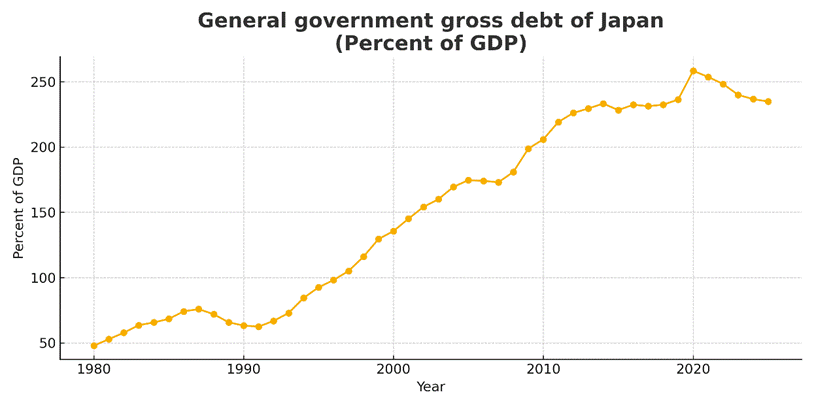
There is no statistic in global finance more frequently cited, and more frequently misunderstood, than Japan's debt-to-GDP ratio. At roughly 230% of GDP, it is the highest among major developed economies, more than double the United States and nearly four times that of Switzerland. Decades of primary deficits, an aging population, and rising social-security burdens have entrenched the figure, and it features in virtually every bearish macro thesis on the yen, on Japanese government bonds, or on the global financial system itself.
And yet, since Shinzo Abe launched the policy mix that bears his name in 2012, Japanese assets have not behaved like those of a country sliding toward fiscal crisis. The Nikkei 225 has tripled. The yen has weakened, but Japan's external position has strengthened. Government bond yields, even after the Bank of Japan's recent normalisation, remain anchored near 2%. Something in the conventional narrative is missing.
A new paper in the Journal of Economic Perspectives by Yili Chien (Federal Reserve Bank of St. Louis), Wenxin Du (Harvard Business School) and Hanno Lustig (Stanford GSB) provides the missing piece. Looking at the consolidated balance sheet of the Japanese public sector—central and local government, the Bank of Japan, the Government Pension Investment Fund, public financial institutions—the authors show that Japan has quietly built one of the largest leveraged investment portfolios in history. Their description is that Japan now operates a sovereign wealth fund financed with borrowed money.
The two sides of the balance sheet
Most commentary on Japanese fiscal sustainability stops at the liability side: gross debt at around 234% of GDP at year-end 2024, well above any peer. What that figure ignores is what the public sector has been doing on the asset side over the same period.
Source: ICIS
Since 2012, three policy decisions have transformed the composition of public-sector assets in Japan. First, the Bank of Japan's quantitative and qualitative easing programme included direct purchases of equity ETFs, a tool no other major central bank has used at scale. Second, the Government Pension Investment Fund (GPIF) doubled its target equity weighting in 2014, moving from roughly a quarter of its portfolio in stocks to half, split evenly between domestic and foreign equities. Third, public financial institutions and social security funds steadily added to their international securities holdings, with very limited currency hedging.
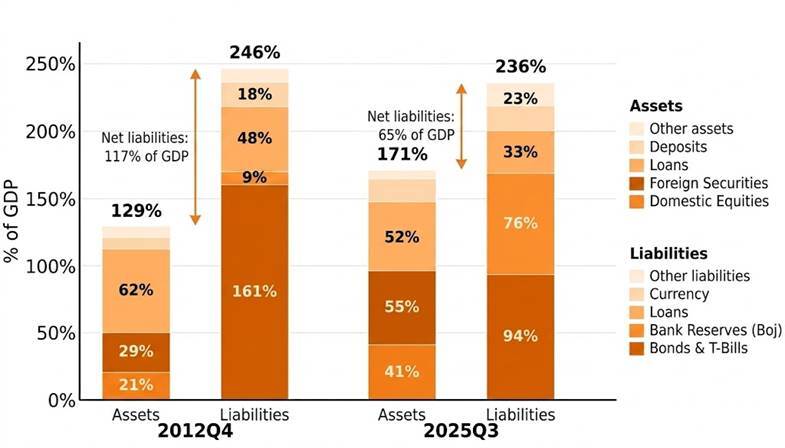
The cumulative effect has been substantial. Chien, Du and Lustig estimate that the consolidated public sector now holds approximately 95% of GDP in risky assets, domestic equities and unhedged foreign securities, against roughly 18% of GDP in 1997. On the funding side, the public sector has shifted from borrowing through the postal-savings system (the old FILP) to issuing JGBs and, increasingly, bank reserves at the Bank of Japan that for years paid zero or even negative interest.
This is, mechanically, a carry trade, but executed at the scale of a national balance sheet. Borrow short, at rates the central bank controls. Invest long, in equities, foreign bonds and unhedged dollar assets. Pocket the spread.
From 2013 to 2023, the Japanese public sector earned an annualised excess return of roughly 4.7% above its funding costs, equivalent to about 6% of GDP per year, or roughly the size of Japan's defence and education budgets combined.
The result is a dramatic divergence between gross and net liabilities. While gross debt has continued to rise toward 240% of GDP, the authors estimate that net consolidated liabilities have fallen from approximately 117% of GDP in 2012 to around 65% in 2025, despite Japan running a primary deficit every single year of the period. Without the rotation into risky assets, they calculate, net liabilities would have surpassed 180% of GDP by 2024.
Put differently, Japan has been printing yen and using them to buy stocks, and the stocks have gone up by enough to offset the new debt—so far.
Source: Composition of the consolidated public sector balance sheet (2012 vs. 2025), Japan’s National Accounts, Financial Times, Verdad
The numbers behind the trade
It is worth pausing to appreciate the size of the positions involved, because they are difficult to grasp in the abstract.
- The Bank of Japan, which began purchasing ETFs in 2010 and accelerated under Abenomics, ended September 2025 with ETF holdings worth about ¥83 trillion, roughly $530 billion at prevailing exchange rates, or approximately 7% of the entire Tokyo Stock Exchange market capitalisation. Of that, around ¥46 trillion represents unrealised paper gains.
- The Government Pension Investment Fund manages approximately $1.87 trillion as of September 2025, making it the largest pool of retirement savings in the world. About half is in equities, split roughly evenly between Japanese and foreign listings.
- Including these vehicles and other public institutions, the consolidated public sector holds domestic equities equivalent to roughly 39-41% of GDP and unhedged foreign securities equivalent to about 57-62% of GDP, figures that no other developed economy comes close to.
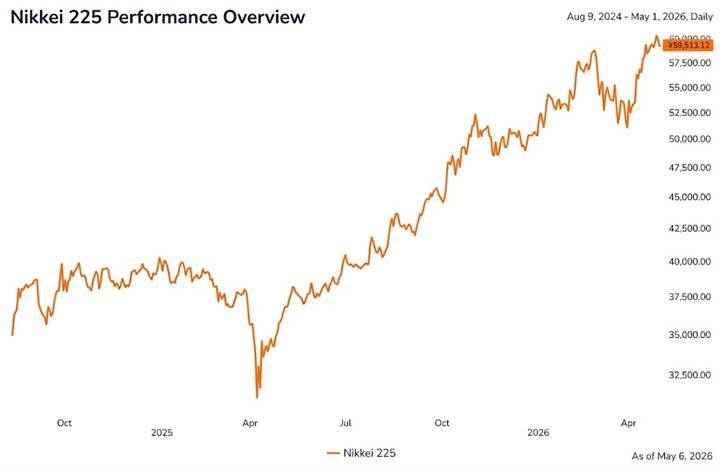
The performance has been extraordinary. The Nikkei 225 closed 2025 at 50,339, a 26% annual gain and the third consecutive year of double-digit returns. By February 2026 it had broken through 58,000, and by early May it stood near 59,500. Over twelve months, the index gained more than 60%. GPIF reported net returns of 9.83% for the first half of fiscal 2025 alone, after a relatively modest 0.71% in fiscal 2024.
Source: Factset
The Bank of Japan's position is even more remarkable. Its ETF book carries unrealised gains of roughly 124% on cost, a staggering paper profit on what was originally framed as a monetary-policy operation rather than an investment programme. At a meeting in September 2025, the BOJ announced it would begin selling these holdings, but at a pace of roughly ¥330 billion per year at book value. At that rate, full disposal would take well over a century.
Why corporate governance reform is macro policy
Once you see Japan's public sector as a leveraged equity investor rather than simply a heavily indebted government, several puzzling policy choices snap into focus.
The most important is the Tokyo Stock Exchange's March 2023 request that listed companies adopt management practices conscious of cost of capital and stock price. The TSE asked boards to assess profitability, capital efficiency and market valuation, and to disclose plans for improvement, with a particular focus on the roughly 50% of listed firms then trading below book value. By March 2025, more than 90% of Prime Market companies had responded with disclosures, and over 60% had updated their initial commitments by July.
This is conventionally described as long-overdue corporate housekeeping: unwinding cross-shareholdings, deploying excess cash, lifting return on equity, narrowing the persistent valuation gap between Japanese stocks and global peers. All of that is true, but it understates what is happening. When the state itself owns 7% of the equity market through one institution and another 14% of GDP through a pension fund, every percentage point added to corporate ROE flows directly into the sovereign balance sheet. Higher equity prices are not just shareholder-friendly; they are fiscally significant.
The data supports this reading. Japanese share buybacks reached more than ¥10 trillion in fiscal 2024, with another ¥6 trillion announced in just the first two months of fiscal 2025, 50% ahead of the prior year's pace. Cross-shareholding unwinds have accelerated sharply, with the three largest non-life insurers committing to fully eliminate strategic stakes. Activist campaigns and unsolicited takeover bids, once unthinkable in Japan, have become routine. Private equity inflows have followed, with KKR's co-founder publicly observing that Japan would be the destination for any 30-year-old he was advising today.
None of this is accidental. It is what happens when a sovereign with a very large equity book decides to actively manage that book.
The risks the carry trade conceals
The same mechanics that have repaired Japan's balance sheet over the past decade also describe how that balance sheet could deteriorate quickly. A national-scale carry trade is still a carry trade, and carry trades carry tail risks.
Three vulnerabilities deserve particular attention. The first is interest-rate risk. Approximately 91% of GDP in public-sector liabilities sits in floating-rate bank reserves at the BOJ; the corresponding asset is concentrated in long-duration securities, Japanese stocks have an estimated effective duration of around 75 years given current valuations, and the JGB index runs around 7 years. Even modest increases in funding costs imply meaningful mark-to-market losses on the asset side. The BOJ's policy rate hike to 0.75% in December 2025, the highest since 1995, marks the start of a normalisation that the authors of the JEP paper argue is genuinely dangerous to the strategy.
The second is currency risk. Japan's public sector holds an unhedged foreign-securities position equivalent to roughly 62% of GDP. That has been a source of windfall gains during the yen's weakening from 110 to 155 against the dollar, but the same exposure cuts the other way during yen-strengthening episodes, as those who watched the August 2024 carry-trade unwind will recall. The yen carry trade is not a Japanese phenomenon alone; estimates of its size run into the trillions of dollars globally, and the public sector sits at the centre of the position rather than at the margin.
The third is equity-market risk, and it is the most psychologically uncomfortable for policymakers. The same dynamic that allowed Japan to repair its balance sheet through asset appreciation also leaves it acutely exposed to a sustained bear market. A 30% correction in domestic equities and unhedged foreign securities, if accompanied by a yen appreciation, would erase a meaningful portion of the gains accumulated since 2012 and force the public sector to confront a far harder set of choices. This is the asymmetry of leverage. The same mechanism that compounded gains on the way up compounds losses on the way down.
Sanae Takaichi's arrival as prime minister in October 2025 added a further layer of complexity. Her ¥21.3 trillion supplementary stimulus package, the largest since the pandemic, deepens fiscal expansion at precisely the moment monetary policy is tightening. The 10-year JGB yield has now moved through 2% for the first time in two decades, while the yen has remained weak, markets seem unconvinced that the policy mix is sustainable on its current trajectory.
What this changes for global investors
Three implications follow for institutional asset allocators.
First, the standard framing of Japan as a fiscal time bomb is incomplete. The consolidated balance sheet is in materially better shape than the gross debt headline suggests, and the Japanese public sector has both the institutional capacity and the political incentive to defend the equity-market levels its solvency now depends on. This does not eliminate fiscal risk, but it reframes it: the binding constraint is not debt service but the joint behaviour of equity prices, the yen, and the level of short rates.
Second, Japanese corporate governance reform is more durable than the typical reform-fatigue narrative implies. The reforms have a sovereign sponsor with a balance-sheet stake in their success, which is precisely why the TSE has continued tightening expectations rather than declaring victory. For active equity investors, this remains one of the more compelling structural alpha opportunities in developed markets. For passive allocators, the case for raising Japan weights from typical 5–6% benchmark levels has rarely been stronger, particularly given that domestic households and corporates alone could continue to absorb supply.
Third, the symmetry of the trade should be respected. The conditions that have made Japan's strategy successful, financial repression at home, dollar strength abroad, equity bull markets globally, are not laws of nature. A scenario in which the Federal Reserve cuts aggressively, the dollar weakens substantially against the yen, and global equities correct simultaneously would put unprecedented stress on the Japanese public balance sheet. That scenario is not the base case, but it is no longer dismissible either.
Conclusion
Japan has the highest debt-to-GDP ratio in the developed world. But stopping at that figure means looking only at the liability side of the balance sheet, without accounting for the assets. On the other side, the Japanese state holds a massive, leveraged investment portfolio that has performed exceptionally well over the past decade.
This perspective changes how Japan’s risk should be assessed. As Chien, Du and Lustig show, analysing debt without incorporating public-sector assets gives an incomplete and potentially misleading picture of fiscal sustainability.
Japan is therefore not merely reforming its companies or adjusting monetary policy. It is managing a national portfolio that has become central to the balance of its public finances, far removed from the simplistic narrative of a country crushed by debt.Disclaimer
This marketing document has been issued by Bank Syz Ltd. It is not intended for distribution to, publication, provision or use by individuals or legal entities that are citizens of or reside in a state, country or jurisdiction in which applicable laws and regulations prohibit its distribution, publication, provision or use. It is not directed to any person or entity to whom it would be illegal to send such marketing material. This document is intended for informational purposes only and should not be construed as an offer, solicitation or recommendation for the subscription, purchase, sale or safekeeping of any security or financial instrument or for the engagement in any other transaction, as the provision of any investment advice or service, or as a contractual document. Nothing in this document constitutes an investment, legal, tax or accounting advice or a representation that any investment or strategy is suitable or appropriate for an investor's particular and individual circumstances, nor does it constitute a personalized investment advice for any investor. This document reflects the information, opinions and comments of Bank Syz Ltd. as of the date of its publication, which are subject to change without notice. The opinions and comments of the authors in this document reflect their current views and may not coincide with those of other Syz Group entities or third parties, which may have reached different conclusions. The market valuations, terms and calculations contained herein are estimates only. The information provided comes from sources deemed reliable, but Bank Syz Ltd. does not guarantee its completeness, accuracy, reliability and actuality. Past performance gives no indication of nor guarantees current or future results. Bank Syz Ltd. accepts no liability for any loss arising from the use of this document.
Related Articles
The AI story has been one of relentless momentum. ChatGPT marked the first chapter, transforming OpenAI into the central force behind the industry’s expansion. The company now faces the challenge of supporting the scale of investment behind it.
Major infrastructure trades often look obvious only after the fact. Railroads created fortunes not just through transport, but through the land and networks built around them. Undersea fibre cables were once seen as overcapacity before becoming the backbone of the internet. Investors who identify the infrastructure layer before the applications fully emerge tend to be early to the real value creation. Leopold Aschenbrenner, a former OpenAI safety researcher with no traditional finance background, appears to have identified such an opportunity.
Somewhere right now, an employee is producing what once required an entire team. The difference comes from the tools and systems now embedded in the workflow. As processes become faster and simpler, fewer layers are needed within the company. This evolution is quietly becoming one of the most significant organisational changes of the decade. Many companies are only starting to realise it.


