
The launch of Muse, Meta's new personal AI agent, has become one of the most widely discussed developments in tech investing this month. Currently available only in the US, Muse differs from conventional chatbots by performing tasks on a user's behalf, from managing emails and schedules to researching products, booking services and completing multi-step workflows.

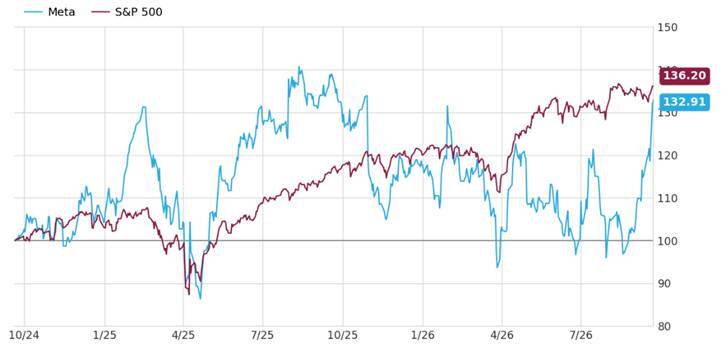
Investor enthusiasm has been considerable. After trailing the market for more than a year amid concerns about rising AI spending and slowing earnings momentum, Meta shares rose sharply following the launch of Muse, including an 11% gain on 21 September alone. The speed of the move suggests that investors are reassessing the potential return on Meta's substantial AI investments.

Yet it is important not to overinterpret the early data. Successful consumer technology platforms are rarely determined by download statistics in their first few weeks. Adoption, engagement and monetisation typically develop over years rather than months.

The timing is also notable. Meta is hosting its annual Connect developer conference on 23-24 September, where investors expect further updates on Muse, Meta's broader AI roadmap and future agent capabilities. With investor attention already focused on Muse, Connect is likely to provide the first meaningful indication of how Meta intends to develop and monetise the platform.

The key question for investors is therefore not whether Muse had a successful launch, but whether it can evolve into a durable platform that changes Meta's long-term earnings power.

Chart 1: Meta share price versus the S&P 500

(Two-year total-return chart, indexed to 100 at the starting date)
Source: Factset (22 September 2026)


Why Muse matters 

For years, investors have viewed Meta's AI investments primarily to strengthen its advertising business. AI-powered recommendations and targeting have improved engagement and helped support earnings growth, but they have not fully addressed concerns about the company's rapidly rising spending on infrastructure and model development.

Muse changes that conversation. Rather than using AI solely to enhance existing products, Meta is attempting to create a new category: the personal AI agent, distributed through platforms — Facebook, Instagram, WhatsApp and Messenger — that already reach approximately 3.5 billion users. That distribution advantage, more than any single feature, is what OpenAI, Anthropic and other leading AI developers cannot easily replicate. The significance of Muse is not its current revenue contribution, which remains negligible, but the possibility that it could eventually support standalone revenue streams outside the company's traditional advertising ecosystem.

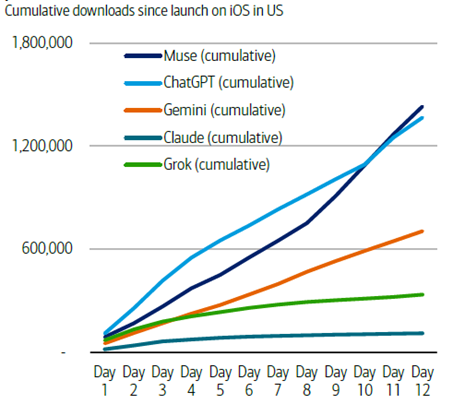
Early evidence supports that read: Muse quickly climbed app-store rankings and, by day 12, its cumulative US iOS downloads had moved ahead of ChatGPT's comparable launch trajectory. These figures should not be overinterpreted, but they suggest Meta's distribution engine can generate consumer awareness and experimentation at exceptional scale.

As a result, the debate is shifting from whether Meta can build competitive AI products to whether it can build a platform on top of them.

Chart 2: Muse cumulative downloads have outpaced other AI platforms since launch
Source: Sensor Towers, Bank of America


Beyond the chatbot 

What differentiates Muse from most AI products is its ability to act rather than simply provide information.

If consumers increasingly delegate tasks to AI agents, the way they interact with the internet could begin to change. Instead of browsing multiple websites and completing transactions manually, users could instruct an agent to research options, make purchases or manage subscriptions on their behalf.

This possibility is fuelling debate about how AI agents could reshape internet economics. Companies that monetise traffic, advertising or customer acquisition may face disruption if the agent becomes the primary interface between consumers and online services.

Reactions across the industry have not been uniform. Amazon has taken a defensive approach, blocking Muse from its marketplace outright and citing unauthorised access to its platform, while Shopify has moved the other way, integrating its merchant catalogue into Muse and announcing plans for Shop Pay checkout inside the agent. Investors welcomed the latter development, sending Shopify shares higher.

The contrast is instructive. AI agents may not simply destroy value across the internet. Some business models could come under pressure, while others may emerge as critical infrastructure in an increasingly agent-driven economy 

Agent-to-agent commerce could be the real prize

The most compelling strategic opportunity is not consumer subscriptions, but business participation.

Meta has begun allowing developers to build connectors that integrate external services into the Muse ecosystem. Over time, businesses could create their own agents that interact directly with consumer agents. A user's agent might negotiate with a retailer's agent, book directly with an airline or arrange an appointment with a healthcare provider, while Meta earns transaction fees, commissions or outcome-based payments.

This vision remains highly speculative, and the commercial model is largely untested. However, it is the first credible framework investors have identified that could link Meta's substantial AI investments to a meaningful new revenue opportunity.

Trust may become the ultimate adoption constraint

One risk that has received less attention from investors is user trust. Unlike conventional chatbots, personal agents require deep access to an individual's digital life. To deliver their full functionality, they may need access to emails, calendars, subscriptions, payment methods, browsing activity and connected applications. The trade-off is straightforward: greater access enables greater utility but also requires greater trust.

For many consumers, allowing an AI system to read correspondence, manage purchases or interact with third-party services represents a much larger leap of faith than asking a chatbot a question.

Muse must therefore persuade users not only to try the product, but also to grant access to increasingly sensitive parts of their digital lives. If the utility clearly outweighs the privacy trade-off, adoption could accelerate. If not, usage may remain superficial and engagement could plateau before Meta reaches the scale required for a meaningful business model.

This challenge is particularly relevant given Meta's history with personal data. Trust should therefore be monitored alongside user growth, retention and monetisation.

Meaningful monetisation is likely still several years away

Today's Muse thesis rests primarily on optionality rather than earnings. The product has improved confidence in Meta's long-term AI strategy, but it has not materially changed near-term financial expectations. Meta's core advertising business remains the principal driver of revenue, profits and valuation.

Investors should also be cautious about reading too much into early download data. Sustained usage, retention, connected accounts and completed tasks will matter far more than launch-week rankings.

Other risks remain substantial. Competition from OpenAI, Google and Anthropic is intense. Adoption may slow once the initial novelty fades, privacy concerns could limit permission sharing, and agentic workloads remain expensive to run.

The recent re-rating should therefore be interpreted as increased confidence in Meta's AI strategy, not validation of a new profit engine.


Bottom line

Muse may prove to be Meta's most important new product since Reels, but it remains far too early to know whether it will ultimately justify the enthusiasm reflected in the share price.

For the first time, however, investors can see a credible pathway from Meta's enormous AI investments to a potential business model built around personal agents, business agents and eventually agent-to-agent commerce.


Disclaimer

This marketing document has been issued by Bank Syz Ltd. It is not intended for distribution to, publication, provision or use by individuals or legal entities that are citizens of or reside in a state, country or jurisdiction in which applicable laws and regulations prohibit its distribution, publication, provision or use. It is not directed to any person or entity to whom it would be illegal to send such marketing material. This document is intended for informational purposes only and should not be construed as an offer, solicitation or recommendation for the subscription, purchase, sale or safekeeping of any security or financial instrument or for the engagement in any other transaction, as the provision of any investment advice or service, or as a contractual document. Nothing in this document constitutes an investment, legal, tax or accounting advice or a representation that any investment or strategy is suitable or appropriate for an investor's particular and individual circumstances, nor does it constitute a personalized investment advice for any investor. This document reflects the information, opinions and comments of Bank Syz Ltd. as of the date of its publication, which are subject to change without notice. The opinions and comments of the authors in this document reflect their current views and may not coincide with those of other Syz Group entities or third parties, which may have reached different conclusions. The market valuations, terms and calculations contained herein are estimates only. The information provided comes from sources deemed reliable, but Bank Syz Ltd. does not guarantee its completeness, accuracy, reliability and actuality. Past performance gives no indication of nor guarantees current or future results. Bank Syz Ltd. accepts no liability for any loss arising from the use of this document.

Read More

Straight from the Desk

Syz the moment

Live feeds, charts, breaking stories, all day long.

Thinking out loud

Sign up for our weekly email highlighting the most popular posts.

Follow us

Thinking out loud

Investing with intelligence

Our latest research, commentary and market outlooks