



From a distance, OpenAI and Anthropic look like the same company. Both were founded by researchers from the same lineage, both train frontier large language models, and both are heading for the public markets. Anthropic filed its S-1 with the SEC on 26 October, OpenAI filed confidentially in June but has said it will not list this year.
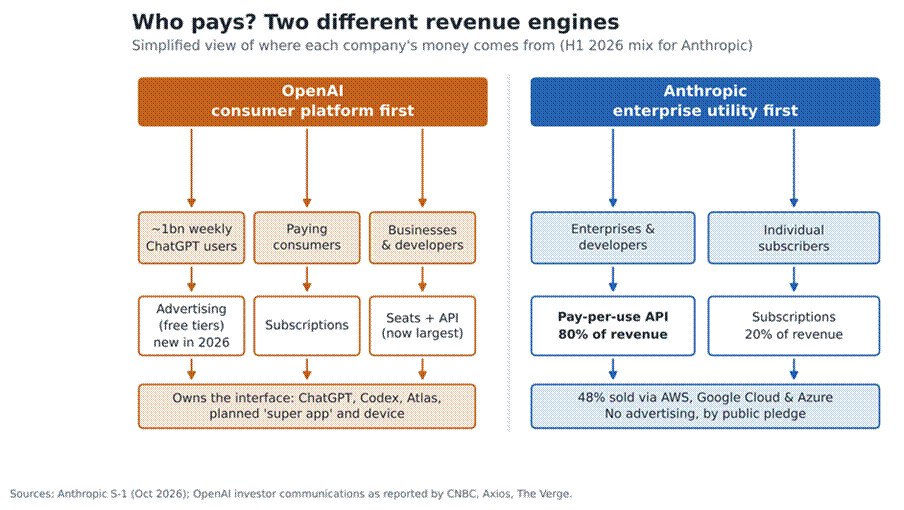
However, if one looks closer the two are building fundamentally different businesses. OpenAI is turning ChatGPT into a mass-market consumer platform, increasingly funded by advertising and wrapped in its own apps, browser and soon, hardware. Anthropic is building something closer to an enterprise utility: intelligence sold by the token to companies and developers, largely distributed through the big cloud platforms, and explicitly free of ads. These competing strategies could shape how both companies are valued when they reach the public markets.
The most striking strategic move of 2026 has been OpenAI’s embrace of advertising. In October 2024, Sam Altman described ads as a “last resort” for the company. Fifteen months later, in January 2026, OpenAI announced it would test ads for adult users on its Free tier and its low-cost Go plan in the United States. Ads went live on 9 February at a reported $60 CPM. They appear as labelled sponsored cards beneath answers with commercial intent; paid tiers stay ad-free.
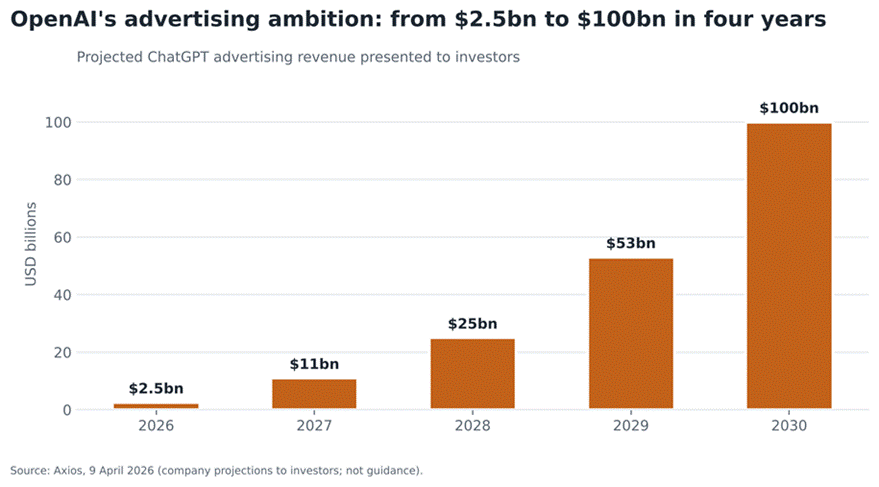
The ramp has been fast. The pilot passed $100mn of annualised revenue within about six weeks, and the programme expanded to Europe in August and India shortly after. In early October, ChatGPT’s ad business passed a $1bn annualised run rate. The ambition is even larger: according to Axios, OpenAI has told investors it expects about $2.5bn of ad revenue this year, $11bn in 2027, $25bn in 2028 and $100bn by 2030.
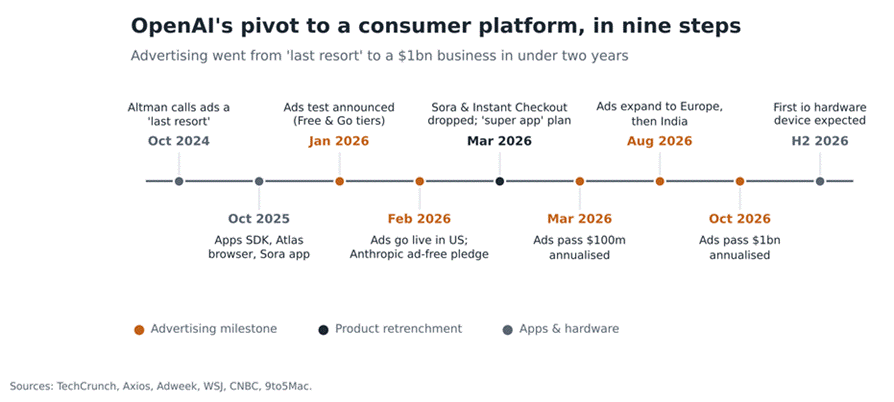
Advertising is only half of the consumer strategy; the other is distribution. In October 2025, OpenAI launched an Apps SDK that lets companies such as Zillow, Instacart and Target run inside ChatGPT, turning the chatbot into something resembling an operating system. It launched the Atlas browser and a standalone Codex coding app. In March 2026, OpenAI announced plans to combine ChatGPT, Codex and Atlas into a single desktop “super app”. Following its $6.5bn acquisition of io, an AI hardware startup co-founded by former Apple design chief Jony Ive, the company is also preparing its first dedicated device, which executives have said will be unveiled in the second half of 2026.
The logic is the classic consumer-internet playbook: own the interface, own the user relationship, and monetise attention and intent. If ChatGPT becomes the place where a billion people start their searches, plan their purchases and run their errands, it occupies the same strategic position that Google Search has held for two decades.
Execution has been uneven. OpenAI shut down its Sora video app in March, less than six months after launch, losing a planned $1bn Disney investment in the process. The same month, it discontinued Instant Checkout, its in-chat shopping feature, after weak uptake, redirecting commerce to retailer-run apps instead.
The shift to advertising is about unit economics. A major share of ChatGPT’s users pay nothing, OpenAI reported more than 50 million consumer subscribers in February, compared with roughly 900 million weekly users at the time. Leaked financial documents reported by the press put OpenAI’s 2025 operating loss at about $21bn, and the company carries hundreds of billions of dollars of multi-year compute commitments.
Subscriptions alone cannot close that gap, because only a small minority of users will ever pay $20 a month. Advertising is the proven way to monetise the long tail of free users at internet scale. For a company built on reach, the pivot is arguably inevitable. It is also why investors backing OpenAI at a private valuation of around $1.4tn are underwriting a potential successor to Google’s advertising franchise.
The risk is that advertising changes the product. Once a business is paid by advertisers, there is a permanent incentive to maximise engagement and time spent, and a temptation to let commercial interests shade the answers. OpenAI insists that ads do not influence responses. Still, trust is the core asset of a conversational assistant that people consult on health, money and personal matters, and that trust is now subject to regulatory and legal scrutiny, as a recent Texas lawsuit over child safety illustrates.
If OpenAI’s plan works, the most exposed incumbent is Alphabet. A sponsored answer in ChatGPT is the closest substitute yet for a Google search ad: it reaches the user at the moment of intent, and chatbot users describe exactly what they want in their own words. Gil Luria, Managing Director at D.A. Davidson’s, argues that ChatGPT’s ad budgets will come mainly out of Search, and that consumer attention is zero-sum, which also exposes YouTube.
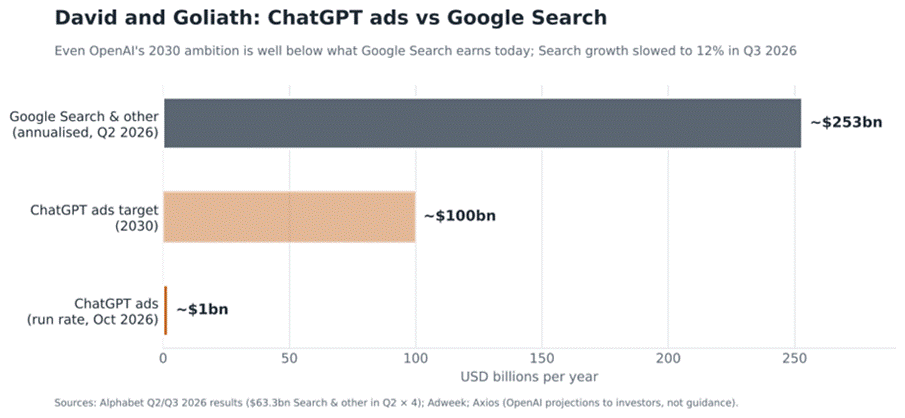
Scale keeps the threat in proportion. Google Search runs at more than $250bn a year, ChatGPT ads at roughly $1bn. Even OpenAI’s $100bn target for 2030 sits well below what Search earns today. Yet markets are increasingly focused on the direction of growth. Search growth slowed to 12% in the third quarter, from 17% and 19% in the previous two, and Alphabet’s shares fell about 8% after results on 28 October, even as Google Cloud revenue roughly doubled.
Alphabet is far from defenceless. Its Gemini app and AI Mode in Search each reach around a billion monthly users, it is rolling out ads inside AI answers globally, and it can fund the transition from one of the most profitable franchises in corporate history. The more realistic risk for Search is a gradual erosion of pricing power, as advertisers chasing intent now have a credible second channel for the first time in two decades.
Anthropic has chosen the opposite approach and communicated it. In February, it published a pledge that Claude would remain ad-free across all tiers and ran its first Super Bowl campaign under the tagline “Ads are coming to AI. But not to Claude.” Sam Altman publicly called the campaign dishonest, which helped promote it.
The commitment reflects Anthropic’s broader business strategy and the economics behind it. Anthropic does not need advertising because its customers are companies paying for measurable productivity gains. They pay per token consumed, so spending scales with value created. That makes revenue more predictable, less sensitive to consumer fashion, and, profitable at the margin.
The numbers in the S-1 are remarkable. Revenue rose from $41mn in 2023 to $4.6bn in 2025, then reached $16.3bn in the first half of 2026, roughly 14 times the prior-year period. The second quarter alone produced $11.6bn of revenue and $974mn of GAAP operating income. Third-quarter revenue rose a further 47% to nearly $17bn, with the company reporting $2.5bn in adjusted operating income, despite a $567mn operating loss under GAAP.
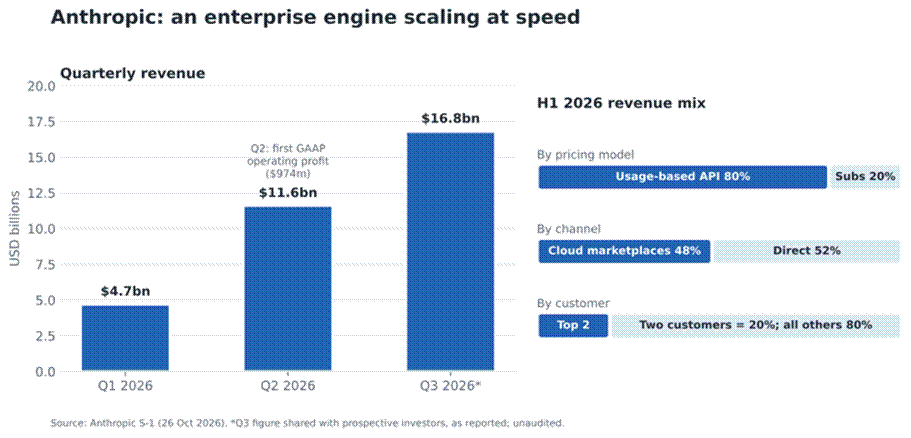
This model has weaknesses too. About 20% of first-half revenue came from just two customers, and almost half flows through cloud partners who are also competitors with their own models. Anthropic has committed at least $518bn to cloud and compute over the next decade, a massive fixed obligation if demand cools. Price competition is intensifying. OpenAI has reportedly won some Anthropic customers with aggressive discounts, and without a mass consumer audience, Anthropic has less direct control over how end users discover AI.
The table below summarises the two models as they stand today.
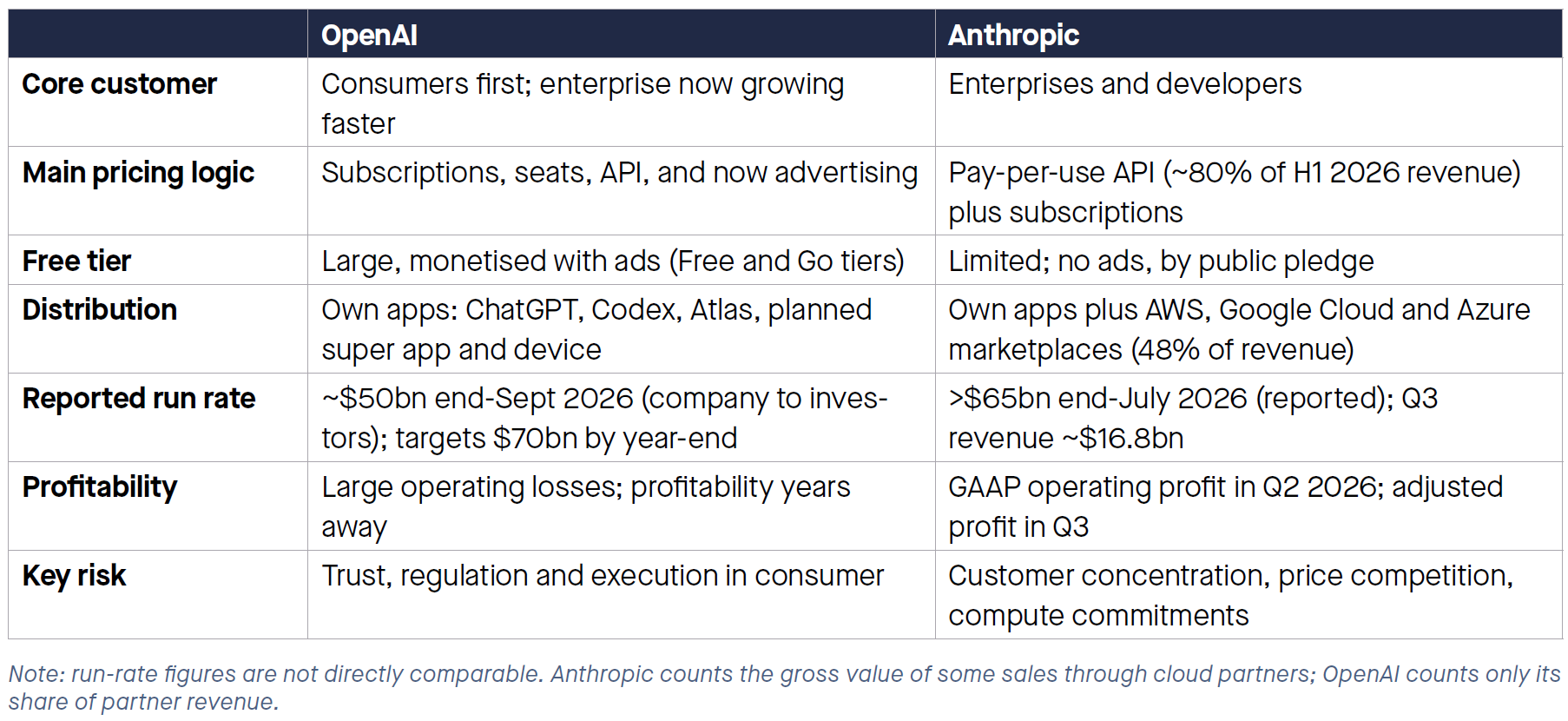
Early-October reports of a $70bn OpenAI run rate turned out to be an investor estimate, OpenAI itself cited nearer $50bn. Investors should wait for audited, comparable figures before deciding which company is actually larger.