

Alphabet just delivered its fastest revenue growth since 2021, and its slowest Search growth in more than a year. At the same time, OpenAI is building an advertising business inside ChatGPT aimed at the commercial queries that pay Google’s bills. The long-feared contest for search advertising is now showing up in the numbers. For a company that has called itself “AI-first” since 2016, the threat to the search franchise it built more than 20 years ago now comes from AI itself.
Key takeaways
-
Google Search & other revenue rose 12% to USD 63.4bn in Q3 2026, below consensus of c. USD 65.0bn and down from 17–19% growth in the previous three quarters.
-
The paradox: Google says query growth is the strongest in five years, yet revenue is decelerating, which points to lower monetisation per query.
-
OpenAI’s ChatGPT Ads reached a USD 1bn run rate in under 200 days, now run in 89 countries. The business is still small relative to Google, but it targets the most valuable commercial queries.
Record growth, slower Search
Alphabet’s third quarter was strong at group level. Revenue grew 25% year-on-year to USD 127.6bn, the fastest pace since 2021, carried by Google Cloud, which more than doubled to USD 30.7bn on the back of AI infrastructure demand and TPU system sales. Operating income rose 30% and the Gemini app crossed one billion users.
Investors focused elsewhere. Search & other, still Alphabet’s largest and most profitable franchise, grew 12% to USD 63.35bn, short of the roughly USD 65.0bn the market expected. Total advertising rose 11% to USD 82.0bn, also below forecasts. The disappointment was compounded by an EPS miss (USD 2.12, depressed by an USD 8.7bn loss on equity holdings), negative free cash flow of USD 9.1bn (including a USD 5.2bn payment for a 2018 EU fine) as quarterly capex hit USD 51.4bn, and the shares fell more than 9% in after-hours trading.
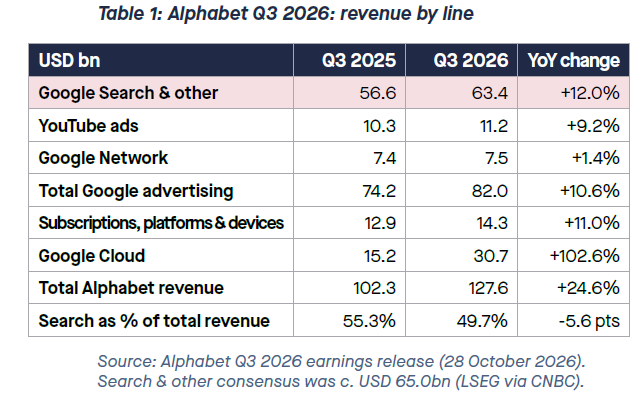
Search growth had been running in a 17–19% band since late 2025, helped by AI Overviews and AI Mode. Q3 fell well below (chart 1). For the first time in this cycle, Search accounted for less than half of Alphabet’s total revenue. This partly reflects Cloud’s surge, but also a cash engine that is no longer accelerating.
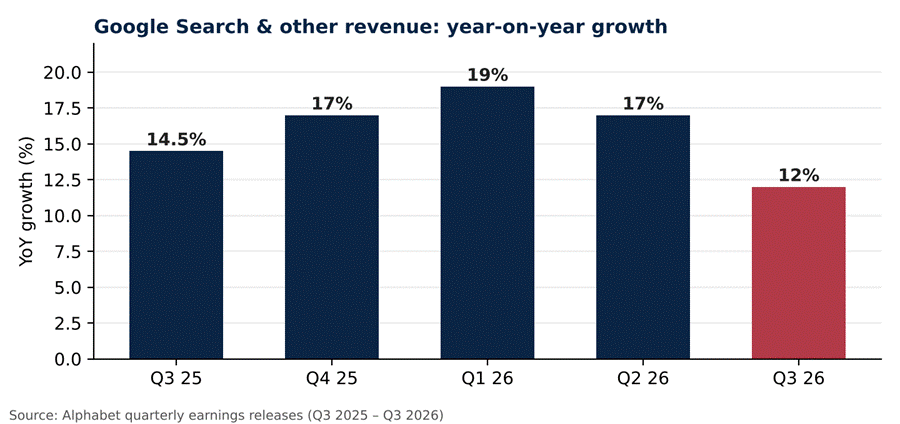
Chart 1: Search growth has dropped out of its 17–19% range. Source: Alphabet earnings releases.
More queries, slower revenue
Sundar Pichai stressed that AI features are driving overall query growth, including commercial queries, at the highest rate in five years. With volumes growing faster and revenue growing slower, revenue per query is falling.
The market is debating several explanations, which are not mutually exclusive. First, AI-generated answers are harder to monetise than ten blue links: when Google summarises the answer at the top of the page, users have fewer reasons to click on organic results or on ads. Second, comparisons are tougher after a very strong 2025. Third, and most relevant to this article, advertisers may be testing new AI surfaces with part of the budgets that previously went entirely to the Google auction.
On the call, management went on the defensive. Chief Business Officer Philipp Schindler named FX as the largest driver of the slowdown versus Q2, along with sector effects: APAC retailers hit by the end of the EU’s de minimis exemption, and a Q2 boosted by the World Cup. Some of these points are fair, but they do not change the debate. FX was only a slight headwind year-on-year and, by our rough estimate, does not explain the majority of the step-down. Search revenue was flat quarter-on-quarter, against a 4% rise a year earlier. Schindler conceded the key point: AI Mode is growing fast but monetises less well.
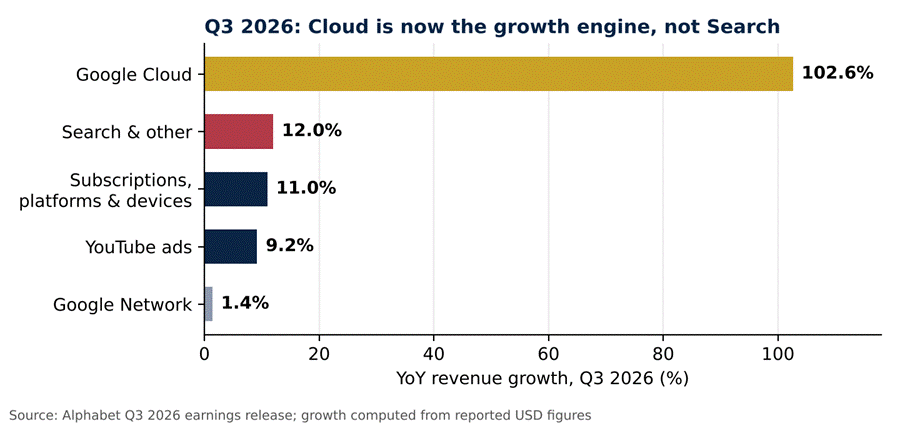
Chart 2: Q3 2026 year-on-year growth by business line. Source: Alphabet Q3 2026 earnings release.
What Google really sells, and why ChatGPT is well placed to capture it
ChatGPT has long been seen as the main threat to Google because of what Google sells. Search advertising monetises intent. When a user types “best travel insurance for Thailand” or “compare 65-inch OLED TVs”, they reveal precisely what they want at the moment they are ready to act. Advertisers bid in a real-time auction to appear next to that query and pay only when the user clicks. No other medium captures purchase intent as directly, and search has become the most profitable advertising format to date.
Revenue is also highly concentrated. Most queries like weather, sports scores, or trivia carry little to no ad value, while a minority of commercial queries in travel, finance, retail, insurance and healthcare generate the bulk of it. An AI assistant therefore does not need to replace Google. It only needs to capture a meaningful share of the research, comparison and shopping conversations at the top of the purchase funnel.
This is the disintermediation risk. In ChatGPT, the user asks, the model answers and, until this year, there was no auction at all. A commercial question answered inside a chatbot never reaches Google’s ad marketplace. Google also faces an “innovator’s dilemma”: to defend usage, it must offer AI answers of its own, which can cannibalise the click-based format that funds the company.
Management is not in denial. Past incumbents have shelved their own breakthroughs: Xerox PARC invented the graphical interface, and Apple and Microsoft commercialised it. Alphabet has done the opposite. It has put AI Overviews and AI Mode at the centre of Search, sells ads inside them and markets Gemini as a way to search, accepting that this cannibalises its own format.
So far, the evidence of a mass exodus is limited. Google still handles roughly 90% of conventional searches worldwide according to StatCounter, and ChatGPT generated only around 0.24% of combined Google-plus-ChatGPT referral traffic in August 2026. But habits are shifting at the margin, as ChatGPT now claims 1.2 billion weekly users, and Meta AI, built into WhatsApp’s search bar and Meta’s other apps, already reached around one billion monthly users by mid-2025. The real risk is that these assistants capture the most valuable intent and then learn to monetise it.
OpenAI switches on the ad machine
OpenAI has now taken that step. It announced its first ad tests in January 2026 and launched them in the US on 9 February for logged-in adults on the Free and low-cost Go tiers; paying Plus, Pro, Business and Enterprise users remain ad-free. Early advertising was sold at premium CPMs of around USD 60 with minimum commitments of USD 200,000–300,000. By April, cost-per-click bidding and a self-serve Ads Manager had arrived, mirroring the building blocks that helped Google AdWords scale.
The format resembles search. Sponsored units and shopping carousels appear beneath ChatGPT’s answer, mainly in shopping, comparison and planning conversations, when users are still evaluating options. OpenAI insists ads are clearly labelled, kept separate from responses and never influence answers. Commerce partnerships with Shopify and Etsy allow checkout inside ChatGPT.
The commercial traction has been rapid. ChatGPT Ads hit a USD 1bn annualised run rate on 31 August, less than 200 days after launch. On 21 October, OpenAI extended ads to 26 more countries (89 in total) and said more than 100,000 advertisers had run campaigns. The company targets USD 2.5bn of ad revenue this year, and reported longer-term ambitions run to tens of billions by the end of the decade. In early partner-reported data, WeightWatchers recorded an acquisition cost 15.3% below its blended paid-search benchmark.
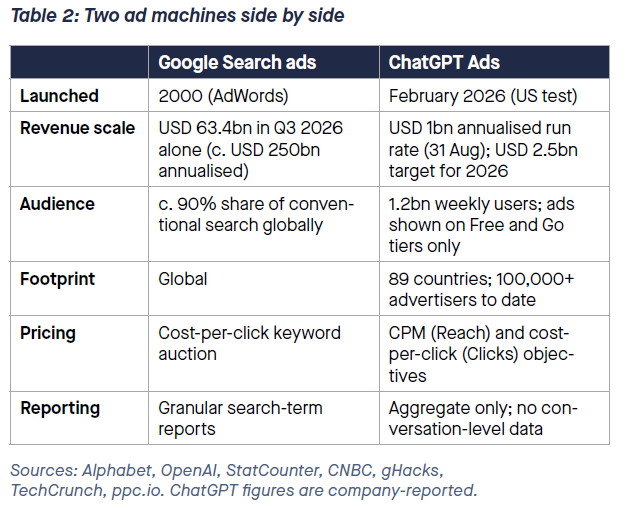
Google Search generates in one quarter roughly 60 times OpenAI’s annualised ad run rate. Advertising is still only about 2.5% of OpenAI’s revenue, several agencies have publicly questioned performance, reporting is aggregate-only, and a run rate is not booked revenue; sceptics doubt the USD 2.5bn 2026 target is achievable. Yet OpenAI does not need to win the auction outright to hurt Google’s growth rate. Even a few percentage points of commercial search budgets moving to conversational ads would be material for a franchise whose valuation rests on sustained double-digit growth.
What it means for Alphabet
- A tangible threat. Google’s dominance in conventional search is intact, but Q3 is the first quarter where the competitive narrative and the numbers line up. The metric to watch is Search growth rather than market share.
- The funding question. Search is the cash engine financing Alphabet’s AI build-out: trailing-twelve-month capex reached USD 160bn and free cash flow turned negative for two consecutive quarters and was still around USD 3.9bn negative in Q3 excluding the EU fine.
- A full-stack hedge for growth. owning chips (TPUs), cloud, models and distribution allows Alphabet to serve AI answers more cheaply and to capture AI demand whichever company wins the user interface. Cloud is adding revenue far faster than Search is losing growth. The cash-flow picture is less favourable: capital-light Search profit is being replaced by capital-intensive Cloud profit, which lowers the return on capital. Management is walking a fine line.
- What to monitor: paid clicks versus cost-per-click in the 10-Q; disclosure on AI Mode monetisation; OpenAI’s booked (not annualised) ad revenue ahead of its planned listing; and advertiser budget allocation between the two platforms.
For two decades, Google had the moment of purchase intent largely to itself. ChatGPT now captures a growing share of it and, since this year, charges advertisers for it.
Conclusion
The argument that America bears the costs while China reaps the benefits has some merit. Chinese labs build on US breakthroughs, sometimes through practices that American companies allege are illicit, and their low-cost open models are gaining market share. Chinese companies are also investing heavily, developing their own innovations and generating far less revenue than their US counterparts. A more accurate assessment is that America’s technological lead generates returns for an increasingly limited period. Recent developments suggest this period is narrowing rapidly, and investors should monitor whether growth in demand is sufficient to offset the decline in pricing power.
Disclaimer
This marketing document has been issued by Bank Syz Ltd. It is not intended for distribution to, publication, provision or use by individuals or legal entities that are citizens of or reside in a state, country or jurisdiction in which applicable laws and regulations prohibit its distribution, publication, provision or use. It is not directed to any person or entity to whom it would be illegal to send such marketing material. This document is intended for informational purposes only and should not be construed as an offer, solicitation or recommendation for the subscription, purchase, sale or safekeeping of any security or financial instrument or for the engagement in any other transaction, as the provision of any investment advice or service, or as a contractual document. Nothing in this document constitutes an investment, legal, tax or accounting advice or a representation that any investment or strategy is suitable or appropriate for an investor's particular and individual circumstances, nor does it constitute a personalized investment advice for any investor. This document reflects the information, opinions and comments of Bank Syz Ltd. as of the date of its publication, which are subject to change without notice. The opinions and comments of the authors in this document reflect their current views and may not coincide with those of other Syz Group entities or third parties, which may have reached different conclusions. The market valuations, terms and calculations contained herein are estimates only. The information provided comes from sources deemed reliable, but Bank Syz Ltd. does not guarantee its completeness, accuracy, reliability and actuality. Past performance gives no indication of nor guarantees current or future results. Bank Syz Ltd. accepts no liability for any loss arising from the use of this document.
Related Articles
US tech giants are investing hundreds of billions of dollars to develop the most advanced AI models. Meanwhile, Chinese companies are developing models with similar capabilities at a fraction of the cost, often making them freely available to download. Some analysts see this as a form of subsidy, but the economics behind it are more complex.
Donald Trump has delivered on some of his biggest promises, from border security to tax cuts and deregulation. But as Americans prepare to vote in the midterms, rising prices, stubborn borrowing costs and two unresolved wars have exposed the limits of his agenda.
One of John Ternus’s first major launches as Apple CEO takes the company into a market already served by Amazon and Google. With HomeView, Apple is betting that a smarter Siri and its tightly integrated ecosystem can persuade consumers to pay a premium for a place in their homes.


