


.png)
Introduction
Nuclear power is back in the global conversation. After a decade dominated by renewables, tech breakthroughs, and geopolitical shocks, energy security and decarbonization have pushed policymakers to reconsider every tool available. But the traditional image of nuclear—massive concrete domes, decade-long delays, spiralling budgets—has always stood in the way of public acceptance and political capital.
Enter small modular reactors (SMRs). A new generation of compact, factory-built nuclear reactors which promises cheaper projects, faster timelines, simpler designs, and enhanced safety. They compress gigawatt-scale ambitions into units that look more like industrial modules than mega-projects. The pitch is straightforward: if we can’t build nuclear bigger, maybe we should build it smaller, smarter, and repeatable.
But what exactly are SMRs? Why do they matter now? And can they realistically reshape the global energy system, or are they still more hype than solution?
Why traditional nuclear hit a wall
For decades, nuclear power was sold as the “energy of the future.” And for a while, it lived up to the promise. Gigawatt-scale reactors produced clean, reliable baseload power for millions of households. But the model eventually broke. Projects ballooned in cost, timelines doubled, and political momentum evaporated. There are multiple issues that led to this downfall.
First, projects became too big to manage. Large reactors routinely take 10 to 15 years to build, with every single year of delay adding cost, political friction, and uncertainty. The famous examples include Olkiluoto 3 in Finland, Flamanville 3 in France, or Vogtle in the U.S. All of those suffered massive overruns, giving nuclear the reputation of being late and expensive.
Then, financing risk became unbearable. A multi-billion-dollar project with a 15-year timeline is a nightmare for both private investors and governments. Even if it produces cheap electricity eventually, the upfront capital kills it.
Furthermore, public perception stagnated. Chernobyl and Fukushima left a permanent scar. Even though modern reactors are far safer, the stigma didn’t go away. Opponents didn’t need technical arguments, all they needed to say was: “What if?”
Finally, the grid evolved, but reactors did not. Renewables grew fast, natural gas filled gaps, and electrification accelerated. Yet the nuclear industry continued to push the same enormous devices, fight the same political battles, and rely on the same construction model.
In short, traditional nuclear didn’t lose because the technology failed. It lost because the business model did. This is the problem SMRs aim to solve.
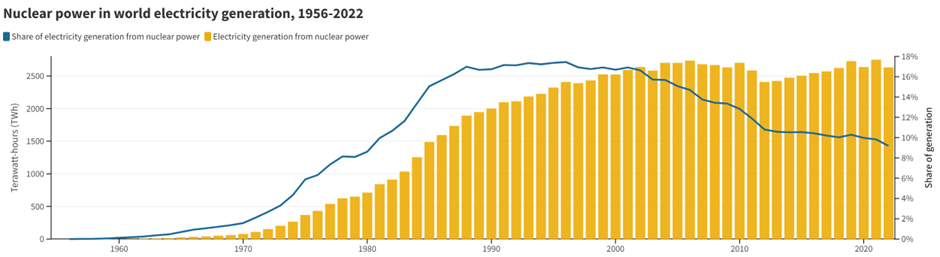 Source: Visualizing Energy
What SMRs actually are and why they matter
At their core, SMRs are just nuclear reactors made smaller and modular. But the change in size flips the economics, risk profile, and deployment model of nuclear energy. Most SMRs produce 50 to 300 Mwe (megawatts electric), compared to 1,000+ MWe for classic reactors. That means fewer materials, smaller sites, easier construction, and better alignment with local grids.
The modular aspect is also of interest. Instead of building everything on-site, SMRs are manufactured in factories. This means that the units can be prefabricated and then shipped and installed on site. Factory production means repeatability, predictable costs, shorter timelines, and quality control. Nuclear is treated more as a product than as an event.
Third, the reactors are built with modern safety. SMRs integrate passive safety systems, meaning they cool themselves without pumps or power. If something goes wrong, safety relies on physical processes such as natural circulation, convection, gravity, or self-pressurization. As a result, the severe accident scenarios associated with older reactors are physically harder to initiate, reducing the risk of significant radioactive releases.
Finally, another advantage is their flexible deployment. Indeed, SMRs can be used for powering remote regions, supporting industrial processes, producing hydrogen, and stabilizing renewable-heavy grids. They slot into places where giant reactors simply don’t make sense. One of the most promising use cases is the replacement of retiring coal plants. SMRs can plug directly into the existing transmission infrastructure, cutting both cost and construction time. The same logic applies to industrial hubs that need constant heat and power, such as steel, cement, chemical, and fertilizer production. And then there is the explosion in datacentre demand driven by AI. These facilities require enormous, steady electricity loads that renewables alone can’t provide. SMRs offer something rare in today’s energy system: compact, clean, round-the-clock power that fits exactly where demand is growing fastest. Wind and solar can grow fast, but they can’t carry everything. Big nuclear is too slow, coal is politically toxic, and gas is geopolitically exposed. SMRs hit the sweet spot: fast, scalable, low-carbon, and dispatchable.
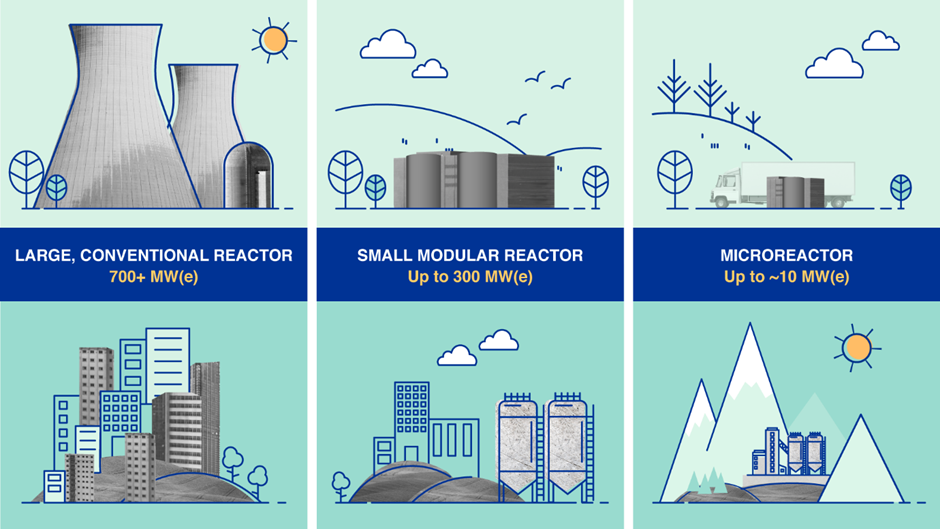
Source: International Atomic Energy Agency
The global SMR landscape: who is actually building them?
SMRs aren’t one product. They’re an entire family of technologies. First, there are the Light-Water SMRs. These are the closest to today’s reactors and are split in two types: pressurised water reactors and boiling water reactors. They use the same basic technology as current nuclear plants, just smaller. The Producers of Light-Water SMRs that already have a license include NuScale (U.S.; license acquired for three models), Rosatom (Russia; one model already operational), the China National Nuclear Corporation (CNNC; model under construction), and Kaeri (South Korea; license acquired). These light-water SMRs designs will likely be first to scale because regulators already know the underlying technology.
Another model is the high-temperature gas reactor, which use helium as coolant instead of water and run at much higher temperatures. They have a few key benefits, such as industrial heat, hydrogen production, and high efficiency. China already has a demonstration plant operating, produced by the Huaneng Group, while Valar Atomics in the US has achieved cold criticality state in November 2025.
Then, there are the liquid metal reactors. These are sodium-cooled or lead-cooled, offering even better safety margins and high temperatures. Examples include the nuclear power company Kairos Power in the US, currently seeking NRC approval, and Rosatom, in Russia, which already has a model under construction.
Finally, there are also molten salt reactors, a more radical design where the fuel is dissolved in salt, enabling extremely high safety and efficiency. The design is still young but promising, with one model currently under construction in China.
So, who is ahead? For the moment, China and Russia have the most deployed prototypes, North America has the most commercial momentum, while Europe is accelerating but still heavily regulated. Most SMRs today are not fully commercial, but the pipeline is enormous. Countries that abandoned nuclear 20 years ago are suddenly reopening the playbook.
Another factor accelerating the SMR race is government intervention. The United States is encouraging nuclear development through tax credits and large federal loan guarantees, hoping to rebuild a domestic nuclear manufacturing base. Canada has already committed to deploying multiple SMR units at the Darlington site, effectively making it a demonstration hub for commercial rollout. The United Kingdom launched “Great British Nuclear” to fast-track the approval and financing of next-generation reactors, while France is positioning its NUWARD design as a flagship export product. Japan, facing an unstable energy mix, is also reconsidering SMRs as part of its long-term strategy. This level of public support is reshaping the trajectory of nuclear innovation.
The obstacles: hype vs reality
SMRs sound great on paper, but you need to keep one foot on the ground. There are a few bottlenecks. First, costs are not proven at scale. In fact, factory-built reactors are only cheap if a few conditions are satisfied: factories exist, orders are repeated, and supply chains are mature. For the moment, none of that is true. Costs could be low, or not.
Second, regulatory processes are slow. Every country must approve each design, and regulators are used to gigawatt reactors. Now they must adapt to dozens of new technologies, which might take years.
Another obstacle is supply chains, which barely exist. Decades of nuclear stagnation hollowed out skilled labor, manufacturing capacity, and specialist materials. This means that scaling SMRs will require rebuilding an industrial ecosystem.
Then, just like for the current nuclear reactors, public acceptance is still fragile. Even if SMRs are safer, “nuclear” still triggers fear. Some communities won’t accept them, and others will need years of discussion.
Then comes the issue of waste management. While SMRs generate less waste per unit than usual nuclear reactors, waste doesn’t vanish. So, the political problem remains.
Finally, there is competition from renewables and batteries. Solar and wind costs continue to fall, while battery performance steadily improves. To succeed, SMRs must target the right niche—baseload power, industrial heat, remote regions, or datacentre supply—rather than going head-to-head with increasingly cheap solar farms.
Conclusion
Small modular reactors aren’t magic. They won’t replace all fossil fuels overnight, they won’t solve the energy crisis alone, and they won’t eliminate the messy politics of nuclear power. But they represent the first serious attempt in decades to redesign nuclear for modern realities, not Cold War fantasies.
The advantages are multiple, with scalable manufacturing, shorter construction times, improved safety, flexible deployment, and compatibility with existing energy infrastructure.
This comes at a time where the world needs clean, reliable, 24/7 power, and not just for households, but for steel plants, chemical production, datacentres, and national grids which are already running at full stretch. But the challenges are equally real: unproven costs, regulatory delays, political resistance, and the slow, heavy machinery of the energy sector.
SMRs are not the future of nuclear instead of big reactors. They are the future of nuclear alongside big reactors. Large plants will still anchor national grids. SMRs will fill the gaps, by replacing coal sites, powering industrial clusters, and scaling in ways big reactors simply can’t.
If they deliver on their promise, SMRs could become one of the most important energy technologies of the next 30 years. If they stumble, nuclear remains stuck where it has been: powerful in theory, slow in practice. Either way, the next decade will decide the outcome. And unlike previous nuclear cycles, this time the world actually needs the technology to succeed.
Disclaimer
This marketing document has been issued by Bank Syz Ltd. It is not intended for distribution to, publication, provision or use by individuals or legal entities that are citizens of or reside in a state, country or jurisdiction in which applicable laws and regulations prohibit its distribution, publication, provision or use. It is not directed to any person or entity to whom it would be illegal to send such marketing material. This document is intended for informational purposes only and should not be construed as an offer, solicitation or recommendation for the subscription, purchase, sale or safekeeping of any security or financial instrument or for the engagement in any other transaction, as the provision of any investment advice or service, or as a contractual document. Nothing in this document constitutes an investment, legal, tax or accounting advice or a representation that any investment or strategy is suitable or appropriate for an investor's particular and individual circumstances, nor does it constitute a personalized investment advice for any investor. This document reflects the information, opinions and comments of Bank Syz Ltd. as of the date of its publication, which are subject to change without notice. The opinions and comments of the authors in this document reflect their current views and may not coincide with those of other Syz Group entities or third parties, which may have reached different conclusions. The market valuations, terms and calculations contained herein are estimates only. The information provided comes from sources deemed reliable, but Bank Syz Ltd. does not guarantee its completeness, accuracy, reliability and actuality. Past performance gives no indication of nor guarantees current or future results. Bank Syz Ltd. accepts no liability for any loss arising from the use of this document.
Related Articles
Imagine an economy that keeps growing, companies making record profits, and markets hitting new highs, yet millions of skilled workers struggle to find jobs. AI now handles tasks that humans used to do, faster and cheaper than any employee. Productivity rises, but wages and household income lag. Growth is happening, but people are being left out. How will society adapt when success no longer depends on human work?
Rising tensions in Iran are sending shockwaves through energy and financial markets. Global oil flows, inflation expectations, and market sentiment are all under pressure. In this climate of uncertainty, careful observation and strategic positioning are key.
Memory chips underpin every layer of the modern technology stack, yet the market that produces them has entered a period of structural constraint with no near-term resolution. The implications for companies dependent on predictable hardware access are becoming increasingly material.