

Introduction
There has never been an IPO quite like this one. In its prospectus published last Wednesday, SpaceX presents itself as a company built to “make life multiplanetary,” “extend the light of consciousness to the stars,” and create “the infrastructure of the future.” Behind the rhetoric lies a business that already dominates global launch, operates the world’s largest satellite broadband network, and now wants to combine space, connectivity and artificial intelligence into a single platform. For investors, the filing raises a deceptively simple question: is this the opportunity of a generation, or the hype of one?
What SpaceX has become
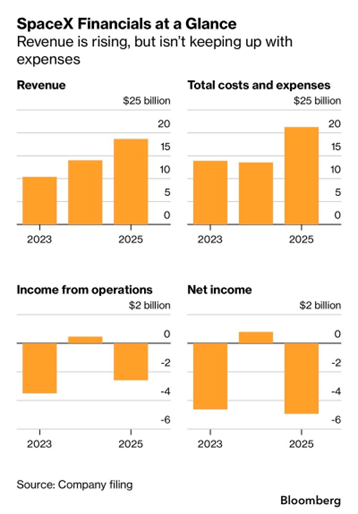
When Musk founded SpaceX in 2002 with a declared ambition of colonising Mars, few took him seriously. Today, the company he built has cornered the global launch market, ferrying some 80% of all mass lifted into orbit each year since 2023. In 2025 alone, SpaceX launched close to 4,000 satellites roughly 85% of the global annual total. Its Falcon rocket remains the world's most cost-competitive launch vehicle, and Starlink, its satellite broadband service, has grown to approximately 9 million subscribers worldwide, more than tripling in two years. That underlying business is genuinely formidable. Starlink pulled in $11.4 billion in revenue last year, generating $4.4 billion in operating income. The space launch segment contributed another $4.1 billion in revenue, though it remains unprofitable. All told, SpaceX reported revenue of $18.7 billion in 2025, a figure that places it in rare company among private enterprises.
Source: Bloomberg
Following its February 2026 merger with xAI, SpaceX has evolved into a diversified tech conglomerate combining space infrastructure, artificial intelligence, and social media through X.
The combined entity is now preparing to go public, targeting a Nasdaq listing under the ticker "SPCX" as early as June, 12, 2026, in what is expected to be the largest stock market debut in history.
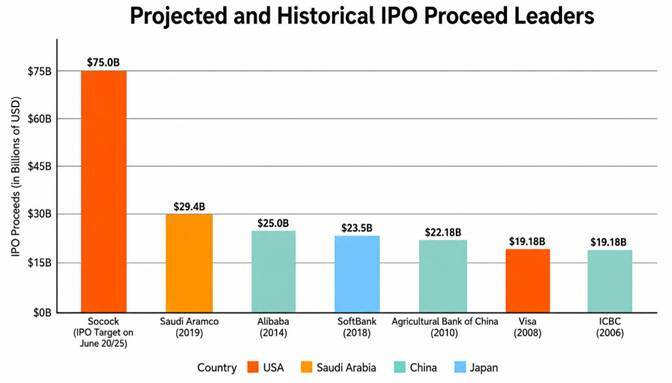
SpaceX has not disclosed how much it intends to raise or the valuation it is targeting. Several media reports suggest the IPO could raise around $75 billion, valuing the company at roughly $1.75 trillion. At this scale, the deal is expected to eclipse the world’s largest IPO to date, surpassing Saudi Aramco’s $25.6 billion listing in 2019.
Source: The Kobeissi Letter
The 200,000-word prospectus frames SpaceX as “the most ambitious, vertically integrated innovation engine on (and off) Earth”. Its mission is “to build the systems and technologies necessary to make life multiplanetary, to understand the true nature of the universe, and to extend the light of consciousness to the stars.”
The IPO is structured as a dual-class system, with Share A allocated to public investors and Share B reserved for insiders. It combines a primary issuance of new shares with a secondary sale from early investors. Final pricing and allocation will be determined during bookbuilding led by Goldman Sachs.
The underwriting syndicate includes Morgan Stanley, JPMorgan Chase, Citigroup, Bank of America, and UBS as co-leads, supported by around 23 banks in total. These institutions handle institutional demand, pricing feedback during roadshows, and global distribution. Lock-up periods of 180 to 366 days will help stabilise post-listing supply, reinforced by a 15% greenshoe option allowing additional share issuance if demand is strong.
Index inclusion could also become another major driver of demand for the IPO. SpaceX is reportedly exploring ways to accelerate entry into major benchmarks. Nasdaq has proposed changes that could allow fast Nasdaq 100 inclusion within 15 trading days of listing and drop the 10% free-float rule, forcing index funds like QQQ to buy shares. S&P 500 inclusion would be an even bigger prize but is less likely at the moment due to SpaceX’s low public float.
The AI gamble
The xAI merger is central to the IPO but also the main source of financial pressure. In 2025, xAI generated $3.2 billion in revenue while spending nearly $13 billion on AI hardware, resulting in a $6.4 billion operating loss for the AI division and pushing the whole company to a $4.9 billion net loss, according to the Wall Street Journal. Losses worsened in Q1 2026, when SpaceX lost $4.3 billion on $4.7 billion in revenue. Total 2025 capital expenditure reached $20.7 billion, including $12.7 billion from xAI alone. The prospectus itself warns that the company “may not achieve profitability in the future.”
xAI also entered a crowded AI market late, competing with OpenAI, Anthropic and Google, which have stronger models and enterprise relationships. Yet Musk sees AI as SpaceX’s largest opportunity, estimating the addressable market at $26.5 trillion, far above the $2 trillion opportunity from Starlink and space operations. One important offset is Anthropic’s agreement to lease SpaceX computing capacity for $1.25 billion per month through May 2029.
The orbital data centre vision
At the core of Musk's pitch is a bold technological proposition: that the cheapest place to run AI computing will eventually be in orbit, powered by unfiltered solar energy and cooled by the vacuum of space. In January, SpaceX filed a request with the Federal Communications Commission to establish a constellation of one million satellite-based data centres. The prospectus frames orbital computing as the first step toward establishing trillion-dollar markets on the Moon, Mars and beyond.
SpaceX’s launch economics, built over two decades, gives it a structural cost advantage that few competitors can match. However, major technical and economic challenges remain. Google researchers concluded last year that launch costs are unlikely to reach terrestrial data-centre economics for at least a decade. Orbital data centres would also require large radiators for thermal management, while cosmic radiation poses ongoing hardware risks. Near-term plans depend heavily on Starship, a very large reusable rocket still behind schedule. Grok, xAI’s model, could be an initial customer, but that alone may not justify the project. More broadly, orbital computing could become a standalone infrastructure business, potentially rented externally as “CoreWeave in the sky.”
The un-fireable CEO
SpaceX’s governance structure would give public investors limited influence over the company. The company has two share classes. Class A shares, sold to the public, carry one vote each. Class B shares, mostly held by insiders, carry ten votes each.
As of May 1, 2026, Musk controlled 85% of total voting power, while insiders together controlled 86%. The most important detail is that Musk controls 93.6% of the Class B vote, and he can only be removed as chair or CEO by a majority of Class B shareholders. In practice, this makes him almost impossible to remove.
His compensation is also extraordinary. In 2025, Musk earned a cash salary of just $54,000, but received large equity awards tied to extreme milestones, including a permanent Mars colony and non-Earth data centres. At a $1.75 trillion valuation, his vested shares would be worth around $700 billion, potentially making him the world's first trillionaire.
The prospectus also addresses a tiered lock-up structure. Musk and certain significant investors are restricted from selling for 366 days after listing double the standard 180-daylockup. Other pre-IPO investors face the standard 180-day restriction, but with a mechanism for early releases: up to 20% of eligible shares may be sold shortly after SpaceX's first quarterly earnings, with an additional 10% released if the stock holds above a certain level. The structure mirrors approach used in Facebook's 2012 IPO, where staggered lockups managed the supply overhang from an equally complex cap table.
Space economy tailwinds
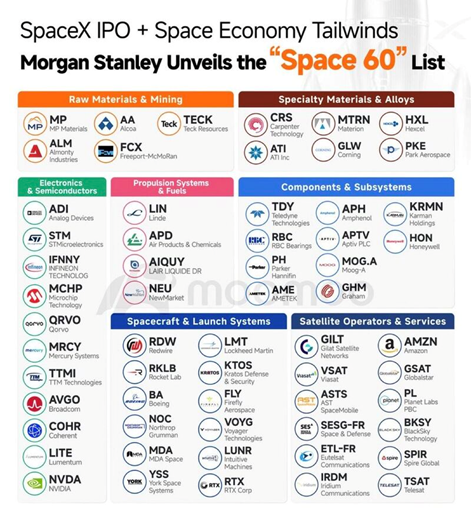
For the broader technology, defence and space ecosystem, the listing could act as a powerful re-rating catalyst, validating decades of capital allocation into sectors that have long struggled to attract mainstream institutional attention.
The most immediate spillover flows through Musk's own industrial web. The prospectus documents a dense network of bilateral flows: SpaceX purchasing Cybertrucks and Megapacks from Tesla, xAI sending hundreds of millions back to Tesla, and joint ventures in chip manufacturing and AI systems. A successful listing would almost certainly amplify investor focus on these linkages and raise expectations for deeper integration across Musk-controlled entities.
Starlink's nine million subscribers and $11.4 billion in revenue are also forcing a fundamental reset in expectations for satellite broadband economics. The IPO crystallises both the opportunity and the competitive pressure for incumbents and challengers alike, and may accelerate consolidation across a sector that has long awaited a defining valuation reference point.
The xAI merger positions SpaceX as a physical distribution layer for both compute and sensing, drawing mainstream capital toward companies monetising satellite imagery and data intelligence, and cementing the idea that orbital infrastructure is becoming foundational to the AI economy.
Less visible but equally significant are the industrial enablers, the suppliers of components, subsystems, propulsion systems and specialty fuels that make space missions possible. A sustained increase in launch cadence driven by SpaceX's economics would flow directly through the order books of this segment, which spans precision instrumentation, aerospace fasteners, advanced motion control and industrial gas supply chains.
At the upstream end of the value chain, the implications extend to raw materials, specialty alloys and the electronics and semiconductor industries whose components underpin both space hardware and AI infrastructure.
With approximately 20% of SpaceX's 2025 revenue derived from NASA, the Pentagon and the National Reconnaissance Office, including classified satellite programmes, the IPO would effectively reprice the entire national security space stack. A $1.5 trillion valuation for a company with deep government dependencies sends a powerful signal about the long-term trajectory of defence space budgets.
Conclusion
SpaceX would enter public markets as a leading launch provider and owner of Starlink satellite broadband. It has dominant commercial launch share and growing recurring revenue, but remains highly capital intensive due to rocket development and satellite deployment. Investor interest would likely be strong given scale and strategic importance. However, long-term returns would depend on profitability of Starlink, launch pricing pressure, and ongoing investment needs. Comparisons are often made with Tesla, which took years to achieve sustained profitability, but outcomes may differ. The main uncertainty is whether SpaceX can transition from growth-driven reinvestment to consistent free cash flow post-IPO eventually.
Disclaimer
This marketing document has been issued by Bank Syz Ltd. It is not intended for distribution to, publication, provision or use by individuals or legal entities that are citizens of or reside in a state, country or jurisdiction in which applicable laws and regulations prohibit its distribution, publication, provision or use. It is not directed to any person or entity to whom it would be illegal to send such marketing material. This document is intended for informational purposes only and should not be construed as an offer, solicitation or recommendation for the subscription, purchase, sale or safekeeping of any security or financial instrument or for the engagement in any other transaction, as the provision of any investment advice or service, or as a contractual document. Nothing in this document constitutes an investment, legal, tax or accounting advice or a representation that any investment or strategy is suitable or appropriate for an investor's particular and individual circumstances, nor does it constitute a personalized investment advice for any investor. This document reflects the information, opinions and comments of Bank Syz Ltd. as of the date of its publication, which are subject to change without notice. The opinions and comments of the authors in this document reflect their current views and may not coincide with those of other Syz Group entities or third parties, which may have reached different conclusions. The market valuations, terms and calculations contained herein are estimates only. The information provided comes from sources deemed reliable, but Bank Syz Ltd. does not guarantee its completeness, accuracy, reliability and actuality. Past performance gives no indication of nor guarantees current or future results. Bank Syz Ltd. accepts no liability for any loss arising from the use of this document.
Related Articles
The country America tried to contain through tariffs and chip export bans has become the world’s fastest-growing AI market, largest EV exporter, and a formidable rival in the very technologies the West sought to keep out of reach. As Donald Trump landed in Beijing on May 13th for his high-stakes summit with Xi Jinping, the symbolism mattered as much as the outcome.
Why the world's most indebted country is also one of its largest equity investors
The AI story has been one of relentless momentum. ChatGPT marked the first chapter, transforming OpenAI into the central force behind the industry’s expansion. The company now faces the challenge of supporting the scale of investment behind it.


