

.png)
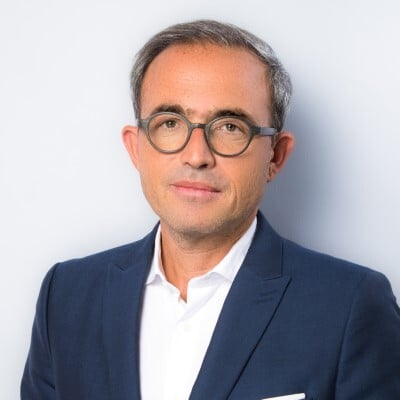
Situational Awareness LP began on paper. In 2024, Leopold Aschenbrenner released Situational Awareness: The Decade Ahead, a widely discussed essay built around one idea: AI progress could come faster than expected, and the world would need to spend heavily on infrastructure to support it. Soon after, he launched a hedge fund carrying the same name and becoming the market expression of that thesis.
The San Francisco-based vehicle was seeded with approximately $225mn in initial capital. Early backers included Silicon Valley figures such as Stripe co-founders Patrick and John Collison, Nat Friedman (Meta AI product lead), and Daniel Gross (now co-leading Meta Compute). Aschenbrenner himself reportedly invested nearly his entire net worth into the fund. Growth was rapid. As of February 2026, 13F filings indicate around $5.5bn of reported US equity exposure and a heavily leveraged portfolio. The fund is reported to have outperformed the S&P 500 by 47% in its first six months.
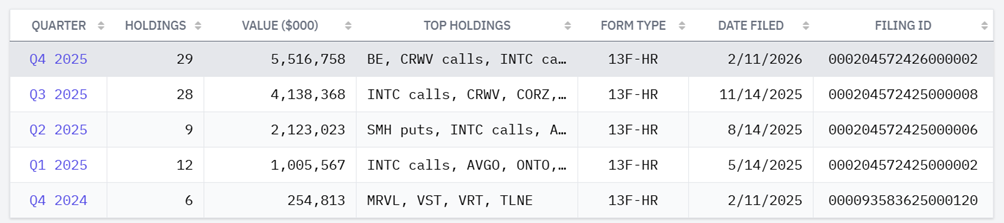
Source: Situational Awareness 13F Filing, Q4, 2025, 13f.Info
The strategy follows the same logic as the original paper. In the 165-page manifesto, Aschenbrenner argues that AGI, machines capable of outperforming humans across most cognitive tasks, is “strikingly plausible” by around 2027, far sooner than most investors and policymakers anticipate. He describes an accelerating race involving trillion-dollar compute clusters, explosive growth in electricity demand, and a massive mobilisation of industrial resources. Situational Awareness LP translates this worldview into public-market bets. It is a thematic, high conviction long/short equity fund that takes directional positions in listed companies expected to benefit from rapid AI scaling, while using shorts, hedges or options on sectors expected to lag or face disruption. Instead of focusing primarily on AI model developers or software applications, the fund targets the physical bottlenecks behind AI scaling: electricity generation, data-centre capacity, compute infrastructure, and the high-performance computing supply chain.
The investment approach has also some perceived advantages. Many investors follow AI through earnings calls, research notes and quarterly filings. Aschenbrenner built his view much closer to the ecosystem itself. His time on OpenAI’s Superalignment team offered direct exposure to scaling roadmaps, compute constraints, and how frontier labs think about the next phase of development. The network surrounding similarly matters as well. Backed by leading Silicon Valley investors, the fund sits close to conversations around capex plans, infrastructure deals, talent flows, and power procurement that markets may only price later.
If Aschenbrenner’s manifesto was the argument, his 13F filings are the proof of conviction. Situational Awareness LP does not hedge across sectors or diversify for comfort. It is structured as a single architecture, where each position functions as a deliberate component of one overarching thesis. Read together, the holdings map where the AI bottleneck is expected to emerge most acutely, and where capital has been slowest to adjust. The portfolio organises itself in 3 layers.
The first is data centre energy production, a bet on the fuel rather than the fire. Power is the binding constraint in the AI build-out. Training frontier models and running inference at scale requires electricity in quantities that existing grids were never designed to supply. Situational Awareness LP reflects this reality directly.
The largest position of the fund is Bloom Energy, accounting for 16% of the portfolio. The position represents an $875mn stake that surged to over $2.2bn after a 60% rally in a single week following an expanded Oracle supply deal in April 2026. Bloom’s fuel cell systems generate electricity on-site, bypassing grid constraints entirely. In a US power system where connecting new data centres can take three to five years, Bloom’s roughly 90-day deployment cycle is structurally advantaged.
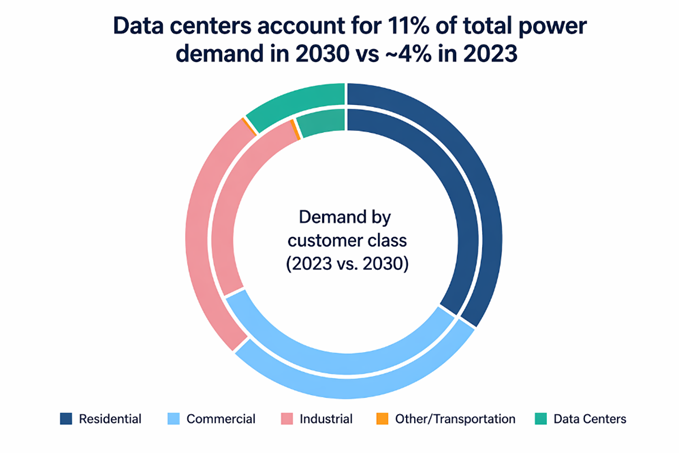
Source: Goldman Sachs
Alongside it sits EQT, the largest natural gas producer in the United States. In July 2025, EQT signed a $15bn natural gas supply agreement specifically designed to power data centres, positioning it directly inside the AI infrastructure chain. Goldman Sachs estimates that 51% of the incremental US power capacity required for data centres through 2030 will come from natural gas. EQT occupies the upstream position in that flow. Together, Bloom and EQT express a unified conviction: control of electrons increasingly determines competitive advantage in the AI era.
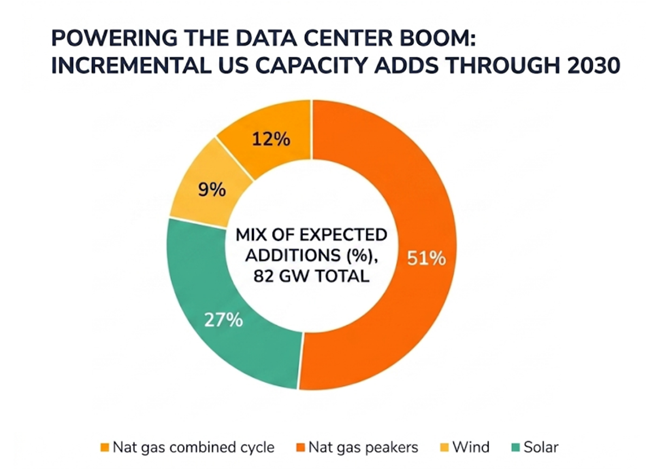
Source: Goldman Sachs
The second theme targets a new class of compute providers emerging between the hyperscalers and the end users. Where Amazon, Microsoft and Google operate general-purpose clouds optimised for a wide range of workloads, neoclouds are built for GPU-dense, high-throughput AI compute. The fund holds reported positions across several names in this space, including CoreWeave, IREN, Cipher Mining, Applied Digital and Core Scientific.
CoreWeave, the most prominent of the group, was originally a cryptocurrency miner that pivoted early to Nvidia GPU infrastructure and has since become one of the primary compute suppliers to frontier AI labs. Its reported contract with Microsoft and its infrastructure scale place it close to the top of the AI supply stack. The others follow variants of the same model. The fund has also built exposure to data-infrastructure and former crypto-mining names such as IREN, Applied Digital, Cipher Mining, and Core Scientific. These companies developed large, power-intensive computing sites during the bitcoin mining cycle, but many of those same assets are now being repositioned for AI workloads. They each operate data centres or high-performance computing campuses, often in locations chosen for access to cheap, renewable power. What these companies share is the ability to deploy GPU clusters at speed, which traditional cloud providers, constrained by procurement cycles and broader infrastructure mandates, cannot always match. For a fund betting on continued AI capital expenditure, neoclouds represent an earlier and more operationally leveraged position in the build-out than the hyperscalers themselves.
The third cluster moves further down the stack, into the components that make high-performance computing infrastructure function at scale. Two segments dominate here: memory manufacturers and optical communications providers.
Memory is a persistent bottleneck in AI training and inference. High Bandwidth Memory, or HBM, is the specific format required by Nvidia's H100 and B200 GPU architectures, and production is concentrated among a small number of manufacturers. Demand has consistently outpaced supply since the large language model buildout accelerated in 2023, and the structural deficit shows few signs of normalising quickly. A position in this segment is effectively a bet on continued compute demand translated through one of its most constrained physical components.
Optical communications occupy a related but distinct role. As data centres expand in both scale and density, the bandwidth required to move data between GPUs, servers and racks grows proportionally. Electrical interconnects become a limiting factor at high speeds and distances. Optical transceivers and co-packaged optics address this by moving data as light rather than electrical signal, enabling the kind of throughput that next-generation AI clusters will require. Companies operating in this space sit at a quiet but critical point in the HPC supply chain, one that receives less attention than GPU manufacturers but faces comparable demand pressure as infrastructure density increases.
Aschenbrenner should not be compared to Warren Buffett. He is not running a disciplined value fund anchored in cash flows, margin of safety, or mean reversion. Situational Awareness's average multiple across its five largest positions sits at approximately 14x EV/Revenue.
In a market driven as much by momentum and storytelling as by fundamentals, that bet has delivered remarkable results in just six months. However, this type of strategy carries a structural vulnerability that no lock-up period can fully mitigate. It performs exceptionally well as long as the underlying narrative remains intact, but once that narrative breaks down, the unwind tends to be abrupt rather than orderly.
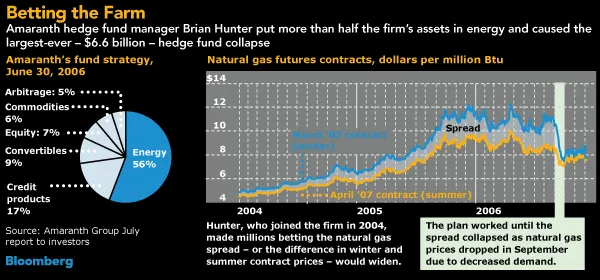
History has a name for this kind of risk. In 2006, Amaranth Advisors was managing $9bn and had allocated roughly 80% of its portfolio to natural gas futures, a highly concentrated bet on a commodity thesis that had appeared structurally sound for years. When natural gas prices collapsed in the autumn of that year, the fund lost $6.6bn in a single week and never reopened. The thesis had been directionally correct for a long time; the timing, however, was off by just one season.
Source: Bloomberg News
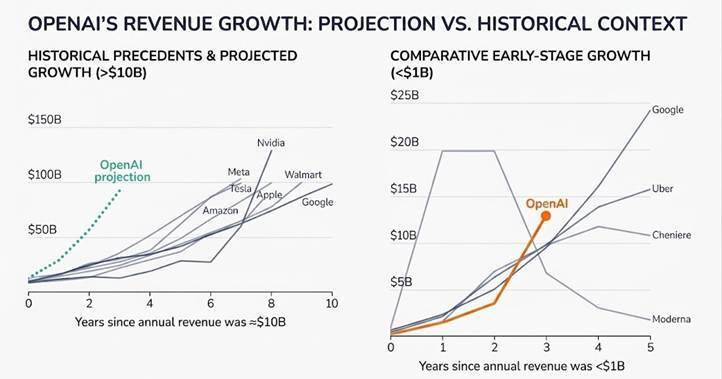
Situational Awareness is a concentrated bet on persistent compute scarcity amid rising AI demand, benefiting power, and infrastructure companies. Its positions from Bloom Energy to CoreWeave, EQT and Cipher Mining lacks diversification. This twenty-nine-position portfolio expresses one conviction and tends to be repriced in unison when it fails, as all holdings share the same underlying foundation. Early stress is already visible, OpenAI’s revenue growth has slowed to around 17%, making its $280bn 2030 target harder to justify. Meanwhile, enterprise AI adoption remains limited, with about 90% of firms not yet integrating AI into core operations. The gap between infrastructure build-out and required revenues remains the central uncertainty.
Source: Epoch AI
Goldman Sachs highlights a related risk through the Jevons Paradox. If efficiency gains in AI reduce instead of expanding total compute demand, for example through cheaper models like DeepSeek-style breakthroughs, the neocloud investment thesis weakens before it fully matures. Infrastructure continues to expand, but demand may not keep pace. Multiples compress, and portfolios priced at elevated revenue valuations are left with little room for adjustment.