

.png)
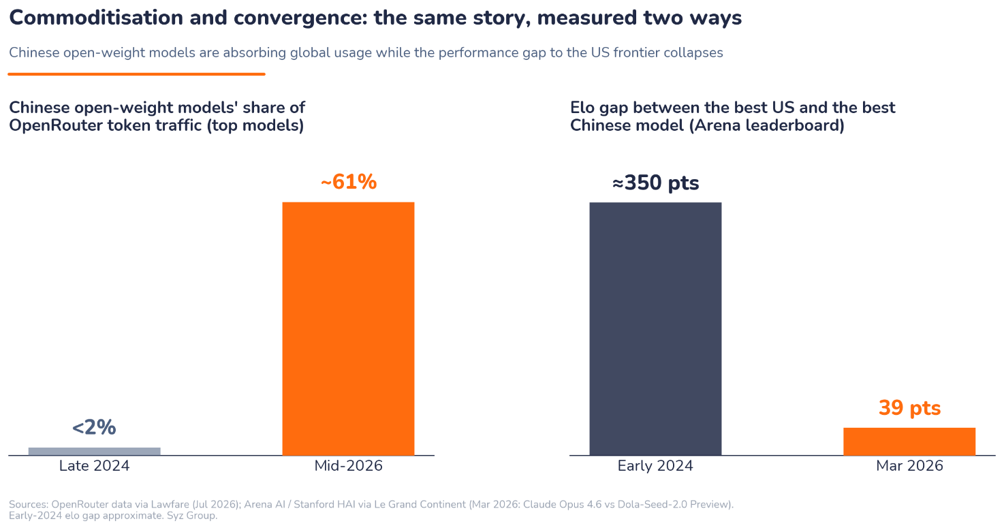
In late 2024, Chinese "open-weight" AI models, models that anyone can freely download and use, rather than closed ones like GPT or Claude, made up less than 2% of usage on OpenRouter, the world's largest marketplace for AI models. By early 2026, they accounted for roughly 61% of usage among the platform's ten most popular models.
That single statistic fundamentally changes how investors should read Xi Jinping's keynote at the World Artificial Intelligence Conference (WAIC) in Shanghai on 17 July, the first time China's president has personally attended the country's flagship AI conference.
For the past three years, investors have viewed artificial intelligence primarily through the lens of computing power. The debate centred on GPUs, hyperscaler capital expenditure and semiconductor leadership. That perspective is becoming incomplete.
China is no longer simply trying to catch up with the United States technologically. It is attempting to reshape the economics, governance and global adoption of artificial intelligence. The next phase of the AI race will not necessarily be won by whoever builds the smartest model. It will be won by whoever builds the largest ecosystem.
History suggests this is how technological revolutions mature. VHS defeated Betamax. Android ultimately became the world's dominant mobile operating system. The internet itself derived its value from network effects rather than technological perfection. AI may now be entering the same stage.
Xi's strategy rests on three mutually reinforcing pillars.