

.png)
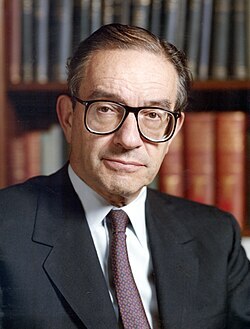
Alan Greenspan was born on 6 March 1926, in the Washington Heights neighbourhood of New York City. His father was a stockbroker and market analyst, and his mother worked in retail. He grew up in the age of the Great Depression, an experience that lent a permanent sobriety to his views on money and risk.
Greenspan’s first passion was music. He played clarinet and saxophone, briefly attending Juilliard before touring with a professional swing band. He eventually discovered that his true talent lay in arithmetic. He thus found his way to New York University, where he earned bachelor's, master's, and doctoral degrees in economics, graduating with highest honours at the undergraduate level. He pursued further graduate study at Columbia under Arthur Burns, who would himself later chair the Fed. By the early 1950s, Greenspan had co-founded the economic consulting firm Townsend-Greenspan & Company, which he ran for more than two decades. Advising corporate clients on the granular realities of steel, copper, and consumer demand, an unglamorous apprenticeship that gave him an almost tactile feel for how the real economy moved.
It was during these years that Greenspan became close to Ayn Rand, the novelist and leading defender of laissez-faire capitalism. He joined her inner circle and absorbed a belief that would stay with him for decades: markets, when left largely alone, tend to allocate capital better than governments or regulators. That this self-described libertarian Republican would spend most of his career inside the machinery of government, ultimately running its most powerful financial institution, is one of the great ironies of American public life.
Greenspan’s entry into Washington came through politics. He advised Richard Nixon's 1968 campaign on domestic policy, chaired the Council of Economic Advisers under Gerald Ford, sat on Reagan's economic policy board, and in 1983 led the bipartisan commission whose recommendations rescued Social Security from near-term insolvency. When Reagan tapped him to succeed Paul Volcker at the Fed in August 1987, Greenspan inherited an institution whose credibility had been hard-won by Volcker's brutal campaign against inflation.
He had barely settled in when the test came. In October 1987, just two months into his chairmanship, the stock market suffered its worst single-day collapse in history. By the closing bell, the Dow Jones Industrial Average had lost 22.6% of its value. Greenspan's response was decisive and instructive. He injected liquidity into the financial system and signalled, in plain terms, that the Fed stood ready to support the economy. Within two days the Dow had recovered more than half of its Black Monday losses. The episode established both his reputation and a doctrine that would shadow him for the rest of his life: the so-called "Greenspan put," the growing belief that the Fed would always intervene to cushion a serious market decline.
That implicit belief became the defining feature of the Greenspan era. It calmed the markets through the 1997 Asian financial crisis, the 1998 Russian default, and the near collapse of the hedge fund Long-Term Capital Management. It also underwrote the longest economic expansion in American history, a boom that ran from 1991 to 2001. Over that time, unemployment briefly fell below 4%, a level unseen since 1970, and inflation, the great enemy of the 1970s, remained surprisingly subdued.
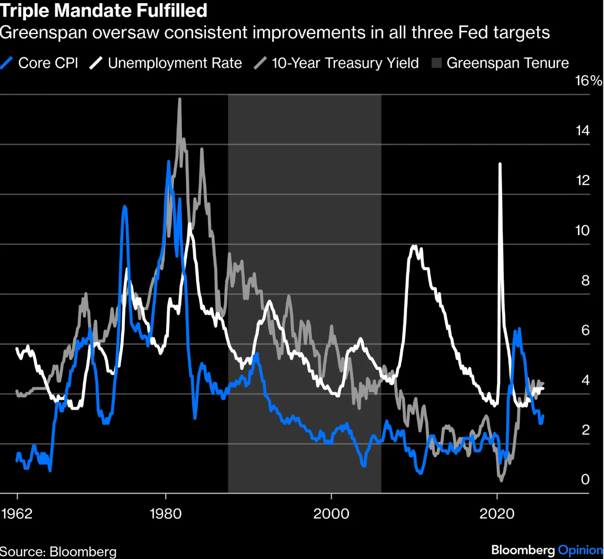 Source: Bloomberg
What set Greenspan apart from his predecessors was a willingness to defy received wisdom. As unemployment drifted lower through the 1990s, orthodox economists urged him to raise rates to head off the inflation they were certain must follow. He refused. The economist Alan Blinder, who served alongside him, recalled how Greenspan simply waited as the rate drifted lower and lower with no inflation in sight. Greenspan’s explanation was that the economy itself had changed. Advances in technology, he argued, had lifted productivity and allowed the United States to grow faster than old models suggested, even with unemployment falling to levels many economists believed would trigger inflation. It was an act of intellectual courage that put hundreds of thousands of Americans to work, and it quietly demolished the idea of a fixed "natural" rate of unemployment.
By the late 1990s, Greenspan was treated as the “Maestro” and the “Oracle”, the central banker whose judgment seemed to hold the expansion together. Investors parsed his speeches for clues about rates, growth, and financial markets. Even his briefcase became part of Fed folklore. According to the so-called “Briefcase Indicator,” a particularly full briefcase carried into a meeting suggested that Greenspan had arrived armed with charts and arguments for a possible policy shift.
That level of scrutiny gave his words extraordinary power and Greenspan learned to use that weight carefully. His speeches were famously impossible to pin down. He constructed his sentences with so many qualifications and sub-clauses that senators, journalists, and market analysts alike left the room unsure of what he had said. This was intentional. Clear language would have forced clear admissions and admitting uncertainty was not something a Fed chair could do openly. By staying deliberately opaque, he could navigate difficult questions without ever revealing that he could not answer them. The approach became so recognisable it acquired its own name: Fed speak. Greenspan once remarked that if anyone found him easy to understand, they would almost certainly miss his point.
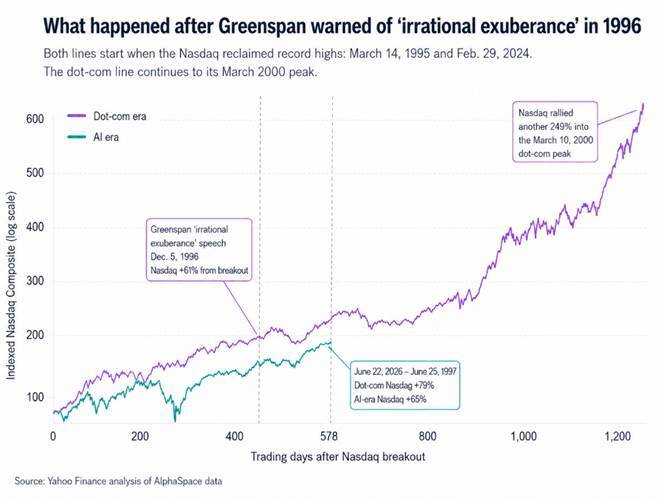
His most famous remark was an exception that proved the rule. In a December 1996 speech, he wondered aloud whether “irrational exuberance” had pushed asset prices beyond reason. The words sent a tremor through global markets, proof of how closely the world parsed his every word. Aware that a careless word could unsettle markets, Greenspan made ambiguity almost a governing style. He could even joke about the impenetrability of his own language.
“I know you believe you understand what you think I said, but I am not sure you realise that what you heard is not what I meant,” he once told a congressional committee.
Yet the bubble he gestured toward kept inflating for another four years before it burst. Even when Greenspan saw the danger, the machinery of the boom proved larger than any warning he was willing to issue.