


.png)
For decades, US Treasuries have stood at the core of official reserves, valued for their depth, liquidity, and enduring safe-haven status. In the post-Bretton Woods era, they became the natural anchor: the US dollar’s share of allocated reserves peaked near 71% in 1999 and held above 60% well into the 2010s (IMF COFER). Transparent markets, reliable settlement infrastructure, and the implicit backing of the Federal Reserve cemented their role as the default store of value for central banks focused on capital preservation.
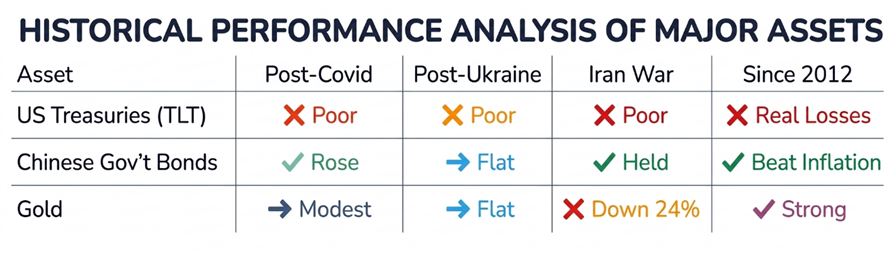
That dominance was first meaningfully tested in early 2020. The pandemic-driven “dash for cash” exposed fragilities within even the deepest markets, as leveraged investors unwound positions and foreign official holders reduced exposure. Liquidity in Treasuries deteriorated sharply, forcing the Federal Reserve to step in with roughly $1.6tr in purchases to restore market functioning. In contrast, gold delivered positive contributions to diversified reserve portfolios even at modest allocations, while Chinese government bonds (CGBs) remained comparatively stable, supported by limited exposure to dollar funding stress. The episode did not displace Treasuries, but it did challenge the assumption of unconditional liquidity.
The shock of 2022 went further. The freezing of Russia’s central bank reserves reframed the risk embedded in dollar- and euro-denominated assets, introducing a new dimension of sovereign vulnerability. Simultaneously, aggressive Fed tightening triggered the sharpest drawdown in long-duration Treasuries since the 1980s, with losses approaching 30% on the long end. Gold, by contrast, remained resilient, supported by record official sector purchases and a rising geopolitical premium. CGBs increasingly entered the conversation as a reserve diversifier, offering positive yields and insulation from sanction risk in a world of near-zero rates elsewhere.
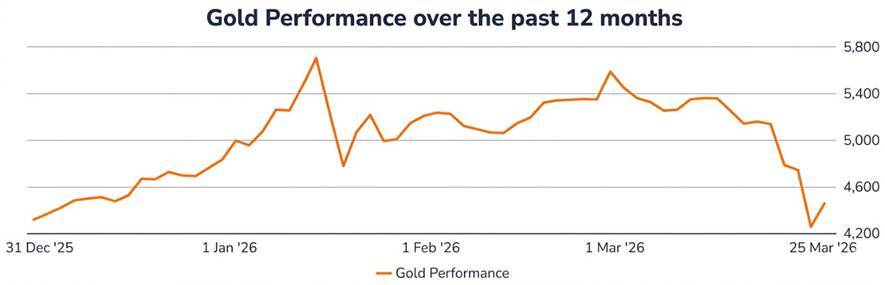
Gold entered 2026 with strong momentum, but that strength quickly reversed as the geopolitical backdrop shifted. Since the escalation of the Iran conflict, the metal has come under pressure, falling sharply despite the very conditions that would typically support it. Prices have declined by double digits since early March, marking one of the weakest performances during a period of heightened global risk.
Renewed tensions in the Middle East did not trigger a traditional flight to gold. Instead, the shock transmitted through energy markets: oil prices surged above $100 as disruptions in the Strait of Hormuz fed into inflation expectations. Higher inflation, in turn, pushed bond yields and the US dollar higher, raising the opportunity cost of holding non-yielding assets. In that environment, investors rotated toward cash and yield-bearing instruments, with some selling gold after a crowded rally in 2025.
 Source: Gavekal Research
No single reserve asset dominates across the core criteria of liquidity, capital preservation, sanction-risk insulation, and crisis behaviour. Each instrument brings a distinct set of structural strengths and weaknesses, creating unavoidable trade-offs for central banks and official reserve managers.
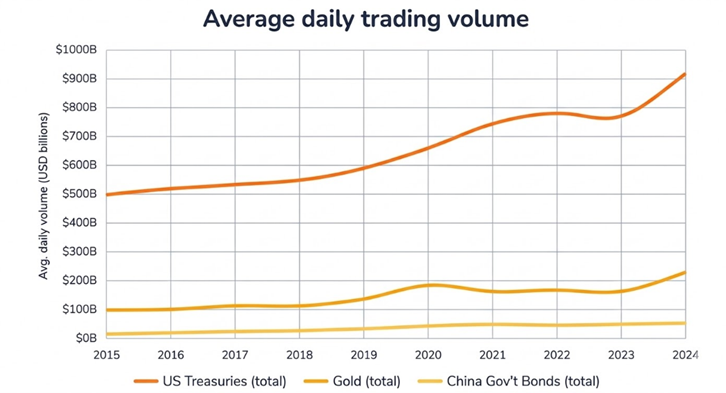
US Treasuries remain the global benchmark for liquidity and financial integration. Their strength extends beyond market depth, anchored in the broader weight of the United States as the leading military, financial, and technological power, supported by strong institutions, rule of law, and its role as a major energy and agricultural producer. Together, these factors sustain confidence in Treasuries as a reserve asset. Yet that dominance is increasingly debated. The growing “weaponisation” of the dollar through sanctions has raised concerns among reserve holders, while rising fiscal deficits, particularly in periods of geopolitical strain, have started to weigh on long-term attractiveness. More subtly, evolving forms of conflict, from cyber to drone warfare, are challenging traditional assumptions about US power projection, feeding into a gradual reassessment of dollar-based assets.
Source: sifma
Chinese government bonds offer a different profile. Backed by China’s position as the world’s industrial and electricity powerhouse, they provide a credible diversification channel and have been among the few major sovereign bonds to outperform US inflation over the past decade. They have also shown relative stability through recent shocks. Still, their role remains constrained. They are often treated as an “emerging” alternative, with broader adoption tied to renminbi internationalisation and deeper financial integration. Geopolitics remains the limiting factor, with persistent tensions capping their potential as a dominant reserve anchor.
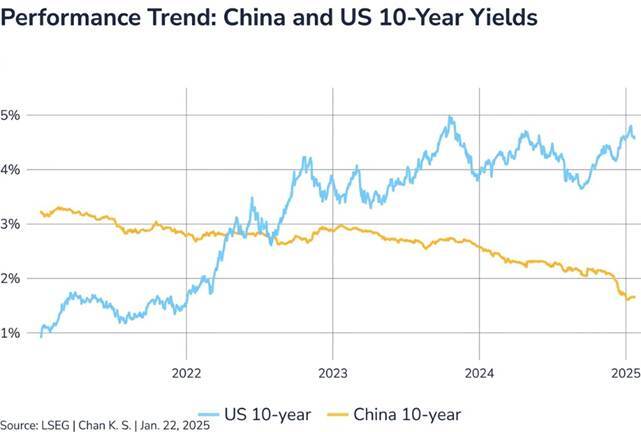
A defining feature of their recent appeal has been the widening divergence in interest-rate cycles. Since 2022, US 10-year yields have moved into the 4–5% range as the Federal Reserve tightened policy, while Chinese yields have drifted below 2% amid weaker growth and a more accommodative stance. The resulting gap has reinforced capital flows toward the US, strengthening the dollar and putting pressure on the renminbi, while highlighting a broader macro divergence between an “overheating” US economy and a “cooling” Chinese one.
Source: LSEG Chan K.S
Gold occupies a distinct position as a neutral, non-sovereign store of value. Since the early 2000s, it has been a preferred long-term reserve asset, particularly in environments where interest rates remain below nominal growth conditions that still broadly hold today. Gold offers no credit or counterparty risk and acts as an “anti-fragile” hedge in periods of systemic stress.
This backdrop makes its recent move striking. Since the escalation of the Iran conflict and disruption of the Strait of Hormuz, gold has fallen around 14%, despite conditions that would typically support safe-haven demand. The shock has come through inflation and rates rather than risk aversion: higher oil prices have pushed yields and the dollar higher, raising the opportunity cost of holding gold. Sources of demand have also weakened. Oil-driven disruptions have compressed surpluses in Gulf economies, reducing petrodollar recycling into reserves, while China’s growth slowdown has weighed on reserve accumulation. This reveals a paradox. Gold does not always rise in times of geopolitical stress. It rises when liquidity flows toward it. At the margin, the emergence of CGBs as a credible alternative has also diluted gold’s role as the default diversification asset.
Source: Facset
Crisis behaviour further highlights these differences. Treasuries retain safe-haven characteristics, but episodes such as the 2020 liquidity squeeze and the 2022 inflation shock have shown that returns are not immune to stress. Gold has historically provided stronger diversification in crisis environments, even if recent dynamics have been more nuanced. Chinese government bonds have demonstrated resilience in recent shocks, supported by domestic policy stability, though their track record remains shorter and less tested than that of Treasuries.
Central banks and sovereign investors do not allocate reserves like traditional asset managers. Their decisions are primarily shaped by governance frameworks that prioritise liquidity and capital preservation over return. Guidelines, often aligned with institutions such as the International Monetary Fund and the Bank for International Settlements, impose strict limits on credit quality (typically AAA or equivalent for the liquidity tranche), duration, and currency exposure. As a result, any change in reserve composition is gradual and institutionally constrained rather than reactive to short-term market movements.
Within this framework, tranching is the central organising principle. Reserve portfolios are typically divided into a liquidity tranche and an investment tranche. The liquidity tranche is designed to meet short-term needs such as currency intervention and is therefore invested in highly liquid, low-risk assets primarily short-term US Treasuries. This explains why Treasuries remain structurally dominant despite recent challenges: their operational role is difficult to replace.
The investment tranche, by contrast, allows for a longer horizon and broader asset universe. It is within this segment that diversification is gradually taking place, including increased exposure to gold and, to a lesser extent, Chinese government bonds. These adjustments can occur without disrupting core liquidity functions, if they remain within predefined risk limits.
Recent developments in China illustrate how these choices are implemented in practice. Since late 2025, Chinese authorities have actively reduced their exposure to US Treasuries, with holdings falling to around $682bn in November the lowest level since 2008 reflecting a broader diversification strategy. Over a slightly longer horizon, China has cut tens of billions of dollars in Treasury holdings since November while simultaneously increasing gold reserves and encouraging domestic institutions to limit exposure to US debt. This shift does not represent a sudden exit from dollar assets, but a controlled rebalancing within existing governance constraints.
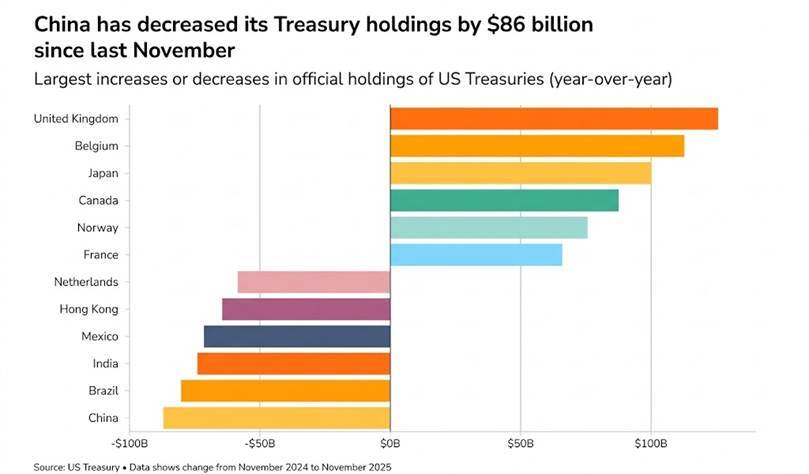
Source: US Treasury
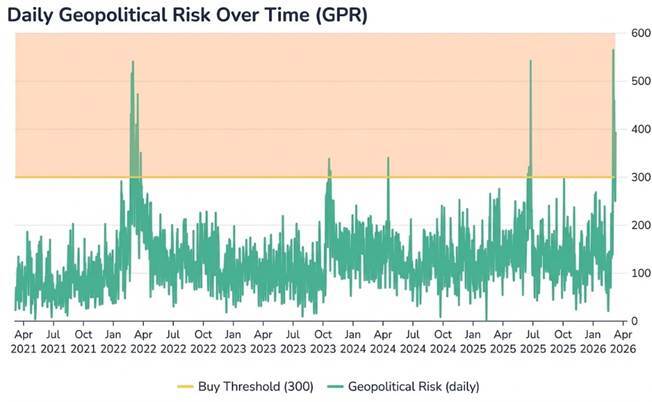
Risk tolerance remains a key differentiating factor and varies across different countries. Those with large reserve buffers can accept more volatility and therefore diversify more easily. In contrast, reserve-scarce economies must prioritise liquidity, anchoring their portfolios in Treasuries. Geopolitical risk particularly after the 2022 reserve freeze has become an explicit part of reserve management. Rather than triggering abrupt reallocations, it shapes marginal decisions within existing frameworks.
Source: Sentiment Market