

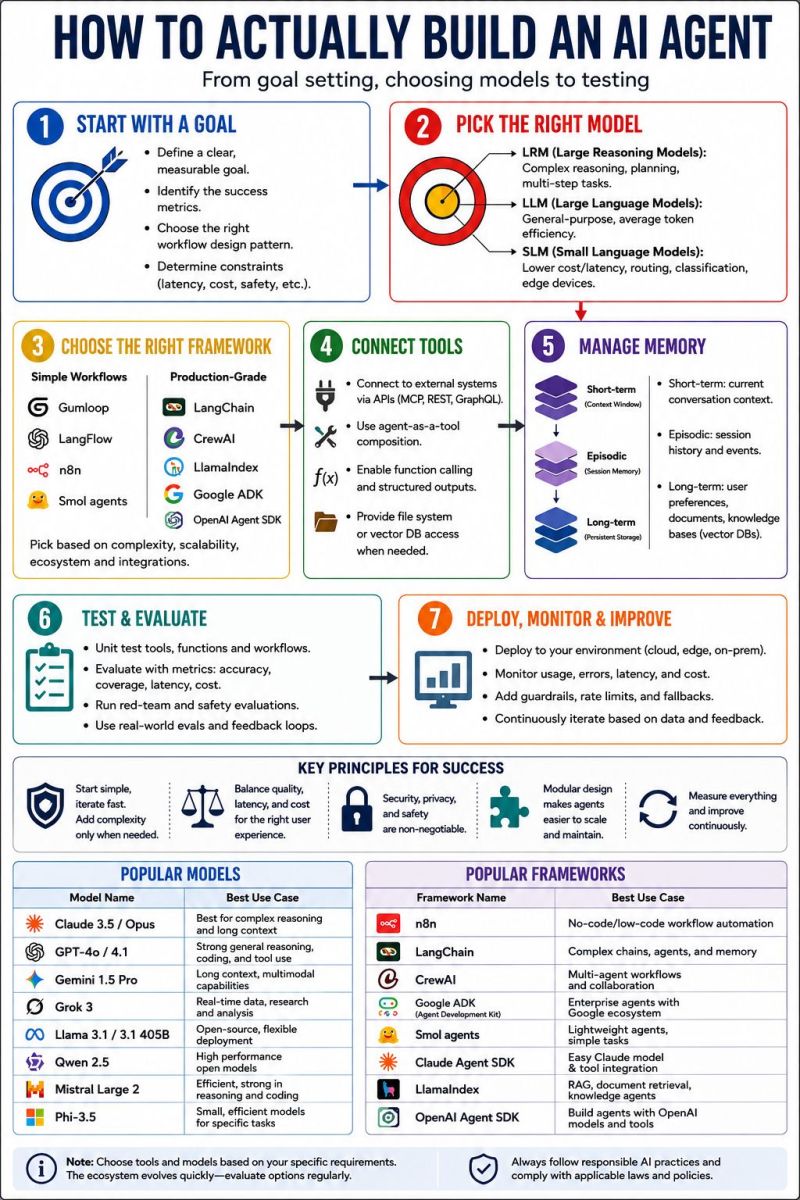
How to Actually Build an AI Agent (That Works in Production)
Disclaimer
This marketing document has been issued by Bank Syz Ltd. It is not intended for distribution to, publication, provision or use by individuals or legal entities that are citizens of or reside in a state, country or jurisdiction in which applicable laws and regulations prohibit its distribution, publication, provision or use. It is not directed to any person or entity to whom it would be illegal to send such marketing material. This document is intended for informational purposes only and should not be construed as an offer, solicitation or recommendation for the subscription, purchase, sale or safekeeping of any security or financial instrument or for the engagement in any other transaction, as the provision of any investment advice or service, or as a contractual document. Nothing in this document constitutes an investment, legal, tax or accounting advice or a representation that any investment or strategy is suitable or appropriate for an investor's particular and individual circumstances, nor does it constitute a personalized investment advice for any investor. This document reflects the information, opinions and comments of Bank Syz Ltd. as of the date of its publication, which are subject to change without notice. The opinions and comments of the authors in this document reflect their current views and may not coincide with those of other Syz Group entities or third parties, which may have reached different conclusions. The market valuations, terms and calculations contained herein are estimates only. The information provided comes from sources deemed reliable, but Bank Syz Ltd. does not guarantee its completeness, accuracy, reliability and actuality. Past performance gives no indication of nor guarantees current or future results. Bank Syz Ltd. accepts no liability for any loss arising from the use of this document.
Related Articles
The limits apply only to agentic coding software, and they apply to each tool, so employees can spend $1,500 on each different tool, according to the report, which cited an Uber spokesperson. Uber provides employees with a dashboard on which they can track their usage of different tools, and it allows individuals to seek permission to exceed the limits, per the report. “We think this is all a pretty straightforward way to responsibly encourage agentic AI adoption and experimentation at scale across the company,” the Uber spokesperson said in the report. The limits were implemented in recent months after Uber used up its AI budget for the full year by April, the report said, noting that The Information reported that fact in April. In The Information’s report, Uber Chief Technology Officer Praveen Neppalli Naga, who shared the news about the AI budget, said the company was “back to the drawing board. Source: Pymnts
If $GOOGL — a company printing massive FCF — is tapping equity markets for $80B, it’s because credit conditions are tightening. The private credit canary in the coal mine may have just died. The structure of the raise says a lot: a massive $40B ATM alongside a $10B private placement to Berkshire Hathaway. That’s what a desperate search for liquidity looks like. So who else is heavily exposed to credit markets? $ORCL is probably the first name that comes to mind. The stock has ripped higher and suddenly it feels like everyone forgot the financing overhang. Meanwhile, debt-to-equity is still above 5x. $META continues spending at an almost irrational pace. At some point this may force Zuck to reevaluate the playbook here. (Arete upgraded it today, by the way.) Then you have the companies that need constant access to capital just to keep expanding. $EQIX and $DLR immediately stand out. A 200MW data center now costs roughly $8B to build — not exactly pocket change. But the biggest credit story of them all might be $CRWV. The stock rallied yesterday on $DELL headlines, yet the company is sitting on $21B of debt, including an $8.5B delayed-draw term loan backed by GPUs. Source: Scrooge McDuck
And Berkshire Hathaway $BRK.B is writing a $10 billion check to get in. Here's the full breakdown: THE DEAL: - $30B in underwritten public offerings - $40B through an at-the-market stock program starting Q3 2026 - $10B private placement to Berkshire Hathaway THE BERKSHIRE PIECE: - $5B in Class A Common Stock at $351.81 per share - $5B in Class C Capital Stock at $348.20 per share - Berkshire has been building this position since Q3 2025 THE PURPOSE: - Scale AI compute infrastructure to meet "unprecedented customer demand" - Approximately $30B of the ATM proceeds will cover 2026 employee equity tax obligations - Remaining proceeds go directly to AI infrastructure buildout Source: Evan