

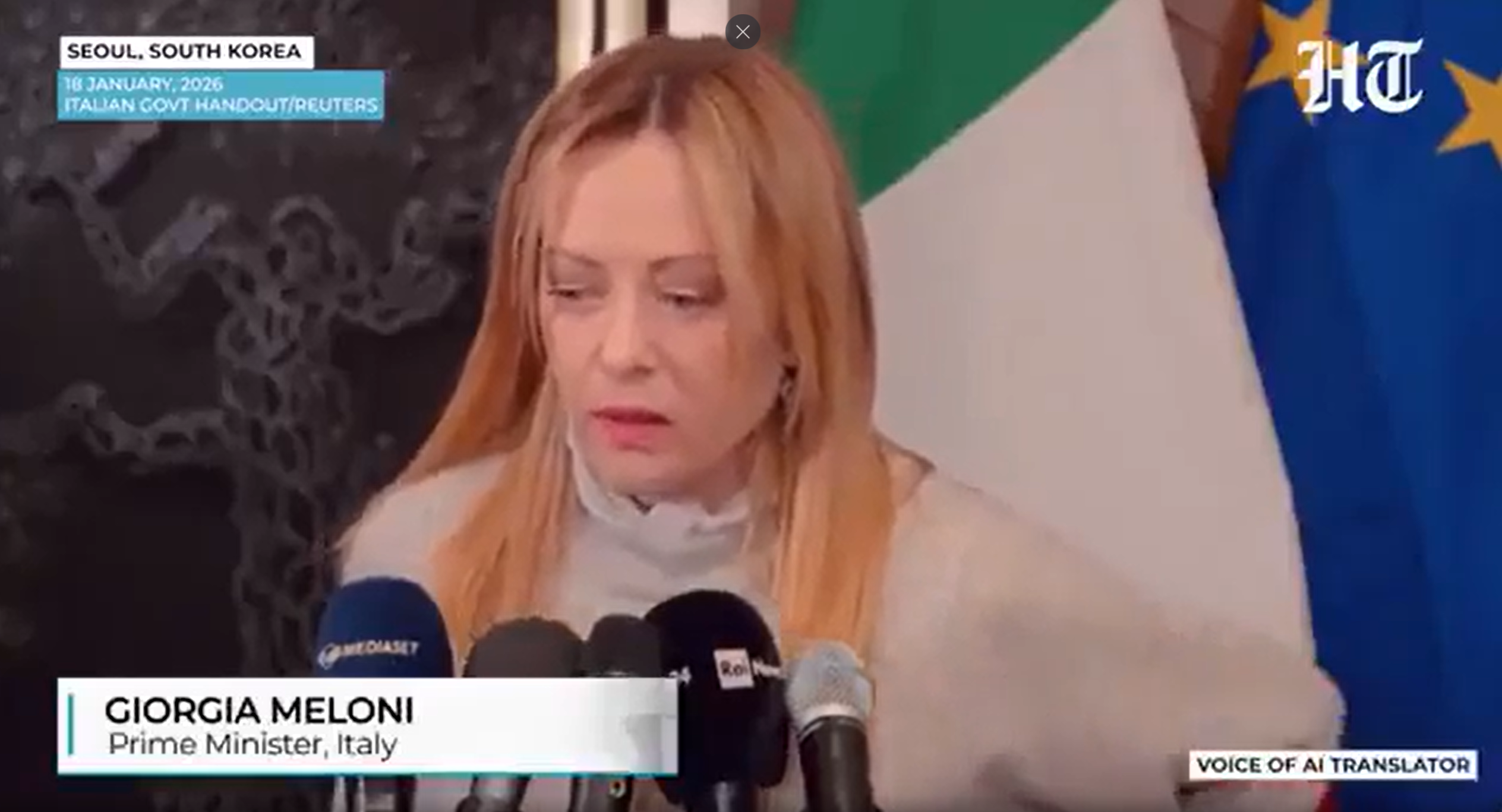
Meloni warns Trump: NATO, not tariffs, is the answer in Greenland and the Arctic
Disclaimer
This marketing document has been issued by Bank Syz Ltd. It is not intended for distribution to, publication, provision or use by individuals or legal entities that are citizens of or reside in a state, country or jurisdiction in which applicable laws and regulations prohibit its distribution, publication, provision or use. It is not directed to any person or entity to whom it would be illegal to send such marketing material. This document is intended for informational purposes only and should not be construed as an offer, solicitation or recommendation for the subscription, purchase, sale or safekeeping of any security or financial instrument or for the engagement in any other transaction, as the provision of any investment advice or service, or as a contractual document. Nothing in this document constitutes an investment, legal, tax or accounting advice or a representation that any investment or strategy is suitable or appropriate for an investor's particular and individual circumstances, nor does it constitute a personalized investment advice for any investor. This document reflects the information, opinions and comments of Bank Syz Ltd. as of the date of its publication, which are subject to change without notice. The opinions and comments of the authors in this document reflect their current views and may not coincide with those of other Syz Group entities or third parties, which may have reached different conclusions. The market valuations, terms and calculations contained herein are estimates only. The information provided comes from sources deemed reliable, but Bank Syz Ltd. does not guarantee its completeness, accuracy, reliability and actuality. Past performance gives no indication of nor guarantees current or future results. Bank Syz Ltd. accepts no liability for any loss arising from the use of this document.
Related Articles
The headlines are screaming "Trade War." JPMorgan’s desk is whispering "Opportunity." 📈 While the media focuses on the chaos, JPM’s International Market Intel team is looking at the scoreboard. Here is why they think the "Greenland Standoff" is actually a bullish signal for 2026: 1. It’s a Negotiation, Not an Invasion. 🤝 Federico Manicardi (JPM) calls it straight: This is classic Art of the Deal. Trump throws out a maximalist stance (10% EU tariffs / buying Greenland) to create leverage and urgency. The goal? A "Negotiated Arrangement," not a sale. 2. The "Bullish" Outcome. 🐂 JPM expects a deal where: ✅ Denmark keeps sovereignty. ✅ The US gets Arctic security & missile defense upgrades. ✅ Access to critical natural resources is secured. Result? Uncertainty clears, and the 2026 growth reboot stays on track. 3. The "Tail Risks" are Overblown. 🧊 An actual invasion? "Melts NATO faster than Arctic ice" and polls horribly. A sale? Unlikely and unnecessary. JPM sees the downside limited to a mid-single-digit (MSD) drop at worst before the rebound. 4. Eyes on Davos. 🏔️ With Trump addressing the World Economic Forum tomorrow, expect the rhetoric to shift from "threats" to "affordability and growth." The Bottom Line: Volatility is a gift if you understand the playbook. The market is anticipating a growth reboot, and JPM believes this "orange flag" is just noise on the path to a deal. Source: ZeroHedge
Greenland has a unique history with the EU, being the only territory to ever leave it. Originally joining in 1973 as part of Denmark, Greenland’s population consistently opposed European integration. 1972 Referendum: 70% voted against joining the European Communities, but Greenland joined anyway as part of Denmark. 1982 Referendum: After gaining home rule in 1979, 52% voted to leave, driven by disputes over the Common Fisheries Policy, control of natural resources, and a sense that the EC ignored Greenland’s interests. Turnout was 74.9%. 1985 Withdrawal: Greenland formally left the EC on January 1, 1985, via the Greenland Treaty, becoming an Overseas Country and Territory (OCT) associated with the EU, maintaining some economic ties while regaining sovereignty over its fisheries.
Greenland has a longstanding defense arrangement with the United States. On April 27, 1951, Denmark and the United States signed the Defense of Greenland Agreement, which remains in effect today. This treaty grants the United States significant military rights in Greenland: - The right to establish and operate military bases and “defense areas” in Greenland - Free movement of US ships, aircraft, and military vehicles across Greenland’s territory - The ability to construct facilities without paying rent or taxation to Denmark - Authorization to expand military presence if deemed necessary by NATO The most notable result of this agreement was the construction of Thule Air Base (now Pituffik Space Base) in northwest Greenland, which during the Cold War housed more than 10,000 US troops. Today, it remains the northernmost US Department of Defense installation, located 1,210 km north of the Arctic Circle. The agreement was updated in 2004 to recognize Greenland’s Home Rule government, but the fundamental military rights granted to the United States remain unchanged. The treaty continues in force as long as both countries remain NATO members.