

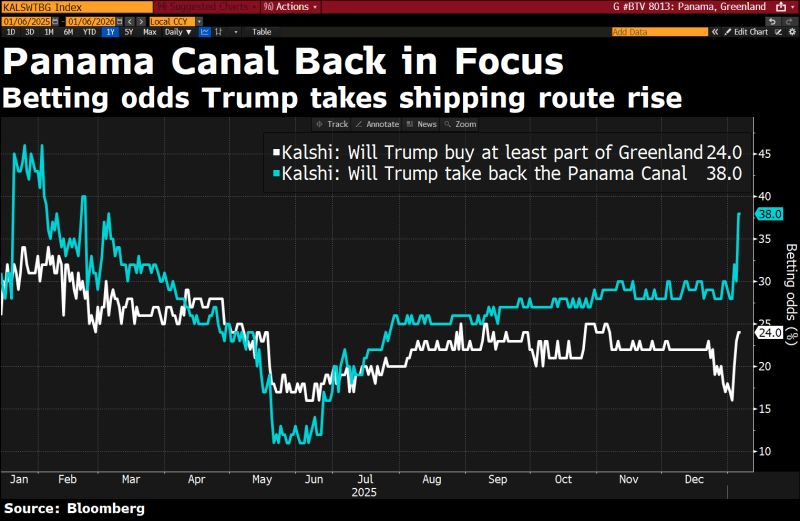
Traders are betting that the Panama Canal will be the next target of the Trump administration, given the market's dawning understanding of the "Donroe Doctrine:"
Disclaimer
This marketing document has been issued by Bank Syz Ltd. It is not intended for distribution to, publication, provision or use by individuals or legal entities that are citizens of or reside in a state, country or jurisdiction in which applicable laws and regulations prohibit its distribution, publication, provision or use. It is not directed to any person or entity to whom it would be illegal to send such marketing material. This document is intended for informational purposes only and should not be construed as an offer, solicitation or recommendation for the subscription, purchase, sale or safekeeping of any security or financial instrument or for the engagement in any other transaction, as the provision of any investment advice or service, or as a contractual document. Nothing in this document constitutes an investment, legal, tax or accounting advice or a representation that any investment or strategy is suitable or appropriate for an investor's particular and individual circumstances, nor does it constitute a personalized investment advice for any investor. This document reflects the information, opinions and comments of Bank Syz Ltd. as of the date of its publication, which are subject to change without notice. The opinions and comments of the authors in this document reflect their current views and may not coincide with those of other Syz Group entities or third parties, which may have reached different conclusions. The market valuations, terms and calculations contained herein are estimates only. The information provided comes from sources deemed reliable, but Bank Syz Ltd. does not guarantee its completeness, accuracy, reliability and actuality. Past performance gives no indication of nor guarantees current or future results. Bank Syz Ltd. accepts no liability for any loss arising from the use of this document.
Related Articles
We are witnessing the rollout of a global energy stranglehold. If you think the recent moves in South America are local politics, you’re missing the forest for the trees. This is a masterclass in Geopolitical Chess, and the target is much bigger. Here is why Venezuela is the "Patient Zero" for a new era of American dominance: 🔴 1. Cutting China’s Lifelines By taking control of Venezuela’s oil and aligning Nigeria under Western oversight, Washington is effectively pulling the plug on China’s access to cheap, reliable energy. Control the supply + control the transit = control the rival. 🚢 2. The Chokepoint Strategy Look at the map. From the Bab al-Mandab (Somaliland/Yemen) to the Strait of Hormuz, the U.S. is positioning itself to insulate its own economy while leaving China’s economy vulnerable to any disruption. 🛡️ 3. Neutralizing the Iran Factor Securing the world’s largest oil reserves in Venezuela provides a massive "buffer." If the Persian Gulf goes dark in a conflict with Iran, the U.S. won't flinch. Venezuela becomes the ultimate insurance policy, making military escalation in the Middle East "affordable." 💵 4. Defending the Petrodollar This is about ensuring the U.S. Dollar remains the undisputed king of energy markets. By restructuring sovereign states to align with U.S. interests, Washington is reinforcing the financial plumbing of the global economy. The Bottom Line: Venezuela is a strategic precedent. If this succeeds, it’s a blueprint for reasserting dominance over trade routes and energy flows for the next 50 years. But there’s a massive "IF." If the U.S. gets bogged down in a prolonged crisis in Caracas, it drains the very capital needed to project power in the Middle East and Asia. Is this a brilliant strategic realignment, or a high-stakes gamble that could overextend American power?
Here is the situation: The U.S. is moving to seize the Marinera, a Russian-flagged tanker carrying sanctioned Venezuelan oil. Russia’s response? They deployed a submarine to escort it. 🇷🇺🇻🇪🇺🇸 The Breakdown: -> The Move: The U.S. is enforcing sanctions with physical force. -> The Counter: Moscow is signaling they will use military hardware to protect their assets. ->The Global Ripple: China is watching closely. 🇨🇳 Why this matters: This isn't just about oil prices. It’s about the shift from Economic Diplomacy to Kinetic Confrontation. If the U.S. succeeds, American sanctions become the ultimate global law. If Russia blocks them, the era of U.S. naval dominance faces its biggest test in decades. Source: Mario Nawfal on X, Reuters, @sentdefender, WSJ
In geopolitical terms, the concept of the Western Hemisphere vs. the Eastern Hemisphere is a framework that divides the world into two distinct spheres of influence. Historically, this served to separate the "New World" (the Americas) from the "Old World" (Europe, Asia, and Africa). Under President Trump’s 2nd administration, this concept has been revitalized through a policy often referred to as the "Trump Corollary" to the Monroe Doctrine. This strategy shifts the focus of U.S. foreign policy away from global commitments in the East (like NATO or the Indo-Pacific) to assert absolute "preeminence" in the West. 1. The Hemispheric Divide The Eastern Hemisphere: Often framed by this administration as a region of "civilizational erasure" and competition. Trump’s strategy suggests that Eastern powers—specifically China and Russia—should stay out of American affairs, while the U.S. simultaneously reduces its traditional role as the "policeman" of Europe and the Middle East. The Western Hemisphere: Framed as the US "neighborhood" or "home turf." The goal is to create a "fortress" in the Americas where the U.S. exercises unchallenged control over security, trade, and resources. 2. The Monroe Doctrine: Colonial vs. Defensive The Monroe Doctrine (1823) originally stated that any intervention by European powers in the politics of the Americas was a potentially hostile act against the U.S. and notably to prevent European monarchs from recolonizing newly independent Latin American nations. Critics argue the doctrine was always a "colonial" tool because it didn't grant Latin American nations true sovereignty; it simply replaced European masters with American ones. 3. The "Trump Corollary" (Monroe 2.0 or Donroe doctrine) The 2025 National Security Strategy (NSS) explicitly introduced the Trump Corollary. It links the 19th-century doctrine to modern "America First" goals in several ways: - Resource and Asset Control: The U.S. now claims the right to deny "non-hemispheric competitors" (China) the ability to own "strategically vital assets" in the Americas, such as ports, mines, or 5G networks. - Militarized Border & Migration: The Western Hemisphere is prioritized as the "main line of defense." Trump has used this framework to justify military operations in the Caribbean and near the Mexican border to stop migration and drug trafficking, treating these as "invasions." - Regime Change & Sovereignty: The recent 2026 military action in Venezuela to remove Nicolás Maduro is the most direct application of this doctrine. It sends the message that the U.S. will manage the affairs of the hemisphere and will not tolerate "hostile" regimes aligned with Eastern powers. - Territorial Expansion: Informal discussions about Greenland or "annexing" parts of Canada are viewed by some as an extreme, modern extension of the "the Monroe Doctrine.