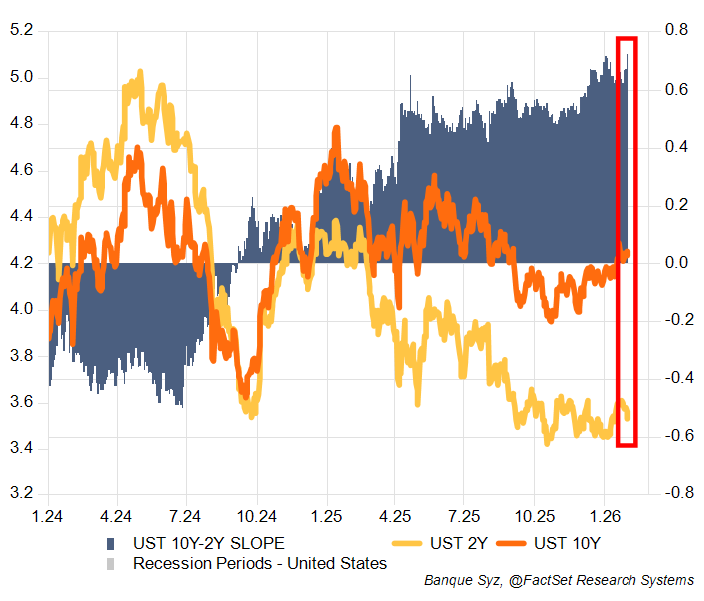
Sovereign bond markets absorbed the nomination of Kevin Warsh as Fed Chair relatively smoothly amid a broader risk-off tone late in the week. US front-end yields rallied, with the 2-year Treasury down 7bps on the week to 3.52%, reflecting both safe-haven demand and expectations that the Fed’s next move remains a cut. This was reinforced by Wednesday’s FOMC decision to hold rates steady at 3.50–3.75%, with Chair Powell offering little near-term guidance but signalling no change in the easing bias.
By contrast, longer maturities cheapened modestly. The 10-year Treasury rose 1bp to 4.24%, while the 30-year increased nearly 5bps to 4.87%, extending the mild curve steepening triggered by Warsh’s nomination. Inflation expectations edged slightly higher, with the 10-year breakeven up 3bps, while real yields declined marginally.
In Europe, sovereign yields fell broadly amid ongoing disinflation dynamics and cautious ECB communication. German 10-year Bund yields declined 6bps to 2.84%, with similar moves across France and the periphery. UK gilt yields were broadly stable, while Swiss yields fell sharply across the curve. Japanese yields were little changed.
Bond ETF performance reflected these moves. US short-duration Treasury ETFs posted modest gains, while long-duration funds underperformed amid rising long-end yields. In contrast, euro government bond ETFs delivered solid positive returns, particularly in longer maturities and inflation-linked exposures.
Emerging market
Emerging market (EM) credit markets remained stable last week, supported by the Fed’s decision to leave policy rates unchanged. Argentina and Romania were among the outperformers.
Trade developments continued to attract attention. The EU–India trade agreement, long under negotiation, has moved back to the top of the agenda as the U.S. has sharply increased trade barriers. In parallel, the EU–Mercosur agreement—covering Argentina, Brazil, Paraguay, and Uruguay—would, if ratified by EU member states, remove tariffs on around 91% of goods traded with the EU. For Latin American exporters, this would materially improve access to European consumer markets, particularly for agricultural, dairy, and food products.
In fact, across Latin America and the Caribbean sovereign, the average S&P’s rating has greatly improved in recent years, reaching 50% share of investment grade. This marks a break from the past decade.
EM debt primary market activity was exceptionally strong in January. EM sovereign issuance reached $73 billion debt, far exceeding the previous monthly record of $54 billion in April 2020.
EM debt funds recorded a weekly inflow following three consecutive weeks of outflows. To put this in perspective, EM debt funds experienced steady inflows throughout the second half of 2025, following three years of sustained outflows. It is widely expected to see scope for inflows to extend into 2026.
EM sovereign USD bonds were down marginally by -0.1% total return last week despite record new bond issuance (iShares EM Sovereign USD Bond ETF). EM local-currency sovereign bonds were broadly flat after the strong gains in the previous week (The J.P. Morgan EM Local Currency Bond ETF).
The projected positive GDP growth in emerging markets, conservative EM corporate leverage and a weaker U.S. dollar create a supportive backdrop for EM debt to deliver resilient carry.




.png)