Maggie Cheng

Senior Fixed Income Analyst

Adrien Pichoud

Head of Fixed Income

The Chart of the week

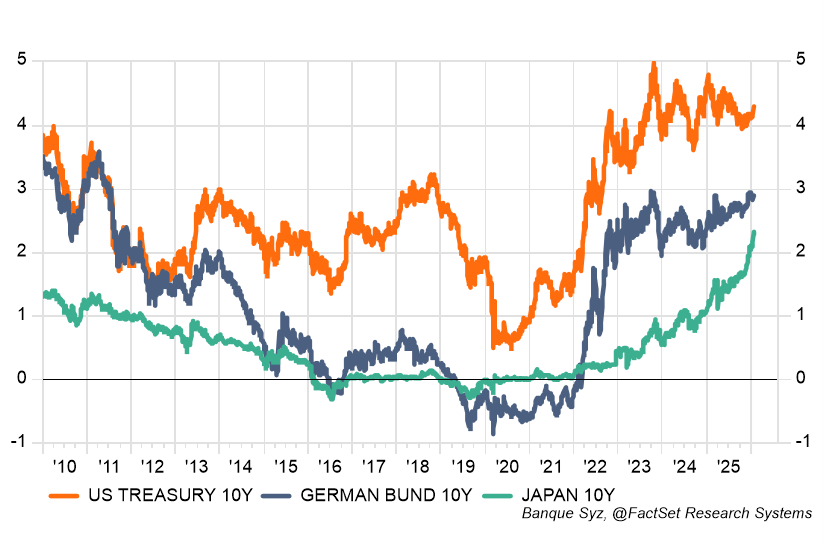
Japan government yields push global yields up

Japanese government bond yields have been on a clear upward trend since 2024, but the trend has recently been accelerating with prospects of additional fiscal stimulus. 10-year JGB yields are up to their highest level since 1999 (+22bp since the beginning of the year, to 2.29%) and the 30-year yield reached the highest level ever recorded, at 3.88%.

This relentless rise in what used to be the lowest-yielding part of the global sovereign bond market is contributing to push the whole sovereign bond yield complex higher. Domestic reasons can also explain the rise in EUR sovereign rates or the stickiness of US Treasury 10y yields above 4%. But the upward dynamic in JGBs is also contributing to reshape the global sovereign rate market.

What happened last week?

Central banks

The Fed entered its pre-FOMC media blackout ahead of next week’s meeting, after an intense round of communication that reinforced a broadly patient stance. Vice Chair Jefferson noted policy rates are close to neutral and that easing services and shelter inflation keeps the disinflation process on track toward 2%. Comments from regional presidents reflected a range of views: Williams stressed policy is well calibrated, Paulson envisaged possible modest rate cuts later this year if inflation continues to moderate, while Kashkari warned inflation risks could remain elevated for years. This week’s key data are delayed October–November PCE releases, with core readings expected to remain moderate. Institutional uncertainty also lingers, with the Supreme Court case on Fed Governor Cook and political scrutiny around Chair Powell’s future complicating expectations around Fed leadership.

ECB officials, including Chief Economist Lane, signaled comfort with the current policy stance and little appetite for near-term rate changes. Croatia’s Vujčić was tapped as the next ECB Vice President.

The BoJ is expected to hold its policy rate at 0.75% at the January meeting, while beginning gradual sales of ETF and REIT holdings. Officials are increasingly attentive to yen weakness as a potential inflation driver, suggesting currency dynamics may play a larger role in future tightening discussions, even as near-term policy remains on hold.

Last week the Narodowy Bank Polski (Polish central bank) and the Bank of Korea held their key rate unchanged, respectively at 4.00% and 2.50%.

Credit

EUR and USD credit spreads started the year on a firm footing.

Record new bond issuance in US and EUR investment grade has been met with even stronger demand, allowing supply to be absorbed smoothly without widening spreads. Spreads tightened across US and EUR investment grade and fund inflows continued despite geopolitical tensions between the US and the EU/NATO over the future of Greenland.

Re-militarisation is emerging as a key theme in Europe. However, the defence sector remains quite small within EUR credit markets. European defence companies typically operate with low financial leverage and limited reliance on debt issuance.

In EUR corporates, the new issue premium has averaged around 4 basis points so far this month, By sector, premia have been relatively more generous in single-A issuers, German investment-grade names, and the energy sector. While the current premium is low, it remains above the negative levels observed in the aftermath of pandemic-era monetary easing.

Total returns were modestly positive last week across US investment grade and US high yield, as spread tightening more than offset higher Treasury yields. In contrast, EUR market returns were mixed, with EUR high yield outperforming investment grade. Within EUR high yield, the chemicals sector significantly underperformed, while autos outperformed within EUR investment grade.

Looking ahead, investment-grade supply should slow seasonally through March. In this environment, staying invested for carry remains sensible, while being mindful of short-term volatility driven by geopolitical developments, a recurring feature under the Trump administration.

Rates

Global rates moved divergently last week, with US yields extending higher while core European sovereigns rallied and Japanese yields surged to multi-decade highs. In the US, Treasuries sold off across the curve: the 2yr rose 5bp to 3.59%, the 5yr climbed 7bp to 3.82%, and the 10yr added nearly 6bp to 4.22%, its highest level since late August. The move was driven partly by political headlines on Friday, as former President Trump signaled reluctance to nominate NEC Chair Kevin Hassett as Fed Chair. Market-implied odds quickly shifted toward Kevin Warsh as frontrunner, reinforcing uncertainty around future Fed leadership. Inflation compensation also edged higher, with 10yr breakevens up 4bp, while real yields rose modestly.

In contrast, sovereign bonds edged lower across much of Europe. German 10yr Bund yields fell 3bp to 2.84%, with similar declines in OATs and a stronger rally in peripherals, as Italian 10yr yields dropped 4bp and Spanish yields fell 3bp. UK gilts were slightly up, with 10yr yields up 3bp.

Japan stood out: 10yr JGB yields jumped 9bp to 2.19%, the highest since 1999, amid political uncertainty and expectations of a snap election. The move weighed on long-duration assets globally, reflected in negative returns across US Treasury ETFs, particularly in the belly and long end.

Emerging market

Emerging market (EM) sovereign USD bonds were weaker amid higher U.S. Treasury yields, although markets such as Colombia and Chile outperformed peers. EM corporate USD bonds have shown resilience in this environment.

The U.S. administration has outlined a three-step plan for Venezuela — stabilisation, recovery of the energy sector and political transition — but recent credit developments are unfavourable for Venezuela’s and its state-owned oil company PDVSA’s bondholders. Trump signed an Executive Order to block any judicial process against Venezuelan oil revenues held in U.S. Treasury accounts, designating them as “Foreign Government Deposit Funds” for U.S. foreign policy purposes and shielding them from private creditor claims.

Oil majors have expressed mixed interest in Venezuelan opportunities. Exxon Mobile considered Venezuela as currently uninvertible until the country makes legal changes to protect foreign investments.

Against this backdrop, EM USD corporate bonds fared better with +0.1% total return last week, while EM local-currency sovereign bonds of +0.3% (The J.P. Morgan EM Local Currency Bond ETF) outperformed hard-currency sovereigns of -0.1% (iShares EM Sovereign USD Bond ETF).

Looking ahead, a weaker US dollars and cooling EM inflation should give some EM central banks greater flexibility to cut rates, notably Brazil and, to a lesser extent Mexico, though geopolitical risks will remain front and center.



Our view on fixed income 

Rates
NEGATIVE in current environment

We maintain a Negative stance on government bonds. Positive global growth dynamics, price pressures in the US and profligate fiscal policies reduce the attractiveness of long-term government bonds as a potential hedge for economic downturn and increase the risk of higher long-term yields. Limited prospects of further central banks’ rate cuts and unattractive yield curve slopes at the front-end also reduce the attractiveness of government bonds on short-to-medium term maturities. 


Investment Grade
NEUTRAL, harvest the carry
We continue to find Investment Grade corporate bonds attractive in the current environment, given their yield level and our constructive economic scenario. However, tight credit spreads have reduced the margin for safety in credit, that can be deemed as expensive from a valuation standpoint. As a result, we hold a Neutral stance on Investment Grade credit from an asset allocation perspective. The credit market's overall health is supported by robust demand and strategic maturity management. 
High Yield
NEUTRAL, go short-term

We still like High Yield bonds with short maturity for their attractive combination of yield and low sensitivity to interest rate movements. HY spreads have tightened, signaling economic stability and contained default risk in the short run. However, those tight spreads are not attractive for medium-to-long term maturities as they do not compensate adequately for a potential deterioration in the economic environment. As such, we hold a Neutral view for High Yield in an allocation, with a clear preference for short-duration investments. We continue to find value in subordinated debt.

 
Emerging Markets
NEUTRAL, be selective
We  advocate for a careful selection of issuers to benefit from attractive absolute yields. Substantial inflows into EM debt this year have been fueled by a weak dollar along with EM corporates’ solid credit metrics and support the asset class. However, risks persist, with rich valuations and unpredictable Trump’s trade policies. Idiosyncratic risks also remain, notably in Brazil and India. Given this backdrop, we stay selective, favoring short-duration opportunities while remaining Neutral on the broad EM debt asset class. 

Disclaimer

This marketing document has been issued by Bank Syz Ltd. It is not intended for distribution to, publication, provision or use by individuals or legal entities that are citizens of or reside in a state, country or jurisdiction in which applicable laws and regulations prohibit its distribution, publication, provision or use. It is not directed to any person or entity to whom it would be illegal to send such marketing material. This document is intended for informational purposes only and should not be construed as an offer, solicitation or recommendation for the subscription, purchase, sale or safekeeping of any security or financial instrument or for the engagement in any other transaction, as the provision of any investment advice or service, or as a contractual document. Nothing in this document constitutes an investment, legal, tax or accounting advice or a representation that any investment or strategy is suitable or appropriate for an investor's particular and individual circumstances, nor does it constitute a personalized investment advice for any investor. This document reflects the information, opinions and comments of Bank Syz Ltd. as of the date of its publication, which are subject to change without notice. The opinions and comments of the authors in this document reflect their current views and may not coincide with those of other Syz Group entities or third parties, which may have reached different conclusions. The market valuations, terms and calculations contained herein are estimates only. The information provided comes from sources deemed reliable, but Bank Syz Ltd. does not guarantee its completeness, accuracy, reliability and actuality. Past performance gives no indication of nor guarantees current or future results. Bank Syz Ltd. accepts no liability for any loss arising from the use of this document.

Read More

Straight from the Desk

Syz the moment

Live feeds, charts, breaking stories, all day long.

Thinking out loud

Sign up for our weekly email highlighting the most popular posts.

Follow us

Thinking out loud

Investing with intelligence

Our latest research, commentary and market outlooks