Maggie Cheng

Senior Fixed Income Analyst

Adrien Pichoud

Head of Fixed Income

The Chart of the week

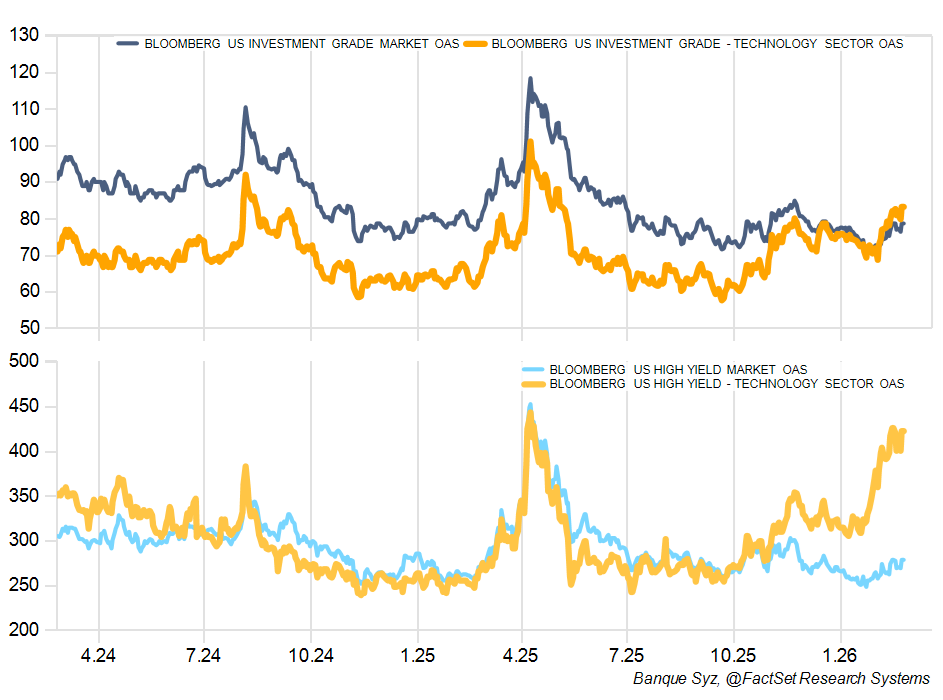
Credit spreads of Technology sector issuers are widening in HY and IG markets as AI fears intensify

Credit markets have come under moderate pressure in recent weeks as investor sentiment has gradually cooled. After reaching new lows in January, average credit spreads in the US Investment Grade (IG) and High Yield (HY) markets have widened back toward December levels.

As in equity markets, the Technology sector is leading the move in corporate credit, as investors grow increasingly concerned about the disruptive potential of AI. Software and technology companies are at the forefront, both because of the risks AI poses to their business models and the significant capex and bond issuance it requires.

In High Yield, the Technology sector has clearly underperformed since last November. The trend accelerated sharply in mid-January, with spreads in High Yield Technology returning to their post–Liberation Day levels, while broader market spreads remain close to historical lows.

In Investment Grade, the Technology sector has historically traded at tighter spreads than the broader IG market, reflecting higher ratings, strong cash positions, and low leverage. This began to change in Q4 2025, when hyperscalers issued substantial debt to finance AI-related capex. Since then, average IG Technology spreads have trended upward and, in February, widened above the broader IG market’s average spread for the first time in twenty years. AI is now reshaping long-standing equilibria in corporate credit markets. 

What happened last week?

Central banks

Global central banks struck a cautious tone last week, balancing easing expectations against lingering inflation risks.

In the US, comments from Federal Reserve officials highlighted divisions over the future rate path. Minutes from the January meeting underscored renewed inflation concerns, with several policymakers open to rate hikes if price pressures persist. However, Fed members’ views are not all aligned: last week, Federal Reserve Bank of Chicago President Austan Goolsbee said further rate cuts are possible if inflation continues to move toward the 2% target, describing tariff-related price pressures as potentially transitory. He signaled openness to several cuts in 2026, contingent on clearer disinflation evidence, and welcomed the prospective nomination of Kevin Warsh to succeed Jerome Powell. By contrast, Governor Michael Barr urged holding rates steady until goods inflation shows sustained improvement, warning that AI-driven productivity gains may actually lift the neutral rate. Similarly, San Francisco Fed President Mary Daly noted stronger productivity could justify higher rates. Overall, Fed minutes and firm growth and inflation data drove rate cut expectations for this year marginally lower, with the end-2026 future rate rising 8bp to 3.08%.

In Europe, leadership uncertainty emerged at the European Central Bank. A FT report suggested Christine Lagarde may step down early, though she later reaffirmed her intention to complete her term. ECB rate expectations were barely affected by the news. In the UK, data showed inflation easing to 3%, keeping the Bank of England on course for possible spring rate cuts, albeit amid sticky services inflation. BoE rate expectations marginally increased last week and future markets price two more rate cuts this year with almost certainty.

Central banks in Romania, in New Zealand and in Indonesia kept their key rate unchanged last week.

Credit

Credit spreads ended the week marginally softer in EUR investment grade, while tightening in EUR high yield, even as escalating tensions between the United States and Iran pushed crude oil prices to seven-month highs.

U.S. trade policy returned to the forefront following a temporary easing of AI-related volatility. The U.S. Supreme Court ruled against the reciprocal tariffs introduced by the Trump administration, although the President retains alternative legal avenues to pursue similar measures. Meanwhile, the European Union may delay ratification of last July’s signed trade agreement.

U.S. investment grade delivered a modest negative total return of -0.2%, driven by slightly higher Treasury yields, erasing part of the previous week’s gains.

Year-to-date, EUR investment grade and high yield fund inflows have outpaced their U.S. counterparts. EUR investment grade recorded another week of positive returns and resilient demand, marking 34 consecutive weeks of inflows, supported by moderating Bund yields over the past fortnight.

European investment banks reported a 16% increase in 2025 trading income, broadly in line with U.S. peers, reflecting strong client activity amid volatile market conditions.

Both U.S. and EUR high yield posted positive weekly returns of +0.2% and +0.3%, respectively, supported by tighter spreads. EUR high yield funds extended their streak to six consecutive weeks of inflows.

Against a backdrop of tariff uncertainty, AI-related fatigue, and persistent geopolitical tensions, maintaining sectoral and geographical diversifications continue to make sense, while staying invested to capture coupon carry.

Rates

Sovereign bond markets diverged over the week, with US Treasury yields moving higher while European core debt outperformed.

In the US, although Q4 GDP surprised to the downside, an upside surprise in core PCE, solid January industrial production, lower-than-expected jobless claims and “hawkish” Fed minutes tempered expectations for near-term Fed easing. Against this backdrop, and amid renewed fiscal uncertainty, the Treasury curve bear-flattened. The 2-year yield rose 7bps to 3.48%, while the 10-year increased 3bps to 4.08% and the 30-year to 4.72%, with inflation breakevens stable last week. As a result, US government bonds ETFs posted negative total returns, especially for longer-maturity ones: the iShares Treasury 1–3y ETF fell -0.08%, while the 20y+ segment declined -0.35%.

In contrast, European bonds rallied. German 10-year Bund yields fell 2bps to 2.74%, while French OATs declined 4bps and UK gilts outperformed, with 10-year yields down 6bps to 4.35% after the release of softer-than-expected inflation data. Peripheral spreads were mixed but generally tighter. Reflecting the move, euro government bond ETFs delivered positive returns, led by longer-duration exposures.

Emerging market

Emerging market (EM) dollar credit markets delivered another week of positive returns, as tighter credit spreads more than offset the drag from higher US Treasury yields. Mexico, Peru and Chile were among the outperformers.

Geopolitical risks remain elevated, with the U.S. assembling a substantial regional force around Iran. While a material escalation is not the base case, policy decisions under the Trump administration continue to introduce a high degree of unpredictability.

In Argentina, President Javier Milei is facing a general strike in opposition to his proposed labour reform bill, part of his austerity agenda aimed at reducing government spending in 2026. Successful passage of the reform could support lower interest rates and improve Argentina’s prospects of returning to international bond markets.

More broadly, EM corporates have so far demonstrated greater resilience in volatile market conditions than in previous cycles, reflecting meaningfully stronger credit fundamentals.

In Colombia, majority state-owned Ecopetrol ended 2025 with proven oil reserves up 3%, corresponding to an average reserve life of 7.8 years. The company remains a strategically important issuer for the Colombian sovereign.

In China, the Lunar New Year holiday (16–24 February) is ongoing. According to the Ministry of Commerce, average daily retail sales during the first four days of the holiday increased markedly year-on-year, pointing to resilient domestic consumption.

From a performance perspective, EM local-currency sovereign bonds (the J.P. Morgan EM Local Currency Bond ETF) were flat over the week, following several consecutive weeks of gains. EM sovereign USD bonds and EM corporate USD bonds (iShares benchmarks) both returned +0.2%, supported by strong investor demand. Global EM debt funds recorded another week of inflows, the largest in seven weeks, after a volatile start to the year.



Our view on fixed income 

Rates
NEGATIVE in current environment

We maintain a Negative stance on government bonds. Positive global growth dynamics, price pressures in the US and profligate fiscal policies reduce the attractiveness of long-term government bonds as a potential hedge for economic downturn and increase the risk of higher long-term yields. Limited prospects of further central banks’ rate cuts and unattractive yield curve slopes at the front-end also reduce the attractiveness of government bonds on short-to-medium term maturities. 


Investment Grade
NEUTRAL, harvest the carry
We continue to find Investment Grade corporate bonds attractive in the current environment, given their yield level and our constructive economic scenario. However, tight credit spreads have reduced the margin for safety in credit, that can be deemed as expensive from a valuation standpoint. As a result, we hold a Neutral stance on Investment Grade credit from an asset allocation perspective. The credit market's overall health is supported by robust demand and strategic maturity management. 
High Yield
NEUTRAL, go short-term

We still like High Yield bonds with short maturity for their attractive combination of yield and low sensitivity to interest rate movements. HY spreads have tightened, signaling economic stability and contained default risk in the short run. However, those tight spreads are not attractive for medium-to-long term maturities as they do not compensate adequately for a potential deterioration in the economic environment. As such, we hold a Neutral view for High Yield in an allocation, with a clear preference for short-duration investments. We continue to find value in subordinated debt.

 
Emerging Markets
NEUTRAL, with opportunities
 We advocate for a careful selection of issuers to benefit from attractive absolute yields. Global growth dynamic, a weaker US dollar, contained public debt & corporate leverage along with strong flows are supportive for EM debt However, risks persist, with rich valuations and unpredictable Trump’s trade policies. Idiosyncratic risks also remain, notably in Brazil and India. Given this backdrop, we stay selective, favoring short and medium-duration opportunities while remaining Neutral on the broad EM debt asset class in a multi-asset portfolio context. 

Disclaimer

This marketing document has been issued by Bank Syz Ltd. It is not intended for distribution to, publication, provision or use by individuals or legal entities that are citizens of or reside in a state, country or jurisdiction in which applicable laws and regulations prohibit its distribution, publication, provision or use. It is not directed to any person or entity to whom it would be illegal to send such marketing material. This document is intended for informational purposes only and should not be construed as an offer, solicitation or recommendation for the subscription, purchase, sale or safekeeping of any security or financial instrument or for the engagement in any other transaction, as the provision of any investment advice or service, or as a contractual document. Nothing in this document constitutes an investment, legal, tax or accounting advice or a representation that any investment or strategy is suitable or appropriate for an investor's particular and individual circumstances, nor does it constitute a personalized investment advice for any investor. This document reflects the information, opinions and comments of Bank Syz Ltd. as of the date of its publication, which are subject to change without notice. The opinions and comments of the authors in this document reflect their current views and may not coincide with those of other Syz Group entities or third parties, which may have reached different conclusions. The market valuations, terms and calculations contained herein are estimates only. The information provided comes from sources deemed reliable, but Bank Syz Ltd. does not guarantee its completeness, accuracy, reliability and actuality. Past performance gives no indication of nor guarantees current or future results. Bank Syz Ltd. accepts no liability for any loss arising from the use of this document.

Read More

Straight from the Desk

Syz the moment

Live feeds, charts, breaking stories, all day long.

Thinking out loud

Sign up for our weekly email highlighting the most popular posts.

Follow us

Thinking out loud

Investing with intelligence

Our latest research, commentary and market outlooks