Maggie Cheng

Senior Fixed Income Analyst

Adrien Pichoud

Head of Fixed Income

The Chart of the week

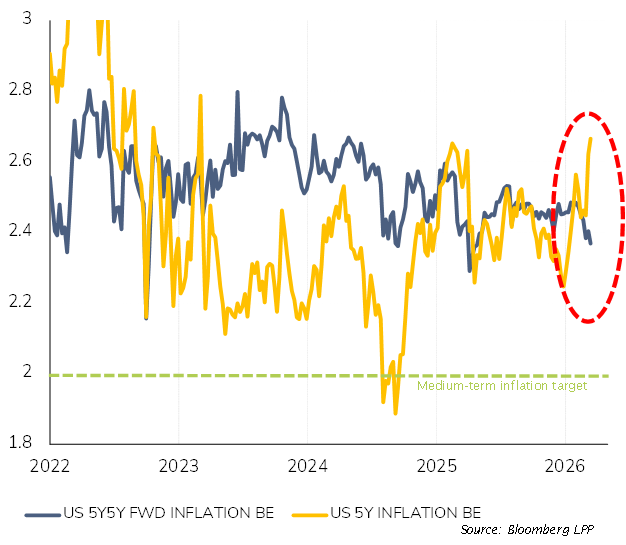
USD market-based inflation expectations

5y spot and 5-year 5-year forward inflation breakeven

With the surge in oil and gas prices, short-term inflation expectations have mechanically risen, with Inflation Breakeven rates up in 1, 2 and 5-years maturity. However, interestingly, medium–term inflation expectations have shown no clear fears of a sustained inflationary dynamic yet.

5-year 5-year forward inflation breakeven, central banks’ preferred measure of medium-term inflation expectations, have only slightly drifted higher in Europe since the beginning of the Middle East conflict. They have even been DECLINING in USD markets. possibly on expectations of less accommodative Fed policies, a stronger USD and slower growth going forward.

The behavior of those 5-year 5-year forward inflation breakeven rates will certainly be closely watched by central banks in the coming weeks and months. A sustained increase triggered by persistent high energy prices could leave them no other choice than to tighten their policy stance. But as long as those medium-term inflation expectations remain contained, central banks can afford to opt for a cautious “wait-and-see” approach.

What happened last week?

Central banks

Ahead of a “super-week” for major central banks around the globe and with central bankers in their “blackout period”, last week was again all about the impact of ongoing developments in energy prices for the monetary policy outlook. As oil prices fluctuate around USD 100/bbl, the outlook for energy prices remains highly uncertain as tensions around the Hormuz strait tend to escalate. With virtually no oil allowed to exit the gulf by sea and land pipelines solutions unable to provide an alternative comparable in scale, each day extends the blow to global oil output.

The risk of this oil price shock for the inflation and growth outlook increases consequently, in parallel with the complexity of the situation facing global central bankers. If ultimately a short-lived price increase, those events might not require specific reactions by central banks, as they will likely look through a temporary blip in energy-related inflation data. But the longer this situation of elevated oil prices last, the higher the risk of seeing energy price increases being passed into other products and services’ prices, and the more consumers and businesses’ inflation expectations could rise. This later scenario would likely warrant a reaction from central banks, as their price stability/moderate inflation target would be threatened.

Addressing a supply-driven inflationary shock with higher rates would have obvious negative consequences for economic growth. Not reacting would threaten central banks’ credibility and potentially create financial market stress by deanchoring inflation expectations and interest rate levels. This dilemma is likely to be reflected in the communication of the Fed on Wednesday, and the ECB, BoE, SNB and BoJ on Thursday. They are all expected to maintain their key rate unchanged but the hints and guidance that they will provide in terms of how they expect to react to the different scenarios for oil prices in the months ahead will be key to assess whether the spectacular repricing in short-term rates expectations since the beginning of the month has to be adjusted.

Credit

Iran war has now entered Day 17, triggering one of the largest oil supply disruptions in history. Despite this shock, the impact on credit spreads has remained relatively contained, supported by yield-sensitive buyers increasing their positions.

However, total returns had another week of negative performance across all credit segments, driven by the rising US Treasury yield and to a lesser extent Bund yield. US investment grade (IG) fell the most of -1.4%. US high yield (HY) and EUR IG dropped -0.7%, and EUR HY -0.8%.

The biggest swing factor for the economy is the duration of the oil shock. Oil price volatility like never before, a peak-to-trough intraday move in Brent of $36. Paradoxically, the biggest release of crude reserves in history last Wednesday saw the oil price ended higher, not lower, on the day. TTF gas price in Europe has been rangebound at EUR50/MWh (mega what hour), is not as high as oil products, might be driven by mild weather in Northwestern Europe.

Even so, the EUR investment grade primary market shrugged off the Middle East conflict, Amazon priced EUR14.5 billion across eight tranches, making the largest ever EUR deal.

EUR IG spreads widened by only one basis point last week, while USD IG spreads even tightened by one basis point. Up-in-quality trades dominated, as higher rated companies tend to be less energy intensive.

EUR investment grade recorded their first outflows after 36 consecutive weeks of inflows. Short-term funds inflow was overshadowed by medium term fund outflow. EUR high yield had a third week of outflow in a row.

Rates

Sovereign bond markets came under significant pressure over the past week, as a broad repricing of macro risks pushed yields sharply higher across major economies. The move was driven by a stagflationary narrative gaining traction among investors, prompting a reassessment of central bank reaction functions and policy paths.

In Europe, expectations for tighter monetary policy intensified. By week’s end, markets were pricing in approximately 50 basis points of rate hikes from the European Central Bank by its December meeting, alongside a fully priced rate cut by July—highlighting elevated uncertainty around the growth-inflation mix. In the US, the outlook also shifted in a more restrictive direction, with expectations for Federal Reserve easing scaled back notably, as the total cuts priced by December fell from 44 basis points to just 25 basis points.

This repricing translated directly into sovereign bond weakness. German Bund yields rose sharply, with the 10-year yield climbing 12 basis points to 2.98%, its highest level since the Eurozone debt crisis in 2011 as for most European sovereign long term yields. The 2-year yield similarly increased to 2.43%, an 18-month high. US Treasuries followed suit, with the 10-year yield rising to 4.28%, its highest since January.

As a result, government bond ETFs posted a second week of negative performance in March. 

Emerging market

Emerging Market sovereign bonds declined last week, driven by a combination of intensified Iranian attacks, oil prices reaching multi-year highs, and rising US Treasury yields. EM local currency debt led the sell-off again, with the J.P. Morgan EM Local Currency Bond ETF down 1.8%. EM sovereign USD bonds also fell 1.4%, and EM corporate USD bonds were more resilient, declining 0.7%. Global EM debt funds recorded their first outflow in five weeks.

Net oil importers, Egypt and Hungary, as well as higher-beta sovereign Romania, underperformed. Saudi sovereign bond spreads widened. However, higher oil prices, the alternative export route via the East–West pipeline to Yanbu on the Red Sea (with an estimated capacity of 5-7 million barrels per day, or roughly 70-80% of Saudi crude exports), together with strong foreign reserve buffers, should help mitigate external shock risks.

Oman has lower foreign reserves than other GCC peers, but benefits from direct access to the Indian Ocean, in case of prolonged shipping disruptions in the Strait of Hormuz.

S&P has recently affirmed the Stable outlook on UAE’s AA rating. Substantial fiscal, economic, external, and policy flexibility can act as an effective buffer against the effects of the Iran conflict.

Meanwhile, Fitch has also affirmed Qatar’s AA rating, given Qatar’s strong balance sheet and credible prospects for a significant rise in LNG (liquefied natural gas) production after the war. Qatar’s Dolphin Gas Pipeline to the UAE remains operating, around 10% of Qatar’s total gas exports. Fitch’s base case is the Hormuz closure will last up to one month.

A prolonged selloff in EM bond markets would disproportionately affect countries with higher energy dependence and greater sensitivity to external funding.



Our view on fixed income 

Rates
NEGATIVE in current environment

We maintain a Negative stance on government bonds. Positive global growth dynamics, price pressures in the US and profligate fiscal policies reduce the attractiveness of long-term government bonds as a potential hedge for economic downturn and increase the risk of higher long-term yields. Limited prospects of further central banks’ rate cuts and unattractive yield curve slopes at the front-end also reduce the attractiveness of government bonds on short-to-medium term maturities. 


Investment Grade
NEUTRAL, harvest the carry
We continue to find Investment Grade corporate bonds attractive in the current environment, given their yield level and our constructive economic scenario. However, tight credit spreads have reduced the margin for safety in credit, that can be deemed as expensive from a valuation standpoint. As a result, we hold a Neutral stance on Investment Grade credit from an asset allocation perspective. The credit market's overall health is supported by robust demand and strategic maturity management. 
High Yield
NEUTRAL, go short-term

We still like High Yield bonds with short maturity for their attractive combination of yield and low sensitivity to interest rate movements. HY spreads have tightened, signaling economic stability and contained default risk in the short run. However, those tight spreads are not attractive for medium-to-long term maturities as they do not compensate adequately for a potential deterioration in the economic environment. As such, we hold a Neutral view for High Yield in an allocation, with a clear preference for short-duration investments. We continue to find value in subordinated debt.

 
Emerging Markets
NEUTRAL, with opportunities
 We advocate for a careful selection of issuers to benefit from attractive absolute yields. Global growth dynamic, a weaker US dollar, contained public debt & corporate leverage along with strong flows are supportive for EM debt However, risks persist, with rich valuations and unpredictable Trump’s trade policies. Idiosyncratic risks also remain, notably in Brazil and India. Given this backdrop, we stay selective, favoring short and medium-duration opportunities while remaining Neutral on the broad EM debt asset class in a multi-asset portfolio context. 

Disclaimer

This marketing document has been issued by Bank Syz Ltd. It is not intended for distribution to, publication, provision or use by individuals or legal entities that are citizens of or reside in a state, country or jurisdiction in which applicable laws and regulations prohibit its distribution, publication, provision or use. It is not directed to any person or entity to whom it would be illegal to send such marketing material. This document is intended for informational purposes only and should not be construed as an offer, solicitation or recommendation for the subscription, purchase, sale or safekeeping of any security or financial instrument or for the engagement in any other transaction, as the provision of any investment advice or service, or as a contractual document. Nothing in this document constitutes an investment, legal, tax or accounting advice or a representation that any investment or strategy is suitable or appropriate for an investor's particular and individual circumstances, nor does it constitute a personalized investment advice for any investor. This document reflects the information, opinions and comments of Bank Syz Ltd. as of the date of its publication, which are subject to change without notice. The opinions and comments of the authors in this document reflect their current views and may not coincide with those of other Syz Group entities or third parties, which may have reached different conclusions. The market valuations, terms and calculations contained herein are estimates only. The information provided comes from sources deemed reliable, but Bank Syz Ltd. does not guarantee its completeness, accuracy, reliability and actuality. Past performance gives no indication of nor guarantees current or future results. Bank Syz Ltd. accepts no liability for any loss arising from the use of this document.

Read More

Straight from the Desk

Syz the moment

Live feeds, charts, breaking stories, all day long.

Thinking out loud

Sign up for our weekly email highlighting the most popular posts.

Follow us

Thinking out loud

Investing with intelligence

Our latest research, commentary and market outlooks