Maggie Cheng

Senior Fixed Income Analyst

Adrien Pichoud

Head of Fixed Income

The Chart of the week

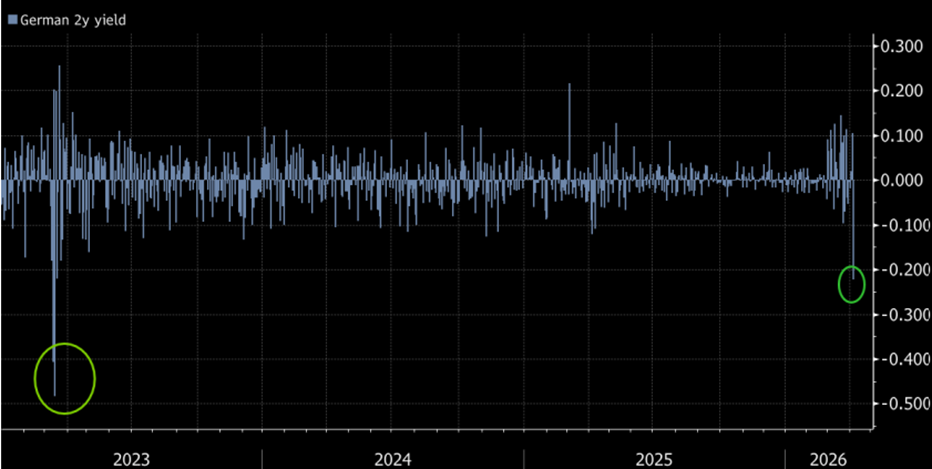
German front-end 2-year yields decline most in three years

 Source: Bloomberg  

The two-year German Bund yield has recorded its sharpest decline since 2023, now hovering around 2.5%. Now, economists expect the ECB to deliver two rate hikes this year, down from three prior to the two-week ceasefire agreement, assuming that oil prices stay elevated relative to the ECB’s baseline of around USD 81/barrel.

What happened last week?

Central banks

Many central banks have held rates steady over the past ten days, reflecting the highly fluid situation in the Middle East the last ten days, namely Reserve Bank of New Zealand, Reserve Bank of India and Bank of Canada.

US Treasury yield was lower following the ceasefire announcement and the sharp drop in oil prices, as markets began to price in a potential resumption of rate cuts by the Federal Reserve.

The ceasefire is expected to halt the U.S.-Israel military campaign in exchange for Iran opening the Strait of Hormuz. Expectations of further easing in oil prices, thereby capping inflation, have reinforced the view that the Fed may be able to loosen monetary policy later this year.

In our view, the two-week ceasefire represents a critical pause in a rapidly escalating conflict. While it has reduced immediate risks, fundamental geopolitical tensions remain unresolved. Whether this becomes a path to stability or a temporary pause will depend on the coming negotiations.

The prospects for a lasting peace agreement remains uncertain. Iran’s 10-point proposals include Iran’s continuation of its uranium enrichment activities, which could possibly be a key obstacle to reaching a deal.

Credit

Credit markets staged a strong rally on Wednesday following the ceasefire announcement, with crude oil falling sharply immediately after the news.

Just prior to the agreement, affordability pressures in the U.S. had reached a critical point: gasoline prices climbed to levels last seen in mid-2022, while the 30-year mortgage rate rose to 6.4%—its highest since September 2025, just before government intervention through MBS purchases to support the housing market (MBS: mortgage-backed securities).

In fact, U.S. corporate credit spreads across both investment grade (IG) and high yield (HY) had already begun to tighten last week, as rising energy costs increased incentives for the Trump administration to pursue de-escalation.

EUR IG recorded a fourth consecutive week of outflows, but the segment continues to benefit from stronger technicals than EUR high yield. Limited bond supply supported EUR IG in March and is expected to remain supportive in the near term. By contrast, technicals in EUR HY have been weaker and more sensitive to fund flows. EUR HY funds suffered their largest weekly outflow since April 2025. The current relief rally should support the broader risk sentiment, including HY segments.

Will markets make a decisive U-turn?

The recovery trajectory will unlikely be a straight line. The two-week ceasefire represents a critical pause in a rapidly escalating conflict. While it has reduced immediate risks, fundamental geopolitical tensions remain unresolved. Whether this becomes a path to stability or a temporary pause will depend on the coming negotiations.

Rates

The U.S. Treasury yield already declined early last week amid mixed domestic data and concerns on economic growth and recession probabilities. It subsequently retraced higher in the latter part of the week, following a more hawkish tone from U.S. President Donald Trump and a stronger-than-expected March payrolls release on Friday.

March non-farm payrolls surprised to the upside, with 178,000 jobs added. Private education and health services accounted for more than half of the gains. The unemployment rate edged down to 4.3% from 4.4% in the previous month, reinforcing pressure on the Federal Reserve to delay rate cuts.

Iranian Foreign Minister has thanked Pakistan for facilitating the ceasefire deal, while Turkey and China likely play a behind-the-scenes role in pushing for de-escalation.

This fragile pause has nonetheless provided meaningful relief to global financial markets. At the time of writing, the 10-year U.S. Treasury yield had eased below 4.3% (4.29%), while the 10-year Germany Bund yield is back below 3%, at 2.95%.

Against this backdrop, the U.S. Treasury proceeded with a USD 39 billion 10-year auction on Wednesday, one day after the ceasefire announcement.

Emerging market

The Iran conflict has, so far, had a material impact on emerging market (EM) credit profiles. Higher energy and commodity prices, tighter financial conditions, and elevated geopolitical risks have increased the dispersion across EM credits.

Brazil, Mexico and Argentina, as net oil-exporting countries and geographically distant from the conflict, have clearly outperformed.

Morocco, as the world’s largest exporter of phosphate fertilisers, benefits from supply disruptions linked to the Strait of Hormuz.

At the other end of the spectrum, credit impact has been negative for energy-importing countries and financially weaker sovereigns, where downside risks to growth are rising. China is expected to see slower growth despite holding over three months of oil reserves. Philippines, Thailand, and Vietnam are already facing acute energy shortage.

The Gulf Cooperation Council (GCC) countries face the most direct geopolitical exposure. The market was notably surprised by the extent of disruption in Qatar, where full recovery of LNG capacity at the Ras Laffan field could take up to three years following Iran’s drone attack. Fitch Ratings has placed Qatar and QatarEnergy on Rating Watch Negative, while highlighting Qatar’s conservative net cash position, with more cash holding than debt. Moody’s took a different view and affirmed a stable outlook, given QatarEnergy’s low-cost operations and robust balance sheet. S&P has not taken rating action and retained the stable outlook.

Last week, EM funds recorded a fourth consecutive week of outflows, although the magnitude of outflows were modest.

At this stage, positioning in EM should stay defensive: short- to medium-duration, which will help limit the price volatility stemmed from the U.S. Treasury yields.



Our view on fixed income 

Rates
NEGATIVE in current environment

We maintain a Negative stance on government bonds. Renewed price pressures from the surge in oil & gas prices and prospects of more profligate fiscal policies reduce the attractiveness of long-term government bonds as a potential hedge for economic downturn. Reduced prospects of further central banks’ rate cuts and unattractive yield curve slopes at the front-end also lower the attractiveness of government bonds on short-to-medium term maturities. 


Investment Grade
NEUTRAL, harvest the carry
We continue to find Investment Grade corporate bonds attractive, given their yield level and our still constructive economic scenario over the medium term. However, tight credit spreads reduced the margin for safety. As a result, we keep a Neutral stance on Investment Grade credit from an asset allocation perspective. The credit market's overall health is supported by robust demand and strategic maturity management.
High Yield
NEUTRAL, go short-term

We like High Yield bonds with short maturity for their attractive combination of yield and low sensitivity to interest rate movements. HY spreads remain tight, and those tight spreads are not attractive for medium-to-long term maturities as they do not compensate adequately for a potential deterioration in the economic environment. As such, we hold a Neutral view for High Yield in an allocation, with a clear preference for short-duration investments. We continue to find value in subordinated debt. 

 
Emerging Markets
NEUTRAL, with opportunities
We advocate for a careful selection of issuers to benefit from attractive absolute yields. Global growth dynamics, contained public debt & corporate leverage in many EM economies along with strong flows are supportive for EM debt However, risks persist, with rich valuations and unpredictable Trump’s policies. Idiosyncratic risks also remain, notably in Brazil and India. Given this backdrop, we stay selective, favoring short and medium-duration opportunities while remaining Neutral on the broad EM debt asset class in a multi-asset portfolio context.

Disclaimer

This marketing document has been issued by Bank Syz Ltd. It is not intended for distribution to, publication, provision or use by individuals or legal entities that are citizens of or reside in a state, country or jurisdiction in which applicable laws and regulations prohibit its distribution, publication, provision or use. It is not directed to any person or entity to whom it would be illegal to send such marketing material. This document is intended for informational purposes only and should not be construed as an offer, solicitation or recommendation for the subscription, purchase, sale or safekeeping of any security or financial instrument or for the engagement in any other transaction, as the provision of any investment advice or service, or as a contractual document. Nothing in this document constitutes an investment, legal, tax or accounting advice or a representation that any investment or strategy is suitable or appropriate for an investor's particular and individual circumstances, nor does it constitute a personalized investment advice for any investor. This document reflects the information, opinions and comments of Bank Syz Ltd. as of the date of its publication, which are subject to change without notice. The opinions and comments of the authors in this document reflect their current views and may not coincide with those of other Syz Group entities or third parties, which may have reached different conclusions. The market valuations, terms and calculations contained herein are estimates only. The information provided comes from sources deemed reliable, but Bank Syz Ltd. does not guarantee its completeness, accuracy, reliability and actuality. Past performance gives no indication of nor guarantees current or future results. Bank Syz Ltd. accepts no liability for any loss arising from the use of this document.

Read More

Straight from the Desk

Syz the moment

Live feeds, charts, breaking stories, all day long.

Thinking out loud

Sign up for our weekly email highlighting the most popular posts.

Follow us

Thinking out loud

Investing with intelligence

Our latest research, commentary and market outlooks