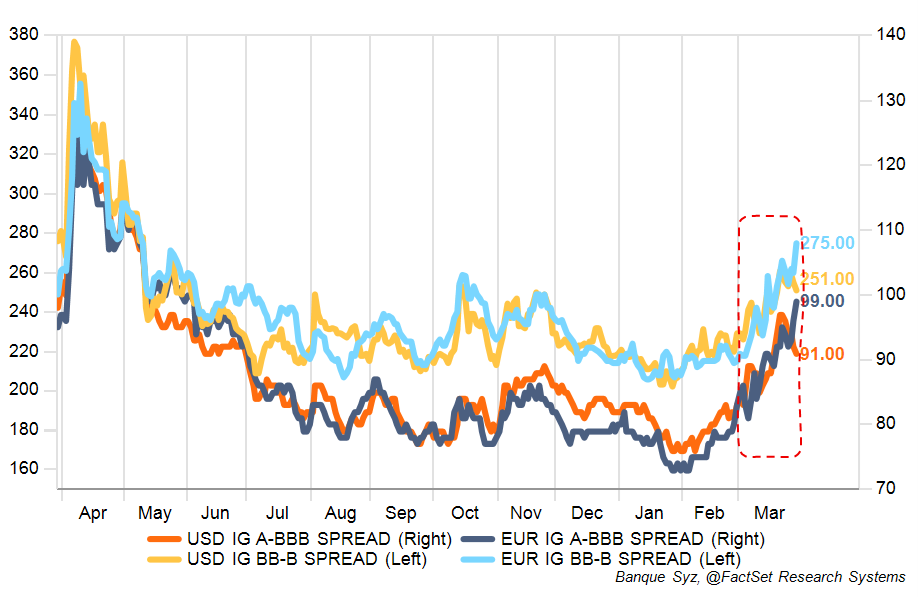
Government bond markets saw a renewed sell-off last week, with yields moving higher across most major economies amid early signs of inflation pressures and despite weaker growth data. Indeed, March flash PMIs on activity disappointed on both sides of the Atlantic, with the Euro Area composite falling to a 10-month low of 50.5 and the US composite to an 11-month low of 51.4. However, survey data pointed to rising input prices and reinforced inflation concerns.
In the US, Treasury yields rose across the curve, led by the long end. The 10-year yield increased by 5bps to 4.43%, while the 30-year rose to 4.96%. Notably, real yields climbed sharply (+11bps), while breakeven inflation declined, suggesting markets are increasingly pricing tighter real financial conditions more than sustainably higher inflation prospects.
European bond markets followed a similar pattern. German 10-year Bund yields rose 5bps to 3.09%, reaching their highest level since 2011. Peripheral spreads widened modestly, with Italian 10-year yields up 9bps to 4.05% and French yields rising 8bps. This indicates some renewed fragmentation risk amid fiscal and inflation uncertainty.
Elsewhere, Japanese 10-year yields jumped 11bps, continuing their upward trend, while UK gilt yields edged slightly lower. Swiss yields remained broadly stable.
Fixed income returns were negative across most segments, particularly in longer-duration ETFs, reflecting the adverse impact of rising yields on bond prices.
Emerging market
Emerging Market Debt delivered only a moderately negative performance over the past week, essentially impacted by the broader backdrop of rising global yields and persistent inflation uncertainty. Hard currency sovereign bonds were relatively resilient, with the Bloomberg EM Hard Currency Aggregate Index declining by just -0.3%, while the iShares EM Sovereign Bond ETF fell -0.2%. EM debt spreads remained broadly stable (CDX EM USD -2bp).
Corporate credit underperformed slightly, with the iShares EM Corporate Bond ETF down -0.4%, pointing to some investor caution amid a more challenging global growth outlook. In Asia, risk sentiment was weaker, as reflected in the sharper -0.8% decline in the iShares USD Asia HY Bond ETF, highlighting continued fragility in the high-yield segment.
Local currency bonds showed relative resilience, with the VanEck J.P. Morgan EM Local Currency Bond ETF slipping just -0.2%. This performance was supported by relatively stable EM currencies, even as US real yields moved higher.
Overall, EM debt markets remain caught between their attractive yield and global geopolitical and growth headwinds. While resilient spreads and the carry offer some support, tighter global financial conditions and elevated geopolitical risks continue to cap upside in the near term.




.png)