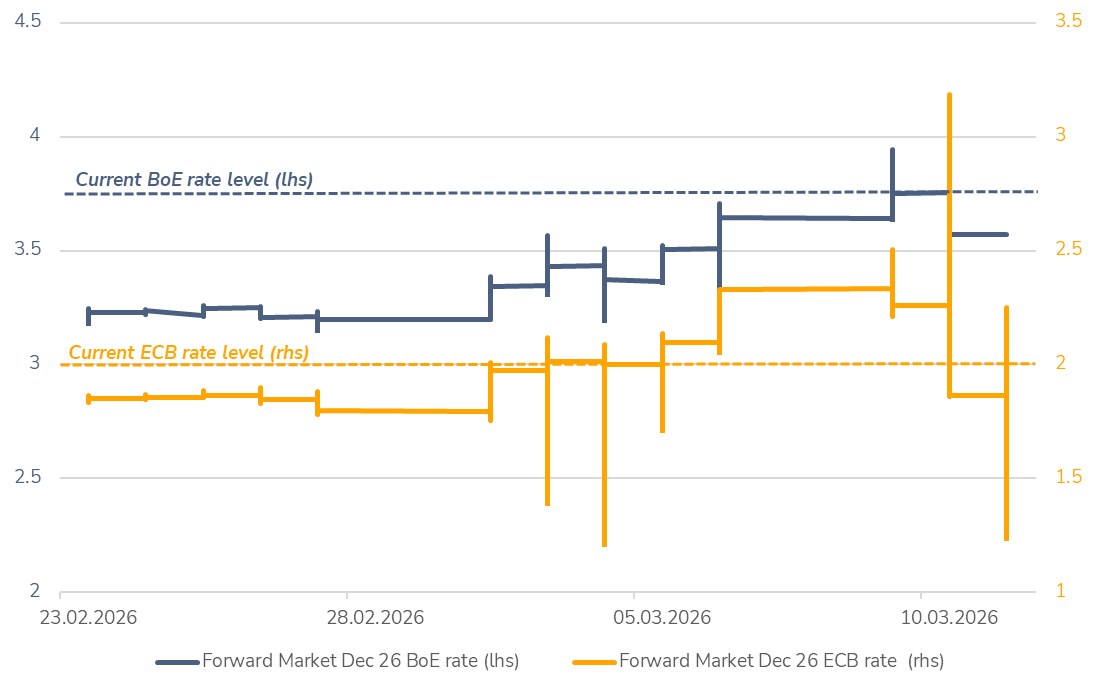
Global sovereign bond markets experienced a sharp sell-off last week as investors reacted to the risk of a sustained oil price shock and its implications for inflation. European fixed income was hit particularly hard, with yields rising markedly across the curve. Germany’s 10-year Bund yield climbed 22bps to 2.86%, marking its largest weekly increase since the announcement of Germany’s debt brake reform last year. Shorter maturities rose even more sharply, with the 2-year Bund yield up 31bps. Other European sovereign markets saw even steeper moves. UK 10-year Gilt yields surged 39bps to 4.63%, while French OATs and Italian BTPs rose 29bps and 35bps respectively. Peripheral spreads remained broadly stable despite the magnitude of the sell-off. The sharp repricing translated into negative performance for bond funds, with euro government bond ETFs falling between -1.4% and -2.6% over the week.
In the US, the adjustment was more moderate but still significant. Treasury yields rose across the curve, with the 2-year yield up 19bps to 3.56% and the 10-year yield increasing 20bps to 4.14%. Inflation expectations also moved higher, with the 10-year breakeven rate rising 10bps to 2.35%. Longer-duration Treasury ETFs posted the largest losses, declining up to -2.6% over the week.
Emerging market
EM sovereign bonds were pressured by higher US Treasury yield and a stronger USD. EM local currency debt led the decline, with the J.P. Morgan EM Local Currency Bond ETF down 3.3%, erasing year-to-date gains. The sell-off was notable in Bahrain and Abu Dhabi, while Argentina outperformed. EM sovereign USD bonds fell 1.6%, and EM corporate USD bonds held up better (-1.1%). Despite the volatility, global EM debt funds recorded a fourth consecutive week of inflows.
Several EM exporters could benefit from higher commodity prices. Brazil, Argentina, Colombia and Nigeria are net oil exporters, while Peru gains from stronger gold prices. Chile’s fuel stabilisation mechanism smooths oil price adjustments over a 21-day period, cushioning consumers.
In Colombia, the primary election produced a fragmented congress, requiring coalition governance. While uncertainty remains ahead of the presidential elections in May and June, the risk of a left-wing majority has diminished.
Iranian drone attacks on Saudi refineries and Qatari gas infrastructure highlight how even temporary disruptions can significantly impact energy markets.
Saudi Arabia can reroute part of exports via the East-West pipeline to Yanbu and benefits from large financial buffers, including over $450 billion in foreign reserves and substantial sovereign wealth assets overseas.
Oman could benefit from ports and oil terminals outside the Strait of Hormuz (Duqm, Salalah, Mina Al Fahal), supporting trade continuity. Any tourism weakness could be partly offset by higher oil prices and increased production. Fitch estimates that each week of a Hormuz closure could add 0.2% to Oman’s GDP growth.
Morocco received a Positive outlook (Ba1) from Moody’s, following S&P’s upgrade last September. With over two-thirds of global phosphate reserves, it is well positioned if fertiliser markets tighten.
China set a 4.5–5% growth target in its five-year plan. Domestic energy prices have risen less than global levels thanks to large oil inventories of over 140 days. Iran accounts for 12–13% of China’s oil imports, a manageable share.
Net oil-importers have been hit harder. Beyond energy, the Strait of Hormuz is also a key route for fertilizers coinciding the spring planting season in North Hemisphere, raising the risk of food inflation ahead.




.png)