


Maggie Cheng

Senior Fixed Income Analyst

Adrien Pichoud

Head of Fixed Income

The Chart of the week

Is the global interest rate repricing not over yet?
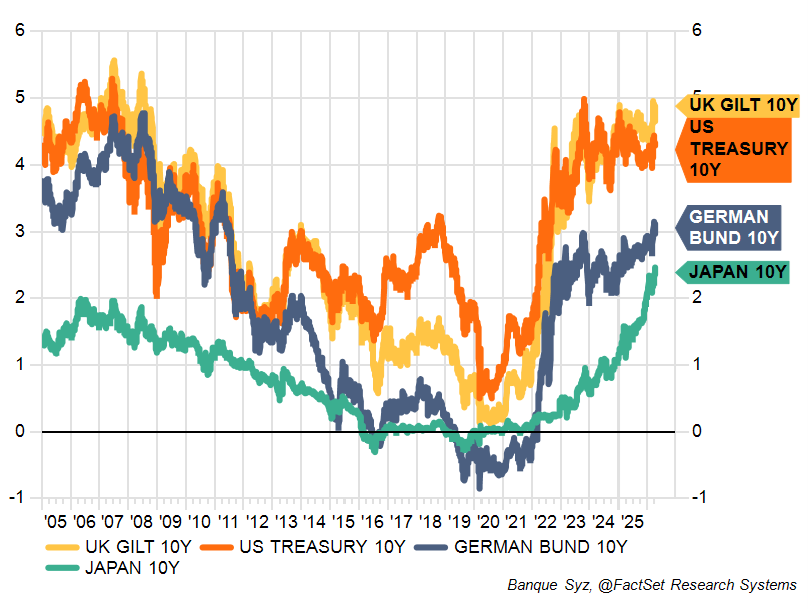
Markets have embraced a more constructive tone in recent weeks. The ceasefire announcement in the Middle East triggered a broad risk-on move: equities rebounded, oil and the US dollar retreated, credit spreads tightened, and expectations of further central bank tightening eased. Unsurprisingly, short-end government yields followed, declining alongside near-term inflation expectations.
And yet, one corner of the market remains almost unmoved: long-term sovereign rates. While US and UK 10-year yields have edged down from their late-March highs, they remain elevated relative to pre-conflict levels. In fact, the US 10-year Treasury yield is still hovering near its highest level since last summer, while the UK Gilt yield is not far from levels last seen in the aftermath of the Global Financial Crisis.
More striking still, core European and Japanese yields continue to grind higher. German 10-year Bund yields have pushed above 3%, a level not seen since 2011, while Japanese 10-year yields are venturing into territory last explored over two decades ago.
For long-term sovereign rates, the Middle East conflict and the spike in energy prices are just one more episode of a seemingly more fundamental and long-term adjustment initiated in 2022: the transition from a low growth/low inflation, globalized world where government and fiscal policy stand in the backseats, to a world of elevated nominal growth, where proactive fiscal policy supports growth and inflation dynamics at the expense of ever-rising public debt.
Recent announcements in Germany and across most European countries of fiscal measures to contain the impact of rising energy prices echo similar decisions in Asian countries. They lower the risk of a sharp economic growth slowdown ahead, but also risk sustaining inflationary pressures while surely weighting on public deficits and public debt burdens. Isn’t it the perfect cocktail to continue pushing long-term rates higher? 

What happened last week?

Central banks

Last week saw the release of the minutes of the March 18th FOMC meeting. They underscored a clear “hold and assess” stance amid heightened uncertainty from the Iran conflict. While near-term inflation has risen on the back of a sharp energy shock, policymakers broadly judged longer-run expectations to remain anchored, allowing them to look through the initial price spike. The key message was that policy is now finely balanced: upside risks to inflation have increased, but so have downside risks to growth and employment. This is reflected in a growing willingness to consider both rate cuts and hikes, depending on incoming data. Recent remarks from Scott Bessent and Stephen Miran reinforce this patience, emphasizing limited pass-through to expectations so far, even if more cautious voices such as Austan Goolsbee highlight stagflation risks. Overall, the Fed appears set to remain on hold ahead of the next FOMC meeting (April 29th), with optionality elevated and timing of any easing pushed back until more visibility on the growth and inflation dynamics. Future markets are pricing stable Fed rates till September, before possibly a rate hike in the later months of the year (35% probability).

At the ECB, the narrative is shifting from a clear tightening bias toward greater uncertainty. While officials such as Dimitar Radev and Olaf Sleijpen acknowledge rising inflation risks from energy, others, including Olli Rehn, stress that rate hikes are “not self-evident.” Christine Lagarde captured the evolving stance, noting the euro area sits between baseline and adverse scenarios without a clear policy direction. Markets have scaled back somewhat expectations for aggressive tightening, reflecting this more cautious and data-dependent approach. A rate hike at the April 30th meeting is seen as unlikely (25% probability) and expectations for end-2026 ECB rates are now closer to two 25b hikes than the three expected earlier in April.

Credit

Credit markets had a rollercoaster week. Last Wednesday saw the biggest one-day decline in Brent oil price since 1991, following the 11th hour ceasefire agreement. The 10-year German government yield recorded its largest daily decline in the past three years.

All credit segments rallied strongly on the day. However, part of these gains was subsequently reversed after Iran accused Israel of violating the ceasefire by striking Lebanon. Gains were further reversed on Monday following the failed ceasefire talks in Pakistan.

Despite this, credit spreads showed negative correlation with Treasury and Bund yield moves. Real money investors such as insurance companies might have stepped in and bought corporate credits. All-in yields of corporate credits are more attractive than the last energy crisis in 2022 during the early phase of Russia-Ukraine war.

Currently, parts of the credit spreads are trading tighter than the pre-US Iran conflict, such as US High Yield (HY), EUR Healthcare and EUR Energy.

While EUR investment grade (IG) and EUR HY continued to see outflows, the pace has moderated significantly. By contrast, in the weeks after the outbreak of Russia-Ukraine war, the outflows were more pronounced.

Government bond funds recorded another week of inflows, supported by elevated risk-free rates in academic concept.

Looking ahead, inflation is likely to move higher in the coming months as the energy price shock feeds through. In this environment, sectors with strong pricing power and the ability to pass on higher costs, such as capital goods and utilities, are likely be better positioned.

Rates

Last week saw a modest decline in US Treasury yields alongside a bear-steepening move in core European curves. In the US, rates edged lower as markets modestly rebuilt expectations for policy easing. The front end led the move, with the 2-year yield down 4bp to 3.80% and the 5-year also 4bp lower, while the 10-year declined a more limited 2bp to 4.32%. The long end was broadly unchanged, leaving the curve slightly steeper. Importantly, inflation expectations firmed, with 10-year breakevens up 2bps, while real yields fell 4bps

In contrast, euro area rates showed a more mixed and generally upward bias beyond the front end. While fading expectations of an imminent ECB hike helped the German 2-year yield dip 1bp to 2.60%, longer maturities sold off, with the 10-year Bund yield rising 7bps to 3.06%. A similar pattern played out across most other governments (French, Spanish, Portuguese and Irish 10-year yields rising between 3bps and 6bps, Italian 10-year down 1bp). Elsewhere, yields moved higher in Switzerland and Japan while UK 10-year yields were broadly unchanged.

Against this backdrop, government bond returns were mixed and reflected curve positioning. In the US, short-duration strategies outperformed, with 1–3 year and 3–7 year Treasury ETFs posting modest gains, while longer-duration segments declined, particularly the 20+ year space (-0.35%). In Europe, a similar dynamic prevailed: intermediate maturities delivered small positive returns, but longer-duration and aggregate indices posted losses. Inflation-linked bonds also underperformed, reflecting rising breakevens but higher nominal yields at the long end. 

Emerging market

Compared to developed markets, emerging market (EM) credits experienced an even stronger rally last week and extended gains into Monday, after the decisive victory of pro-EU leader Peter Magyar in Hungary’s elections. Bahrain, Egypt and Romania were among the outperformer last week. Hungary stood out on Monday in the wake of Sunday’s vote, with government bonds rallying across the curve.

The landslide victory gives pro-EU Tisza party full control of the legislative process. (Tisza refers to a major river in Hungary and Central Europe). This should facilitate the implementation of EU-mandated reforms required to unlock frozen EU funds to rebuild Hungary.

A reset in relations with the EU is likely to begin soon after a new cabinet is formed, with a credible reform commitment potentially sufficient to initiate the release of EU investment grants, even ahead of full implementation. This would be supportive of deeper EU integration.

Romania could also benefit over the medium term, given its close economic ties and shared 450 km border with Hungary.

S&P downgraded Colombia by one notch to BB- but changed the outlook to stable. Market reaction to the downgrade was muted. As a net oil exporter, Colombia could benefit from higher oil prices, although gains may be partly offset by persistently high inflation. The downgrade reflects the slow pace of fiscal consolidation, with fiscal deficit of 7% of GDP in 2025 and public debt close to 60% of GDP.


Our view on fixed income 

Rates
NEGATIVE in current environment

We maintain a Negative stance on government bonds. Renewed price pressures from the surge in oil & gas prices and prospects of more profligate fiscal policies reduce the attractiveness of long-term government bonds as a potential hedge for economic downturn. Reduced prospects of further central banks’ rate cuts and unattractive yield curve slopes at the front-end also lower the attractiveness of government bonds on short-to-medium term maturities. 


Investment Grade
NEUTRAL, harvest the carry
We continue to find Investment Grade corporate bonds attractive, given their yield level and our still constructive economic scenario over the medium term. However, tight credit spreads reduced the margin for safety. As a result, we keep a Neutral stance on Investment Grade credit from an asset allocation perspective. The credit market's overall health is supported by robust demand and strategic maturity management.
High Yield
NEUTRAL, go short-term

We like High Yield bonds with short maturity for their attractive combination of yield and low sensitivity to interest rate movements. HY spreads remain tight, and those tight spreads are not attractive for medium-to-long term maturities as they do not compensate adequately for a potential deterioration in the economic environment. As such, we hold a Neutral view for High Yield in an allocation, with a clear preference for short-duration investments. We continue to find value in subordinated debt. 

 
Emerging Markets
NEUTRAL, with opportunities
We advocate for a careful selection of issuers to benefit from attractive absolute yields. Global growth dynamics, contained public debt & corporate leverage in many EM economies along with strong flows are supportive for EM debt However, risks persist, with rich valuations and unpredictable Trump’s policies. Idiosyncratic risks also remain, notably in Brazil and India. Given this backdrop, we stay selective, favoring short and medium-duration opportunities while remaining Neutral on the broad EM debt asset class in a multi-asset portfolio context.

Disclaimer

This marketing document has been issued by Bank Syz Ltd. It is not intended for distribution to, publication, provision or use by individuals or legal entities that are citizens of or reside in a state, country or jurisdiction in which applicable laws and regulations prohibit its distribution, publication, provision or use. It is not directed to any person or entity to whom it would be illegal to send such marketing material. This document is intended for informational purposes only and should not be construed as an offer, solicitation or recommendation for the subscription, purchase, sale or safekeeping of any security or financial instrument or for the engagement in any other transaction, as the provision of any investment advice or service, or as a contractual document. Nothing in this document constitutes an investment, legal, tax or accounting advice or a representation that any investment or strategy is suitable or appropriate for an investor's particular and individual circumstances, nor does it constitute a personalized investment advice for any investor. This document reflects the information, opinions and comments of Bank Syz Ltd. as of the date of its publication, which are subject to change without notice. The opinions and comments of the authors in this document reflect their current views and may not coincide with those of other Syz Group entities or third parties, which may have reached different conclusions. The market valuations, terms and calculations contained herein are estimates only. The information provided comes from sources deemed reliable, but Bank Syz Ltd. does not guarantee its completeness, accuracy, reliability and actuality. Past performance gives no indication of nor guarantees current or future results. Bank Syz Ltd. accepts no liability for any loss arising from the use of this document.

Read More

Straight from the Desk

Syz the moment

Live feeds, charts, breaking stories, all day long.

Thinking out loud

Sign up for our weekly email highlighting the most popular posts.

Follow us

Thinking out loud

Investing with intelligence

Our latest research, commentary and market outlooks