Maggie Cheng

Senior Fixed Income Analyst

Adrien Pichoud

Head of Fixed Income

The Chart of the week

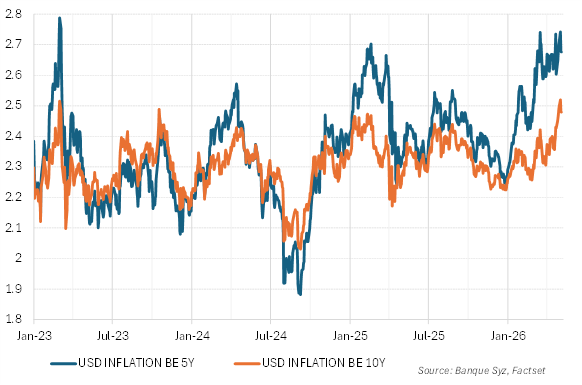
Long-term inflation expectations eventually drift higher and raise concerns among central bankers

Hopes for an agreement between the US and Iran have ebbed and flowed since early April and the announcement of a ceasefire. A concrete truce could still materialise at any time, allowing traffic through the Strait of Hormuz to resume.

Fixed income markets initially assumed that the conflict and any disruption to oil supply would have only a temporary impact on inflation dynamics. While short-term inflation expectations in the US rose sharply at first, medium- and long-term expectations barely reacted during the first month of the conflict.

However, with talks having apparently stalled in recent weeks and oil prices rebounding in the latter part of April, the likelihood of prolonged disruptions to global oil supply has increased, along with the risk of more persistent inflationary pressures.

Long-term inflation expectations have begun to edge higher. The US 10-year breakeven inflation rate has reached 2.5% for the first time in three years, while medium-term expectations remain anchored closer to 3% (with the US 5-year breakeven at around 2.7%). These levels reflect a growing risk that inflation dynamics could become more entrenched, driven by second-round effects across both services and goods prices.

Major central banks have all expressed concern about the inflation outlook in the past week. The longer the stalemate around the Strait of Hormuz persists, the greater the risk that central banks will be forced to raise interest rates later in the year.

What happened last week?

Central banks

The Federal Reserve held rates at 3.50%–3.75% but delivered a notably divided message, with four dissenters—the most since 1992. While one governor, S. Miran, favored a rate cut, three regional presidents pushed back against retaining an easing bias, signaling a subtle hawkish shift. Inflation was described as “elevated,” reflecting energy-driven pressures, with both headline and core PCE rising. Despite solid consumer demand, policymakers emphasized uncertainty around the outlook. Leadership developments also drew attention, with Kevin Warsh set to replace Jerome Powell, who may remain influential as a board governor. The Fed appears set to maintain a “wait-and-see” stance for the time being, and future markets have now fully priced out any potential rate cut for this year. Meanwhile, probabilities of a rate hike in 2027 are slowly rising…

The European Central Bank kept its deposit rate at 2.0% and signaled a clear hawkish pivot. Rate hikes were actively discussed, and President Christine Lagarde hinted that tightening may soon be necessary unless inflation risks subside. Energy-driven price pressures have lifted inflation expectations, even as growth indicators weaken. A de-escalation in the Middle east and lower energy prices could ease pressure for monetary policy tightening, but future markets currently assign an 80% probability to a June rate hike and still expect 2 to 3 rate hikes by the end of 2026.

The Bank of England held rates at 3.75% in an 8–1 vote, describing the decision as an “active hold.” Governor Andrew Bailey stressed that hikes were seriously considered, reflecting elevated uncertainty. The UK economy remains vulnerable to energy shocks and tightening financial conditions, though limited fiscal support may cushion households. While a June hold remains the base case, rising inflation risks are increasing the likelihood of rate hikes in the second half of the year (two 25bp hikes are currently fully priced in by future markets).

The Bank of Japan maintained its policy rate at 0.75% amid a split 6–3 vote, highlighting growing internal debate. Governor Kazuo Ueda adopted a cautiously hawkish tone, emphasizing vigilance toward inflation despite weaker growth prospects. Government stimulus and energy subsidies are expected to support the economy, and a rate hike during the summer remains likely.

Credit

Weekly total returns were flat for EUR credits, but slightly negative for USD credits because of higher U.S. Treasury yield. Stalled progress toward a Middle East resolution kept oil prices elevated, with Brent crude briefly moving above $120 per barrel intraday for the first time since 2022. Sovereign bond yields also reached multi-year highs in many countries last week before retreating this week.

Corporate credit spreads held in with notable resilience, remaining broadly unchanged or tightening despite the higher-rate backdrop and heavy primary supply. U.S. investment grade saw a near-record $184 billion of April issuance, supported by strong demand from retail investors and yield buyers. U.S. high yield delivered the strongest spread tightening, producing its best monthly gains in nearly a year.

In simple terms, perceived corporate credit risk remains contained, while all-in yields are more attractive due to higher Treasury and Bund yields.

For European credit, BofA notes that even two 25 basis point ECB rate hikes would still leave corporate bonds offering a meaningful yield advantage over bank deposits, at around 1.7 percentage points. Moreover, further ECB tightening could eventually create room for rate cuts in 2027–28, as the Eurozone economy may struggle to absorb tighter financial conditions for an extended period.

European bank earnings also remained supportive. Sixteen banks reported Q1 results, with most delivering robust performance and maintaining last year’s positive trends: decent profitability, strong capital and stable asset quality. One notable theme was management’s use of post-model adjustments to reflect geopolitical uncertainty and weaker macroeconomic forecasts. Without these overlays, loan impairment charges would have been lower.

Rates

Global sovereign yields moved higher over the past week, led by the US and core Europe, as inflation concerns—particularly energy-driven—continued to dominate. In the US, yields rose across the curve, with the 2Y and 5Y up 10bp to 3.88% and 4.01%, respectively, while the 10Y increased 7bp to 4.37%. Notably, the US 10Y Breakeven rose 7bp to 2.50%, while real yields were unchanged, pointing to inflation expectations as the main driver.

European rates followed suit, albeit with smaller moves. German 2Y yields climbed 10bp to 2.64%, while 10Y Bunds rose 4bp to 3.04%. Peripheral spreads widened modestly, with Italian 10Y yields up 8bp to 3.86%, underperforming core markets. UK 10Y Gilts increased 5bp to 4.96%, while Japan saw a notable rise, with 10Y JGB yields up 8bp to 2.52%. Switzerland stood out, with 10Y yields declining 4bp, diverging from the broader trend.

Bond performance was negative across most developed markets, particularly in the US where duration weighed heavily. The iShares Treasury 20+ Year ETF fell -1.27%, underperforming shorter maturities. Euro area bonds were more resilient, with the iShares EUR Inflation Linked Govt Bond ETF gaining 0.47%, reflecting the inflation-driven sell-off in nominal bonds.  

Emerging market

Emerging market (EM) sovereign USD bonds declined, pressured by surging oil prices and wider US Treasury yields. However, Angola and Nigeria, being oil producers, were notable outperformers, benefiting from increased demand from Europe.

EM corporates remain the most resilient segment, total return falling less than EM sovereign hard-currency and local currency. EM corporate spreads have held up well, supported by surging earnings expectations.

The UAE’s decision to leave OPEC effective 1 May highlights its long-standing frustration with production caps. The UAE was OPEC’s third largest producer, behind Saudi Arabia and Iraq, and accounted for roughly 3% of global oil output. Abu Dhabi has a comparatively lower fiscal breakeven oil price and meaningful spare capacity than most other OPEC members but is currently constrained by the Strait of Hormuz disruption. Abu Dhabi has increasingly resisted Saudi dominance within the Gulf.

EM debt continued to see inflows for a third consecutive week.

Brazil’s central bank cut the policy rate by 25 basis points to 14.5% last week, as highly anticipated. The communication keeps the door open for more rate cuts, supportive to Brazilian corporates.

Commodity exporters such as Brazil, Colombia, Chile and Peru have benefited from higher commodity prices, providing some fiscal breathing room. Meanwhile, even net oil importers have partly offset the energy-cost drag through resilient agricultural and metals prices.

Romania’s political risk has risen after Prime Minister Ilie Bolojan lost a no-confidence vote on Tuesday. The market reaction has been muted. Romania is nonetheless an EU member state operating under Brussels fiscal surveillance. Bolojan's government was actually running ahead of its fiscal targets, delivering a deficit of 7.9% of GDP in 2025 against an 8.4% commitment. Beyond near-term volatility, the risk for bondholders appears narrower than the political headlines currently suggest. 


Our view on fixed income 

Rates
NEGATIVE in current environment

We maintain a Negative stance on government bonds. Renewed price pressures from the surge in oil & gas prices and prospects of more profligate fiscal policies reduce the attractiveness of long-term government bonds as a potential hedge for economic downturn. Reduced prospects of further central banks’ rate cuts and unattractive yield curve slopes at the front-end also lower the attractiveness of government bonds on short-to-medium term maturities. 


Investment Grade
NEUTRAL, harvest the carry
We continue to find Investment Grade corporate bonds attractive, given their yield level and our still constructive economic scenario over the medium term. However, tight credit spreads reduced the margin for safety. As a result, we keep a Neutral stance on Investment Grade credit from an asset allocation perspective. The credit market's overall health is supported by robust demand and strategic maturity management.
High Yield
NEUTRAL, go short-term

We like High Yield bonds with short maturity for their attractive combination of yield and low sensitivity to interest rate movements. HY spreads remain tight, and those tight spreads are not attractive for medium-to-long term maturities as they do not compensate adequately for a potential deterioration in the economic environment. As such, we hold a Neutral view for High Yield in an allocation, with a clear preference for short-duration investments. We continue to find value in subordinated debt. 

 
Emerging Markets
NEUTRAL, with opportunities
We advocate for a careful selection of issuers to benefit from attractive absolute yields. Global growth dynamics, contained public debt & corporate leverage in many EM economies along with strong flows are supportive for EM debt However, risks persist, with rich valuations and unpredictable Trump’s policies. Idiosyncratic risks also remain, notably in Brazil and India. Given this backdrop, we stay selective, favoring short and medium-duration opportunities while remaining Neutral on the broad EM debt asset class in a multi-asset portfolio context.

Disclaimer

This marketing document has been issued by Bank Syz Ltd. It is not intended for distribution to, publication, provision or use by individuals or legal entities that are citizens of or reside in a state, country or jurisdiction in which applicable laws and regulations prohibit its distribution, publication, provision or use. It is not directed to any person or entity to whom it would be illegal to send such marketing material. This document is intended for informational purposes only and should not be construed as an offer, solicitation or recommendation for the subscription, purchase, sale or safekeeping of any security or financial instrument or for the engagement in any other transaction, as the provision of any investment advice or service, or as a contractual document. Nothing in this document constitutes an investment, legal, tax or accounting advice or a representation that any investment or strategy is suitable or appropriate for an investor's particular and individual circumstances, nor does it constitute a personalized investment advice for any investor. This document reflects the information, opinions and comments of Bank Syz Ltd. as of the date of its publication, which are subject to change without notice. The opinions and comments of the authors in this document reflect their current views and may not coincide with those of other Syz Group entities or third parties, which may have reached different conclusions. The market valuations, terms and calculations contained herein are estimates only. The information provided comes from sources deemed reliable, but Bank Syz Ltd. does not guarantee its completeness, accuracy, reliability and actuality. Past performance gives no indication of nor guarantees current or future results. Bank Syz Ltd. accepts no liability for any loss arising from the use of this document.

Read More

Straight from the Desk

Syz the moment

Live feeds, charts, breaking stories, all day long.

Thinking out loud

Sign up for our weekly email highlighting the most popular posts.

Follow us

Thinking out loud

Investing with intelligence

Our latest research, commentary and market outlooks