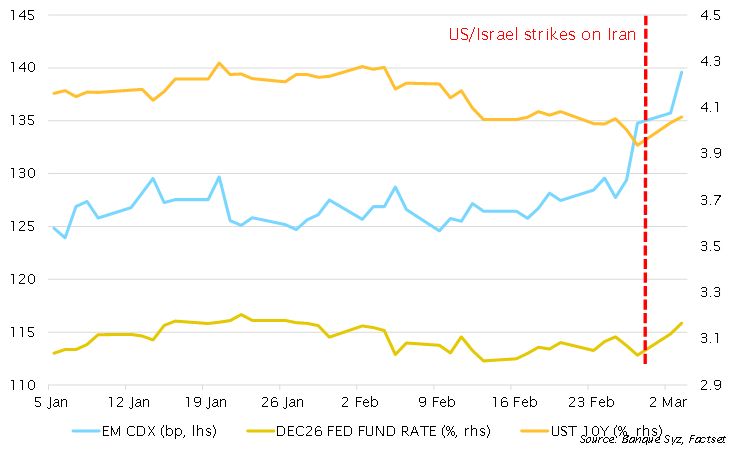
Sovereign bonds rallied decisively last week as broader risk caution and softer macro signals pulled yields lower across core markets. In the US, 10-year Treasury yields declined 14.4bps to 3.94% (-6.4bps on Friday alone), their lowest level since October 2024. The move was led by the belly of the curve, with 5-year yields down 15bps to 3.50%, while 2-year yields fell 10bps to 3.37% and 30-year yields dropped 11bps to 4.61%. The decline in long-end yields reflected both lower real rates and softer inflation expectations: 10-year real yields fell 11bps to 1.68%, while breakevens narrowed modestly by 4bps to 2.26%.
European rates followed suit. German 10-year Bund yields fell 9.4bps to 2.64%, marking their largest weekly decline since last April’s Liberation Day volatility. Moves were broad-based across the curve, with the 5-year down 10bps and the 2-year down 6bps. Peripheral spreads were broadly stable as France (-8bps), Italy (-7bps), Spain (-9bps), Portugal (-8bps) and Ireland (-8bps) all rallied in tandem. UK 10-year Gilts outperformed, with yields down 12bps to 4.23%, while Japan was unchanged.
Duration exposure was rewarded: iShares Treasury 20y+ gained 1.58%, with gains increasing along the curve. In Europe, 10–15 year government bond ETFs rose 0.84%, underscoring renewed demand for high-quality duration.
Emerging market
The widening in EM spreads so far signals investor caution rather than panic. Markets appear to be pricing in near-term uncertainty without anticipating an immediate deterioration in GCC’s (Gulf Cooperation Council) credit profiles.
GCC corporates have historically exhibited very low default rates and generally conservative leverage levels. UAE banks, for example, maintain strong capitalisation, with an average CET1 ratio of 14.4%, well above the 7% regulatory minimum (CET1: Common Equity Tier 1). In addition, the governments of the UAE, Qatar, and Saudi Arabia have consistently demonstrated a willingness to support state-owned and strategically important companies and banks during periods of market stress. In addition, many GCC countries benefit from multi-year liquidity buffers.
A prolonged conflict combined with elevated oil prices could weigh on Turkey and Egypt, which are net oil importers. Nevertheless, both countries enter this period with stronger foreign-exchange reserves than in the past. The Central Bank of Turkey has also shown a willingness to respond rapidly to financial-stability risks, including through decisive monetary tightening when necessary. Fitch’s Positive Outlook on Turkey in January 2026 highlighted the country’s progress in reducing external vulnerabilities, with debt-to-GDP expected to be only 25% next year.
For Latin America, the geographical distance and the structure of economic linkages imply limited first-order effects from the conflict. The primary transmission channel is through oil and commodity prices. Brazil and Colombia are net oil exporters. However, a prolonged conflict and a more challenging external environment could reduce the scope for anticipated rate cuts by central banks in Brazil (-50 basis points), Chile (-25bp), and Mexico (-25bp) for this year.
From a performance perspective, EM local-currency sovereign bonds (the J.P. Morgan EM Local Currency Bond ETF) were the biggest loser, declining by 1.1% during Monday’s session, driven by stronger USD. The U.S. has become a net oil exporter in this conflict. EM sovereign USD bonds and EM corporate USD bonds (iShares benchmarks) fell 0.3% and 0.4%, respectively.
Given the ongoing developments in the Middle East, refraining from adding risk exposure to GCC, Egypt and Turkey will be prudent at this stage.




.png)